
🌻 The Science Behind: Sensory Distress vs Anxiety
🌻 The Science Behind: Sensory Distress vs Anxiety
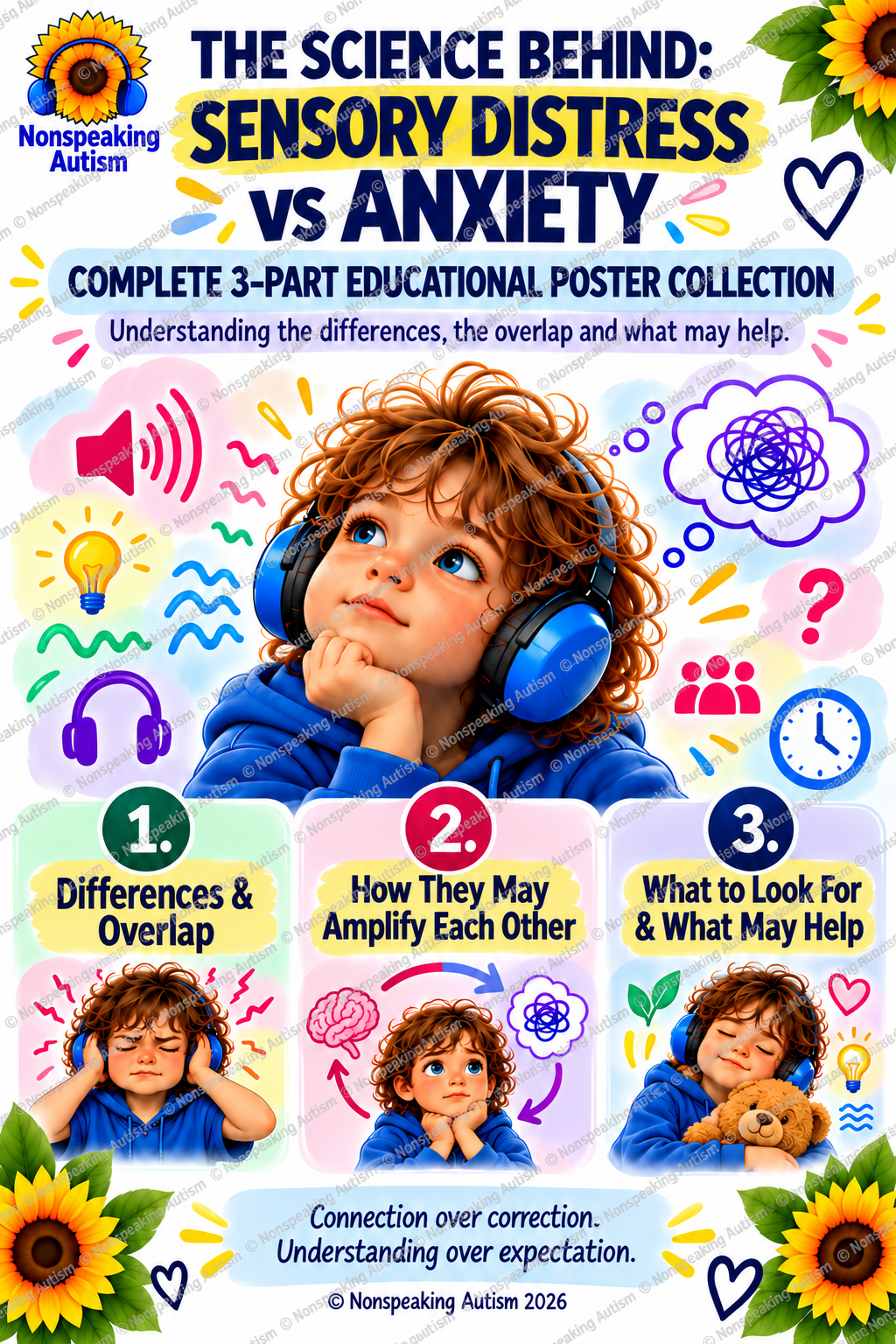
Complete 3-Part Educational Poster Collection
Understanding the Differences, the Overlap and What May Help
Research-Informed Autism Educational Resources | UK Edition
Created by Nonspeaking Autism
Sensory distress and anxiety can look remarkably similar from the outside, but they are not always the same experience.
A child may cover their ears, withdraw from a busy environment, become physically tense, seek reassurance or struggle to communicate.
These responses may relate to overwhelming sensory input, anxiety, or a combination of both.
For some autistic individuals, sensory distress may also increase anxiety. Uncertainty about when a sound will happen, how long discomfort will last or whether an environment will change can make an already difficult experience harder to manage.
The Science Behind: Sensory Distress vs Anxiety is a complete three-part educational poster collection designed to help parents, carers, teachers, therapists and support professionals better understand these experiences and respond with individualised, compassionate support.
Rather than assuming that outward behaviour reveals the cause, this collection encourages adults to consider the environment, uncertainty, body signals, communication and what helps the individual feel safer.
💛 THE CENTRAL MESSAGE
The same outward behaviour does not always have the same cause.
The most helpful question is not simply:
‘Is this sensory or anxiety?’
It is:
‘What may be driving this person's distress right now, and what support would help them feel safer?’
🧠 WHAT'S INCLUDED IN THE COMPLETE 3-PART COLLECTION?
📘 PART 1 — DIFFERENCES & OVERLAP
Where Sensory Distress and Anxiety Overlap, Where They Differ and Why One May Amplify the Other
Part 1 introduces the differences between sensory distress and anxiety while explaining why they can share many outward signs.
What this poster explores:
Sensory distress may occur when sounds, lights, touch, movement, smells, tastes, temperature, crowds or internal body sensations are experienced as overwhelming, aversive, painful, unpredictable or difficult to process.
Sensory distress can occur without anxiety.
Anxiety may involve fear, worry, anticipation of threat or uncertainty. It can arise in relation to sensory experiences, but may also occur around social situations, transitions, separation, health concerns, performance or imagined future events.
Anxiety can occur without an immediate sensory trigger.
Shared outward signs may include:
- Crying or visible distress
- Avoidance or attempts to escape
- Reduced communication
- Physical tension
- Pacing or freezing
- Withdrawal
- Difficulty thinking clearly
- Shutdown-like responses
The poster uses everyday examples to show how the same response can have different explanations.
A child covering their ears may be experiencing sensory discomfort, anxiety about an expected noise, or both.
A child avoiding a busy place may be overwhelmed by the sensory environment, worried about what might happen there, or experiencing several factors together.
Key Message:
Observe the response, but do not assume its cause.
💗 PART 2 — HOW THEY MAY AMPLIFY EACH OTHER
Understanding Possible Feedback Loops, Uncertainty and Internal Body Signals
Part 2 explores how sensory distress and anxiety may influence each other for some individuals.
The poster illustrates a possible pattern:
- Sensory input feels overwhelming.
- Distress rises and the person becomes more alert.
- More sensory input becomes noticeable.
- Uncertainty increases.
- Anxiety rises.
- Sensory tolerance may decrease.
This is an illustrative feedback loop, not a proven fixed neurological sequence or a universal experience.
Intolerance of Uncertainty
Not knowing what will happen, when it will begin or how long it will last may increase distress.
Examples include:
- Not knowing when a hand dryer will start
- Being unable to predict where a noise will come from
- Uncertainty about a transition
- Not knowing how long discomfort will continue
Predictability, preparation and accessible information may help reduce some of this uncertainty.
Interoception and Body Signals
The poster also explores how internal body sensations may be difficult to identify, locate or interpret.
These may include:
- Faster heartbeat
- Breathing changes
- Stomach sensations
- Changes in body temperature
Some individuals notice these sensations clearly, while others may experience them as subtle, confusing or difficult to describe.
This can make sensory distress and anxiety harder to distinguish in the moment.
Key Message:
When distress builds, consider how sensory load, uncertainty and body sensations may be interacting rather than searching for only one explanation.
🌿 PART 3 — WHAT TO LOOK FOR & WHAT MAY HELP
Practical Observation and Individualised Support Strategies
Part 3 turns understanding into practical questions and support approaches.
1. Ask Questions Before Interpreting Distress
Consider:
- What changed in the environment?
- Was there a transition or unexpected event?
- Could sensory input be overwhelming?
- Could the person need additional sensory input?
- Could pain, hunger, thirst, fatigue or illness be involved?
- Is this a familiar pattern?
- What happened immediately beforehand?
- What has helped the person feel safer or more regulated before?
These questions support understanding rather than assigning a fixed meaning to behaviour.
2. Observe Possible Patterns
Patterns that may suggest sensory distress:
- Covering ears or eyes
- Distress linked to particular sounds, lights or textures
- Moving away from sensory input
- Seeking movement, pressure or a quiet space
- Distress decreasing when sensory load is reduced
Patterns that may suggest anxiety:
- Persistent worry or anticipation of threat
- Repeated reassurance-seeking
- Heightened alertness
- Difficulty with uncertainty or change
- Physical symptoms such as nausea or headaches
- Distress continuing after an obvious sensory trigger has ended
These patterns are not diagnostic rules. Both experiences may occur together, and the same signs may have other explanations.
3. Create a Sensory-Supportive Environment
Practical adjustments may include:
- Reducing unnecessary noise
- Adjusting lighting and visual clutter
- Providing a quiet or low-demand space
- Offering comfortable clothing and familiar items
- Supporting regular movement opportunities
- Providing access to preferred sensory tools
- Creating predictable routines
- Allowing time outdoors when appropriate
4. Support Emotional Safety and Reduce Anxiety
Helpful strategies may include:
- Calm, predictable communication
- Reassurance without excessive questioning
- Offering meaningful choices
- Preparing for changes in advance
- Allowing additional processing time
- Reducing unnecessary demands
- Keeping expectations realistic
- Planning recovery after challenging situations
5. Support Interoception and Body Awareness
Depending on individual needs, support may include:
- Reminders for food, water, toileting and rest
- Noticing possible signs of hunger or discomfort
- Movement and body-awareness activities
- Support with temperature regulation
- Gentle, preferred body-awareness activities
- Visual supports for recognising and communicating body signals
6. Allow Recovery Time
After sensory distress or anxiety, some individuals may need additional time before returning to their usual activities.
Support may include rest, a calmer environment, reduced demands, familiar regulation tools and time to process.
Key Message:
Understanding what may be driving distress helps adults offer the right support at the right time.
💬 COMMUNICATION ACCESS MATTERS
During distress, some autistic individuals may find speech, decision-making or processing more difficult.
Support should not depend on a person being able to explain their experience verbally.
Communication options may include:
- AAC devices
- Communication boards
- Gestures and pointing
- Written or typed responses
- Visual choices
- Yes/no responses
- Additional processing time
Reduced speech does not automatically mean reduced understanding.
Avoid making spoken explanations, eye contact or immediate answers conditions for receiving support.
🏫 APPLICATIONS IN UK SCHOOLS
This collection can support discussions about sensory and emotional adjustments in mainstream and specialist education settings.
It may be useful for:
- SENCO discussions
- SEND support planning
- Individual support plans
- Education, Health and Care Plan (EHCP) reviews in England
- Reasonable adjustments under the Equality Act 2010
- Home–school communication
- Multi-agency planning where appropriate
Examples of support may include:
- Predictable timetables and transition warnings
- Reduced competing noise
- Access to quieter spaces
- Visual instructions
- AAC access
- Additional processing time
- Flexible movement breaks
- Individualised sensory adjustments
- Support with identifying and communicating body needs
- Planned recovery time after demanding activities
Support should be based on individual needs, not solely on whether a child has a formal diagnosis.
SEND processes and terminology vary across England, Scotland, Wales and Northern Ireland. EHCPs are specific to England.
🔬 RESEARCH-INFORMED EDUCATIONAL CONTENT
This collection draws on research concerning sensory processing differences, anxiety, intolerance of uncertainty, interoception and the relationships between sensory experiences and emotional distress in autism.
Research supports the importance of considering sensory and anxiety-related experiences together, while recognising that the relationships are complex and vary between individuals.
Important evidence distinctions:
- Sensory distress is a descriptive term, not a stand-alone formal diagnosis.
- Anxiety may occur with or without a sensory trigger.
- Sensory distress and anxiety may coexist.
- Outward behaviour alone cannot establish the underlying cause.
- The feedback loop illustrated in Part 2 is a teaching model, not a validated neurological sequence.
- Support strategies should be individualised rather than treated as guaranteed interventions.
📚 SELECTED RESEARCH & GUIDANCE
Chen, Y., et al. (2024). A systematic review and meta-analysis of the relationship between sensory processing differences and internalising/externalising problems in autism. Clinical Psychology Review, 114, 102516.
https://doi.org/10.1016/j.cpr.2024.102516
Ben-Sasson, A., et al. (2019). Update of a meta-analysis of sensory symptoms in ASD: A new decade of research. Journal of Autism and Developmental Disorders, 49, 4974–4996.
https://doi.org/10.1007/s10803-019-04180-0
Jenkinson, R., Milne, E., & Thompson, A. (2020). The relationship between intolerance of uncertainty and anxiety in autism: A systematic literature review and meta-analysis. Autism, 24(8), 1933–1944.
National Institute for Health and Care Excellence (NICE). Autism spectrum disorder in under 19s: Support and management (CG170).
Evidence Note: These are selected supporting references. The posters also display additional 2024–2026 studies; their full bibliographic details should be independently checked before being advertised as citation-verified.
- Zoltowski et al.: the publication year is 2024, not 2025, on all three parts. I removed the volume number “73” from Part 3 because I couldn’t confirm it. The page numbers (557–580) and DOI are correct.
- Cardon, Tindall & Rojas (2025): corrected the initials to Cardon, G. J. and Rojas, D. C.
- Numbering: Parts 1 and 2 had Powell and Cardon in a different order from Part 3. All three now follow the same 1–7 order.
- Checked and correct: Cummings (2024), Chen (2024), Powell (2025) and Piller (2025).
Sources:
- Crossref API
- OpenAlex
- Powell et al., Development and Psychopathology (Cambridge)
- University of Bath research portal
👨👩👧 WHO IS THIS COLLECTION FOR?
- Autistic individuals and their families
- Parents and carers
- Mainstream and specialist school teachers
- Teaching assistants
- SENCOs and SEND teams
- Educational psychologists
- Occupational therapists
- Speech and language therapists
- AAC specialists
- Paediatric healthcare professionals
- Disability support professionals
- Anyone seeking to better understand sensory distress and anxiety
Although the illustrations feature children, some of the broader educational principles may also be relevant to autistic adolescents and adults.
📦 WHAT YOU RECEIVE
Complete 3-Part Educational Poster Collection
- Poster 1: Sensory Distress vs Anxiety — Differences & Overlap
- Poster 2: Sensory Distress vs Anxiety — How They May Amplify Each Other
- Poster 3: Sensory Distress vs Anxiety — What to Look For & What May Help
- Collection Cover: Sensory Distress vs Anxiety — Complete 3-Part Educational Poster Collection
Total: 3 educational posters + 1 collection cover.
High-resolution printable files are intended for educational display and reference.
The purchased files should be supplied without the promotional preview watermarks. Watermarks visible in Payhip listing images are for copyright protection and preview purposes.
Digital download only — no physical product will be shipped.
⚠️ IMPORTANT DISCLAIMER
This collection is for educational and informational purposes only.
It is not a diagnostic assessment, mental health evaluation, sensory assessment, psychological assessment, individualised treatment plan or substitute for appropriate professional care.
Sensory distress and anxiety can have overlapping signs, but the causes of distress cannot be determined from a poster or checklist alone.
Sudden, severe, persistent or unusual changes in behaviour, communication or physical health should receive appropriate professional assessment.
Pain, illness, injury, medication effects, fatigue and other medical or environmental factors should also be considered.
Deep pressure and other sensory interventions should only be used when appropriate, safe and welcomed. Never force touch or sensory input.
In a life-threatening emergency in the UK, call 999 or 112.
©️ COPYRIGHT & PERMITTED USE
Copyright © 2026 Nonspeaking Autism. All rights reserved.
Purchase permits personal, home, classroom, school and individual professional educational use.
The files may not be resold, redistributed, uploaded to other websites, shared as public downloads, commercially reproduced or included in other products for resale.
Please direct others to the original Nonspeaking Autism Payhip listing.
💛 THE MESSAGE BEHIND THE COLLECTION
A child covering their ears may be overwhelmed by sound.
They may also be worried about the sound happening again.
A child avoiding a crowded room may be struggling with sensory input, uncertainty or both.
And a child who becomes quiet may still be experiencing significant distress.
The response alone does not tell us the cause.
Understanding begins when we look at the whole person, consider the context and respond to what may help them feel safer.
Less assumption. More understanding. More individualised support.
Connection over correction. Understanding over expectation. 🌻💙