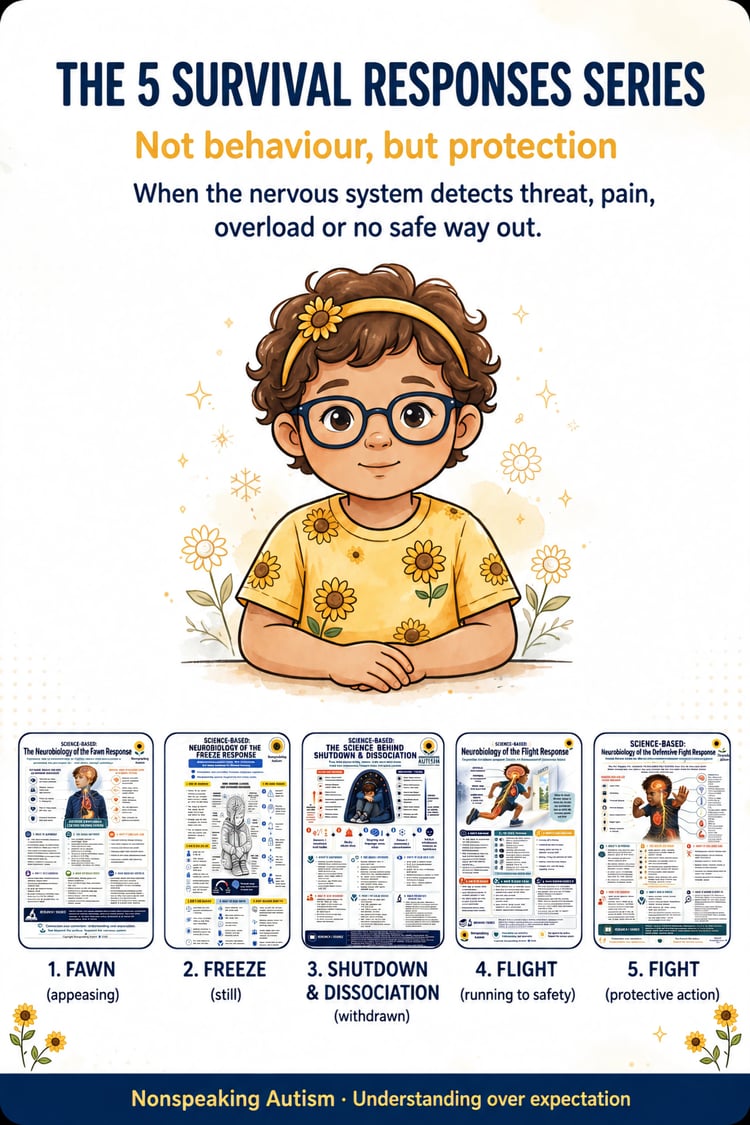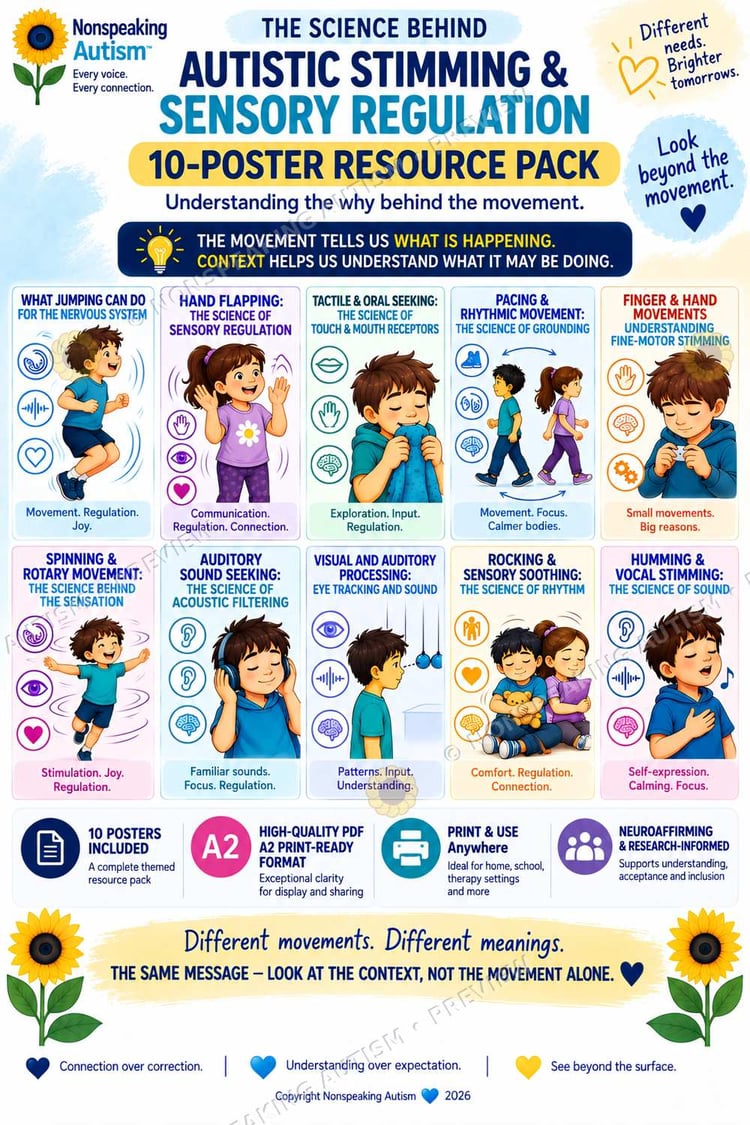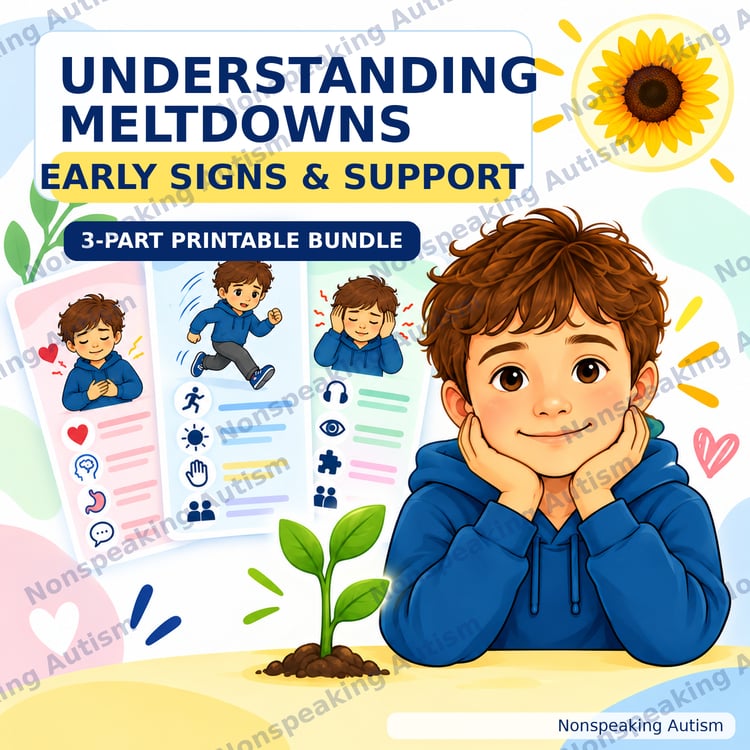


🌻 Understanding Sensory Overwhelm — U.S. Edition
🌻 Understanding Sensory Overwhelm — U.S. Edition
Complete 4-Part Educational Poster Series
Brain & Sensory Processing • Sensory Triggers • Meltdowns & Shutdowns • Prevention, Support & Recovery
4 Research-Informed Educational Posters | A2 Printable PDF Collection
Created by Nonspeaking Autism
Sensory overwhelm is more than being sensitive to sounds, lights, touch, or busy environments.
For some autistic individuals, sensory information becomes difficult to manage when multiple demands accumulate. Noise, bright lighting, unexpected touch, movement, changes in routine, communication expectations, fatigue, and internal body sensations may all contribute to overload.
What looks like challenging behavior, avoidance, withdrawal, or reduced communication may reflect a person experiencing significant sensory or emotional distress.
Understanding Sensory Overwhelm is a complete four-part educational poster collection designed to help U.S. parents, caregivers, teachers, special education teams, therapists, and support professionals better understand sensory differences and respond with compassion.
The collection connects neuroscience with practical support strategies, encouraging adults to look beyond observable behavior and consider the person's sensory experiences, environment, communication needs, and physical well-being.
💛 THE CENTRAL MESSAGE
Sensory distress is not a choice, a failure to cope, or automatically deliberate defiance.
The goal is not to make autistic individuals tolerate every overwhelming situation.
The goal is to reduce unnecessary barriers, support communication, protect safety, and create environments where people can participate and recover.
🧠 WHAT'S INCLUDED IN THE COMPLETE 4-PART SERIES?
📘 PART 1 — THE ANATOMY OF OVERWHELM
How Sensory Filtering, Habituation, and Salience Can Shape Overload
This educational poster explores how the brain receives, processes, and prioritizes sensory information.
It introduces accessible neuroscience concepts to help explain why sensory experiences may differ between autistic individuals.
Topics explored:
- How the brain continuously processes sensory input
- Attention and sensory prioritization
- Sensory filtering and habituation
- Predictive processing and sensory expectations
- The thalamus and sensory relay networks
- The role of sensory and attention-related brain systems
- Competing demands and cumulative overload
- Possible signs of sensory distress
- Practical ways to reduce sensory and cognitive load
The poster includes illustrated explanations of the thalamus, sensory cortices, prefrontal cortex, amygdala, and brainstem.
These structures are presented as components of complex interacting networks, not as a single explanation for autism or sensory overwhelm.
Key Message:
Overwhelm is not always about one sensation being too intense. It may also involve how the nervous system processes, predicts, prioritizes, and adapts to competing information.
👂 PART 2 — RECOGNIZING THE TRIGGERS ACROSS THE SENSES
Understanding Sensory Differences and Cumulative Overload
Sensory overwhelm does not always result from one identifiable trigger.
Multiple sensory and environmental demands can build throughout the day.
This poster explores how different sensory systems and daily experiences may contribute to overload.
Auditory — Sound
- Loud or unexpected noises
- Multiple people speaking
- Alarms and scraping chairs
- Crowded or noisy environments
Visual — Sight
- Bright or flickering lights
- Fast-moving visual information
- Cluttered classrooms
- Crowded environments
Tactile — Touch
- Clothing seams and labels
- Unexpected physical contact
- Hair brushing or haircuts
- Uncomfortable textures or temperatures
Movement & Body Position
- Unstable surfaces
- Crowded spaces
- Unexpected movement
- Individual movement and pressure preferences
Smell & Taste
- Strong food odors
- Perfumes and cleaning products
- Unfamiliar tastes
- Food textures and mealtime demands
Interoception — Internal Body Signals
- Hunger
- Thirst
- Pain
- Toileting needs
- Body temperature
- Fatigue and sleep needs
Understanding Cumulative Sensory Load
A person may tolerate individual demands but become overwhelmed when several occur together.
For example:
Noise + Bright Lights + Crowds + Transitions + Hunger + Communication Demands = Increased Total Load
This is an educational illustration, not a diagnostic formula.
Key Message:
Do not ask only:
“What triggered the distress?”
Also ask:
“What had already been building throughout the day?”
💙 PART 3 — THE DISTRESS SPECTRUM: MELTDOWN & SHUTDOWN
Understanding Different Responses to Overwhelm
Sensory distress can appear in different ways.
Some individuals experience highly visible distress, while others become quieter, less responsive, or withdrawn.
This poster explores meltdown-like and shutdown-like responses and explains how these presentations may overlap.
Meltdown-Like Responses May Include:
- Crying or intense vocalizations
- Pacing or increased movement
- Attempts to escape overwhelming situations
- Pushing away sensory input
- Physical agitation during distress
- Reduced access to speech or AAC
Shutdown-Like Responses May Include:
- Becoming unusually quiet
- Reduced movement
- Freezing
- Withdrawal
- Slower responses
- Reduced speech or AAC access
- Difficulty making decisions
- Appearing exhausted or unreachable
Some individuals may experience a combination of these responses.
What May Be Happening Internally?
During periods of intense distress, some individuals may experience:
- Narrowed attention
- Reduced cognitive flexibility
- Changes in communication access
- Increased need to escape demands
- Physiological stress responses
- Difficulty processing additional information
These experiences vary between individuals and cannot be established from outward appearance alone.
What Not to Assume
A meltdown or shutdown should not automatically be interpreted as:
- A tantrum
- Manipulation
- Attention-seeking
- Intentional noncompliance
- Poor parenting
- A deliberate choice
- A response to only one trigger
Quiet does not necessarily mean regulated.
Visible distress does not automatically mean deliberate behavior.
Key Message:
Different outward responses can arise from overwhelming experiences. Focus on the whole pattern, reduce unnecessary demands, and protect safety and communication.
🌿 PART 4 — SUPPORT DURING SENSORY OVERWHELM
Practical Strategies for Prevention, Intervention, and Recovery
Understanding sensory overwhelm is important.
Knowing how to provide safe, individualized support is equally important.
This poster introduces three practical stages.
🟢 PHASE 1 — PREVENT
Proactive Support and Environmental Accommodations
Strategies include:
- Adjusting lighting and noise levels
- Providing comfortable seating and clothing options
- Scheduling movement and sensory breaks
- Identifying individual sensory triggers
- Providing access to quiet spaces
- Building personalized sensory toolkits
- Increasing predictability
- Supporting choice and control
Preventive accommodations should support access, not be used as rewards for compliance.
🔴 PHASE 2 — INTERVENE
Supporting the Person During Active Overwhelm
When distress increases, immediate priorities include physical safety and reducing unnecessary sensory and cognitive demands.
Strategies may include:
- Lowering sensory input
- Offering a quieter environment
- Reducing verbal instructions
- Allowing processing time
- Keeping AAC available
- Respecting personal space
- Offering preferred sensory supports
- Removing immediate hazards
Deep pressure, weighted items, and other sensory tools are not appropriate for everyone.
They should only be considered when individually appropriate, safe, and welcomed.
Never force physical pressure, touch, or sensory input.
🔵 PHASE 3 — RECOVER
Post-Overwhelm Recovery
Visible distress may decrease before the person feels fully recovered.
Support may include:
- Additional processing time
- A quiet, predictable environment
- Hydration and food when wanted
- Rest
- Checking for pain or illness
- Reducing immediate demands
- Delaying difficult conversations
- Gradually returning to activities when ready
Recovery time is individual.
Some people may recover quickly, while others may need extended periods of reduced demands.
Key Message:
PREVENT → INTERVENE → RECOVER
Support should respond to the individual, not force the individual to fit a rigid program.
🏫 SUPPORTING SENSORY NEEDS IN U.S. SCHOOLS
Sensory differences may affect a student's ability to access instruction, communicate, participate in activities, and manage everyday school demands.
This collection can support conversations between families and school teams about individualized accommodations.
Depending on the student's needs and eligibility, sensory-related supports may be considered through an Individualized Education Program (IEP) under the Individuals with Disabilities Education Act (IDEA) or a Section 504 plan.
Examples of supports that may be considered include:
- Access to a quieter workspace
- Noise-reducing headphones when helpful
- Reduced visual clutter
- Planned movement breaks
- Flexible seating
- Predictable schedules
- Visual supports
- AAC access throughout the school day
- Additional processing time
- Supported transitions
- Access to water and restrooms
- Individualized recovery arrangements
- Collaboration with school-based occupational therapists or speech-language pathologists when appropriate
Not every student requires the same accommodations.
A student's ability to achieve academically does not automatically mean they have no sensory or communication support needs.
The appropriate support should be determined through an individualized, collaborative process.
💬 COMMUNICATION ACCESS DURING DISTRESS
During sensory overwhelm, communication may become more difficult.
Some individuals may experience reduced speech access, slower processing, or difficulty responding to complex instructions.
Helpful approaches may include:
- Keeping AAC devices and communication boards available
- Allowing gestures, pointing, and other communication methods
- Using short, familiar language
- Providing additional response time
- Reducing unnecessary questions
- Avoiding forced eye contact
- Respecting requests for space
- Supporting communication without demanding spoken responses
Speech is not the only valid form of communication.
Reduced speech does not automatically mean reduced understanding.
Communication support should remain available during distress and recovery.
🔬 RESEARCH-INFORMED EDUCATIONAL CONTENT
This collection draws on research concerning:
- Sensory processing differences in autism
- Sensory over-responsivity
- Sensory habituation
- Predictive processing
- Attention and salience
- Sensory-related distress
- Physiological stress responses
- Individualized sensory accommodations
- Communication access
- Environmental modifications
Research suggests that autistic individuals may experience differences in sensory responsiveness and processing.
However, sensory experiences are highly variable.
No single neurological explanation accounts for every individual's experience of overwhelm.
The resources encourage observation, collaboration, and individualized support rather than assumptions based on diagnosis alone.
📚 SELECTED RESEARCH & U.S. GUIDANCE
Ben-Sasson, A., et al. (2019).
Update of a meta-analysis of sensory symptoms in ASD: A new decade of research. Journal of Autism and Developmental Disorders, 49, 4974–4996.
https://doi.org/10.1007/s10803-019-04180-0
Green, S. A., et al. (2015).
Neurobiology of sensory overresponsivity in youth with autism spectrum disorders. JAMA Psychiatry, 72(8), 778–786.
https://doi.org/10.1001/jamapsychiatry.2015.0737
Chen, Y., et al. (2024).
A systematic review and meta-analysis of the relationship between sensory processing differences and internalising/externalising problems in autism. Clinical Psychology Review, 114, 102516.
https://doi.org/10.1016/j.cpr.2024.102516
American Speech-Language-Hearing Association (ASHA).
Augmentative and Alternative Communication (AAC). Practice Portal.
https://www.asha.org/practice-portal/professional-issues/augmentative-and-alternative-communication/
U.S. Department of Education.
Individuals with Disabilities Education Act (IDEA).
U.S. Department of Education, Office for Civil Rights.
Section 504 and Students with Disabilities.
https://www.ed.gov/laws-and-policy/individuals-disabilities/section-504
Important Evidence Note
The cited research and professional guidance support broader concepts discussed in this educational collection.
They do not validate every illustrated example, support strategy, or sensory tool as an effective intervention for every autistic individual.
The neuroscience diagrams are simplified educational representations.
Terms such as meltdown, shutdown, and cumulative sensory load are used descriptively rather than as formal diagnostic classifications.
Evidence for individual sensory interventions, including weighted items and deep-pressure approaches, varies.
Individual preferences, safety, communication, and participation should guide support.
Research & References
Up-to-date research (2024–2026)
Poster 1: The Anatomy of Overwhelm
- Yosef, B., Burgess, V., Banchik, M., Ceballos, J., Dapretto, M., & Green, S. A. (2026). Atypical predictive processing is associated with sensory over-responsivity in autism. Autism Research. https://doi.org/10.1002/aur.70283
- Cummings, K. K., Jung, J., Zbozinek, T. D., Wilhelm, F. H., Dapretto, M., Craske, M. G., Bookheimer, S. Y., & Green, S. A. (2024). Shared and distinct biological mechanisms for anxiety and sensory over-responsivity in youth with autism versus anxiety disorders. Journal of Neuroscience Research, 102(1), e25250. https://doi.org/10.1002/jnr.25250
- Cakar, M. E., Okada, N. J., Cummings, K. K., Jung, J., Bookheimer, S. Y., Dapretto, M., & Green, S. A. (2024). Functional connectivity of the sensorimotor cerebellum in autism: Associations with sensory over-responsivity. Frontiers in Psychiatry, 15, 1337921. https://doi.org/10.3389/fpsyt.2024.1337921
Poster 2: Recognising the Triggers Across the Senses
- Marani, N., Di Gennaro, D., Garotti, R., Maffettone, V., Siracusano, R., Riccio, M. P., Pisano, S., & Bravaccio, C. (2026). Factors influencing the sensory profile in patients with autism spectrum disorder from 16 months to 14 years: Results of an observational study. Frontiers in Psychiatry, 17, 1771832. https://doi.org/10.3389/fpsyt.2026.1771832
- Chaturvedi, A., Ramappa, S., Anderson, A., Banchik, M., Shah, U., Craske, M., & Green, S. (2025). Integrating parent report, observed behavior, and physiological measures to identify biomarkers of sensory over-responsivity in autism. Journal of Neurodevelopmental Disorders, 17(1), 13. https://doi.org/10.1186/s11689-025-09597-6
- Loureiro, F., Ringold, S. M., & Aziz-Zadeh, L. (2024). Interoception in autism: A narrative review of behavioral and neurobiological data. Psychology Research and Behavior Management, 17, 1841–1853. https://doi.org/10.2147/PRBM.S410605
- Russo, N., Cascio, C. J., Baranek, G. T., Woynaroski, T. G., Williams, Z. J., Green, S. A., & Schaaf, R. (2026). A cascading effects model of early sensory development in autism. Psychological Review, 133(2), 450–487. https://doi.org/10.1037/rev0000558
Poster 3: The Distress Spectrum: Meltdown & Shutdown
- Soden, P. A., Bhat, A., Anderson, A. K., & Friston, K. (2025). The meltdown pathway: A multidisciplinary account of autistic meltdowns. Psychological Review, 132(5), 1209–1240. https://doi.org/10.1037/rev0000543
- Paris, K., Lodestone, A., Houser, M., & Lewis, L. F. (2025). “Shutdowns are like you’re stuck on the blue screen of death”: A metaphor analysis of autistic shutdowns. Autism in Adulthood, 8(4), 687–697. https://doi.org/10.1089/aut.2024.0193
- Neupane, K., Pillalamarri, S., & Anderson, G. M. (2025). Basal sympathetic nervous system functioning in autism: A systematic review of neurochemical studies. Journal of Autism and Developmental Disorders. https://doi.org/10.1007/s10803-025-07105-2
- Zadok, E., Golan, O., Lavidor, M., & Gordon, I. (2024). Autonomic nervous system responses to social stimuli among autistic individuals: A systematic review and meta-analysis. Autism Research, 17(3), 497–511. https://doi.org/10.1002/aur.3068
Poster 4: Support During Sensory Overwhelm
- Daniel, S., Mahler, K., Ray, D. C., et al. (2026). Sensory-processing informed autism practice for child-centred therapists. Research in Neurodiversity, 2, 100015. https://doi.org/10.1016/j.rin.2026.100015
- Oldenburg, K., Gibbons, T., Welch, C., Tint, A., & Albin, M. (2026). Describing the communication of autistic people during experiences of distress: A scoping review. Autism, 30(4), 884–900. https://doi.org/10.1177/13623613261417933
- Shah, U. T., Evans, K., Banchik, M., Chaturvedi, A., Ramappa, S., Wong, K., Silvers, J. A., & Green, S. A. (2026). Cognitive reappraisal modulates neural responses to aversive sensory stimulation in autistic youth. Journal of Child Psychology and Psychiatry. https://doi.org/10.1111/jcpp.70202
- Piller, A., McHugh Conlin, J., Glennon, T. J., Andelin, L., Auld-Wright, K., Teng, K., & Tarver, T. (2025). Systematic review of sensory-based interventions for children and youth (2015–2024). Frontiers in Pediatrics, 13, 1720179. https://doi.org/10.3389/fped.2025.1720179
- Zhao, Y., Zhang, Q., Liu, Z., Zhao, Z., & Zhu, Q. (2024). Safety and effectiveness of weighted blankets for symptom management in patients with mental disorders: A systematic review and meta-analysis of RCTs. Complementary Therapies in Medicine, 87, 103104. https://doi.org/10.1016/j.ctim.2024.103104
Across the series
- Tavassoli, T., Marco, E. J., & Puts, N. (2026). Sensory reactivity in autism: Integrating behavioural, affective, physiological, and neural dimensions. Current Psychiatry Reports, 28(1), 36. https://doi.org/10.1007/s11920-026-01682-4
- Chen, Y., Xi, X., Saunders, R., Simmons, A., Totsika, V., & Mandy, W. (2024). Sensory processing differences and internalising and externalising problems in autism: A systematic review and meta-analysis. Clinical Psychology Review, 114, 102516. https://doi.org/10.1016/j.cpr.2024.102516
- Morris, R., et al. (2025). Beyond self-regulation: Autistic experiences and perceptions of stimming. Neurodiversity, 3. https://doi.org/10.1177/27546330241311096
👨👩👧 WHO IS THIS COLLECTION FOR?
Suitable for:
- Autistic individuals and their families
- Parents and caregivers
- General education teachers
- Special education teachers
- Paraprofessionals
- School psychologists
- School counselors
- IEP teams
- Section 504 teams
- Occupational therapists (OTs)
- Speech-language pathologists (SLPs)
- AAC specialists
- Board Certified Behavior Analysts (BCBAs) seeking sensory-informed context
- Pediatric healthcare professionals
- Disability support professionals
- Homeschooling families
- Autism support organizations
Although the posters feature children, many of the educational principles may also be relevant to autistic adolescents and adults.
📦 WHAT YOU RECEIVE
COMPLETE 4-PART PRINTABLE POSTER COLLECTION
4 × Research-Informed Educational Posters
Poster 1: The Anatomy of Overwhelm
Poster 2: Recognizing the Triggers Across the Senses
Poster 3: The Distress Spectrum: Meltdown & Shutdown
Poster 4: Support During Sensory Overwhelm
📐 DIGITAL PRINT SPECIFICATIONS
- 4 high-resolution A2 printable educational posters
- A2 size: 420 × 594 mm
- Approximately 16.5 × 23.4 inches
- Printable PDF format
- Suitable for professional printing
- Can be scaled for other paper sizes where appropriate
- Digital download through Payhip
Important for U.S. buyers: A2 is an international paper size, not standard U.S. Letter or Tabloid. If printing at home, select a suitable scaling option and check readability before printing.
The purchased printable versions should be supplied without promotional preview watermarks.
Digital download only. No physical product will be shipped.
⚠️ IMPORTANT DISCLAIMER
This collection is provided for educational and informational purposes only.
It is not a medical diagnosis, clinical sensory assessment, psychological assessment, functional behavior assessment (FBA), individualized treatment plan, behavioral intervention plan (BIP), emergency safety plan, or substitute for appropriate professional evaluation.
Sensory distress can have multiple contributing factors, including pain, illness, injury, fatigue, anxiety, medication effects, and environmental demands.
Sudden, severe, persistent, or unusual changes should receive appropriate medical or professional attention.
Sensory tools must be selected according to individual preferences and safety needs. Do not force touch, pressure, compression, or sensory exposure.
In a medical emergency or immediate life-threatening situation in the United States, call 911.
IEP and Section 504 eligibility, accommodations, and services depend on applicable law and individual circumstances. This resource does not provide legal advice or determine eligibility for school services.
©️ COPYRIGHT & PERMITTED USE
Copyright © 2026 Nonspeaking Autism. All rights reserved.
Purchase permits:
- Personal and family educational use
- Printing for your own home
- Use in your own classroom
- Individual school educational use
- Use within your own clinic or professional practice
- Personal professional reference and educational display
The digital files may not be:
- Resold
- Redistributed
- Shared publicly as downloads
- Uploaded to other websites
- Included in commercial resource bundles
- Reproduced for resale
- Altered to remove copyright or branding
Please direct others to the original Nonspeaking Autism Payhip listing to obtain their own copy.
💛 THE MESSAGE BEHIND THE COLLECTION
Sensory distress is not a failure.
A child should not have to experience a meltdown before their sensory needs are recognized.
A student should not have to stop communicating before an environment becomes more accessible.
A quiet child should not automatically be assumed to be coping.
And a person should not have to tolerate unnecessary distress to prove they can participate.
Sometimes meaningful support means:
Less noise.
Less pressure.
More predictability.
More communication access.
More choice.
More recovery time.
DIFFERENT SENSORY NEEDS. DIFFERENT RESPONSES. EQUAL RIGHT TO SUPPORT.
Safer people. Kinder spaces. Brighter possibilities.
Connection over correction. Understanding over expectation. 🌻💙
© Nonspeaking Autism 2026
Digital download only.