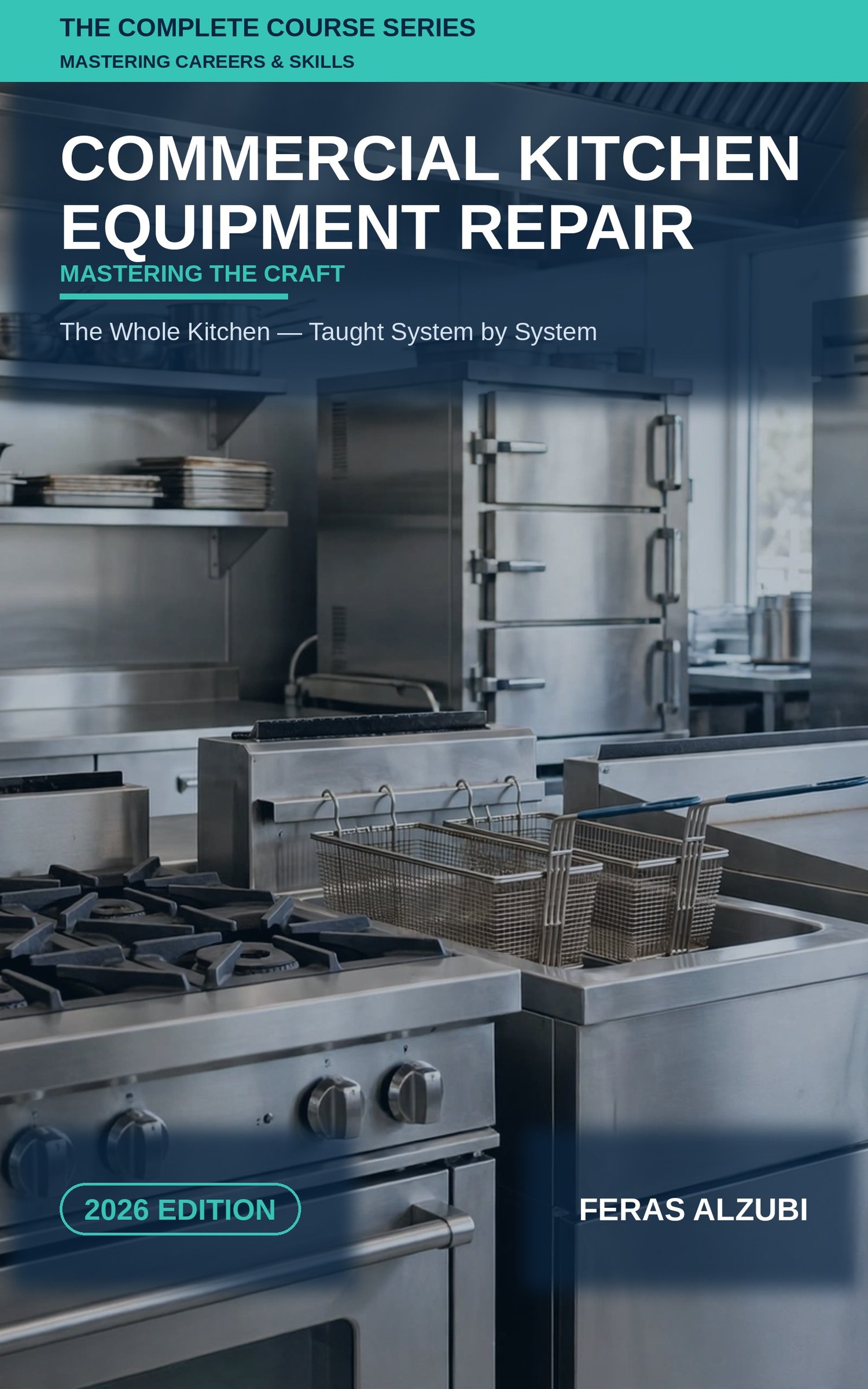
Commercial Kitchen Equipment Repair: Mastering the Craft
Commercial Kitchen Equipment Repair: Mastering the Craft — the whole kitchen
**What this book teaches.** The full trade of commercial kitchen equipment repair — the service trade that keeps restaurants, hospitals, schools, and institutions cooking — taught A to Z in one volume, from first principles to the finished, proved repair. The foundations come first: the trade and its customers; the safety discipline that stands in front of every call — gas, steam, electricity, and heat; the kitchen understood as a system of hot side and cold side, with the service-call craft; and the energies the whole kitchen runs on — electricity, gas, and steam. Then the line in order. The hot side: ranges, ovens, and cooking batteries; fryers and griddles; steam equipment — steamers, kettles, and combi ovens; gas systems — burners, valves, and combustion; and electric cooking equipment and its controls. Then the cold side and warewashing: refrigeration — reach-ins, walk-ins, and prep tables; ice machines; dish machines and sanitization; and food preparation and holding equipment. The service practice follows: preventive maintenance programs; diagnosis by a disciplined service method; parts, seals, and food-safe materials; and calibration and proof — because in this trade a repair is finished only when the temperatures measure right. The book closes with the working technician's world: the service business of calls, contracts, and kitchens that cannot wait; documentation, codes, and the health inspector's world; and the career itself — CFESA certification and the working life. Every system is taught so you can explain it, test it, and trust your conclusion — and the manufacturer's documentation for the specific unit always governs its values and procedures.
**Who it is for.** Apprentice technicians, service-company trainees, and students of the trade who want the whole craft in one place, with names, systems, and reasoning for what their hands are learning; working technicians who want to widen and formalize their knowledge — hot-side hands who do not yet run refrigeration, cooking-equipment hands who do not yet service warewashing — and prepare for the industry's certification disciplines; kitchen managers, chefs, and facilities staff who maintain their own equipment and direct the people who do, and need to understand what their equipment is, why a repair takes the path it takes, and which work belongs to certified hands; and the mechanically minded reader weighing this trade, who wants an honest picture of the work and the career. No general book replaces the manufacturer's documentation for the unit in front of you — the book teaches the systems, the method, and the discipline.
**What's inside** (every count verified against the actual book):
- Complete course — 20 chapters in five parts, foundations to the career
- 340 practice questions — every answer explained, right and wrong
- 40-question diagnostic — scored by domain, with a routing worksheet
- 240 chapter questions — a 12-question check closes every chapter
- 60-question final review — sampling the whole trade, with routed re-study
- 40 labeled figures — system diagrams and equipment maps, two in every chapter
- 25 tables — system data, sequences and reference data for the field
- 150-term glossary · 8 cheat sheets · 3 study plans — the full read, the working technician, and the hot-side to full-trade bridge
- Safety taught as structure — gas-leak discipline, lockout/tagout, steam and hot-oil respect, and food-safety proof throughout
Every one of the 340 questions is original, written for this book, and every explained answer tells you why the right answer is right and why each wrong answer is wrong. The book's facts rest on verified sources, listed in a Sources & Verification Note at the back of the book: the trade's scope, the CFESA certification program, the regulatory register (EPA Section 608 for refrigerant work, the fuel-gas and electrical codes), the FDA Food Code sanitization values, and the rule that manufacturer documentation governs. Safety is structural throughout — no procedure in the book outranks the safety discipline, and no item teaches working a gas leak with ignition sources, defeating a high-limit control, bypassing a door switch, or handling refrigerant without certification as correct.
Read the first chapter free — the sample on this page is Chapter 1 of this book, exactly as it appears in the full edition.
From the **Mastering Careers & Skills** library — complete A-to-Z professional teaching books for careers, trades, and certifications.
This book is an independent teaching work. CFESA — the Commercial Food Equipment Service Association — is named as the public industry credentialing organization it is; this book is not published by, endorsed by, or affiliated with it or with any equipment manufacturer. It teaches the trade — CFESA certification is an industry credential, not a government license, and no credential comes from this book: CFESA certification is earned from CFESA by testing and experience under its own requirements, and refrigerant work requires EPA Section 608 certification from its own program; this book does not itself confer a license or a certification.
**Refunds:** Please read the free sample chapter before you buy. This is a digital ebook, delivered instantly by download. If the file is defective, or you cannot open or download it and we cannot fix the problem, you will receive a full refund — email us within 14 days of purchase. Because the book is delivered instantly as a downloadable file, all other sales are final.
**How to read this book (EPUB format):** After checkout, download the EPUB file, then open it in any free ebook reader app. On iPhone or iPad: Apple Books — it is already on your device. On Android phones and tablets: Google Play Books (free: https://play.google.com/store/apps/details?id=com.google.android.apps.books) — upload the file in the app — or ReadEra (free). On a Windows or Mac computer: Thorium Reader (free: https://thorium.edrlab.org) or Adobe Digital Editions (free). On Kindle: use Amazon's free Send to Kindle (https://www.amazon.com/sendtokindle) to add the file to your Kindle library.