
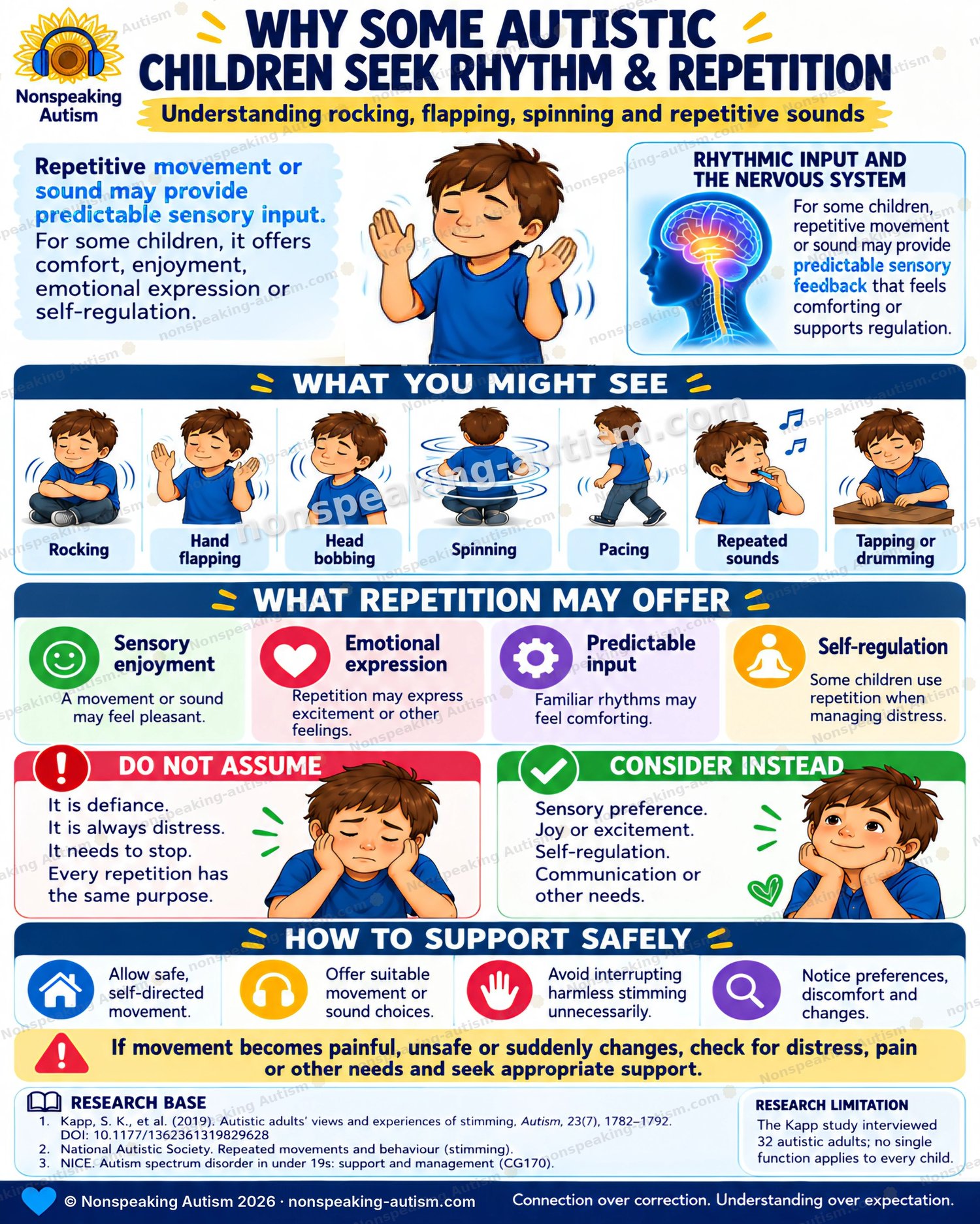
🌻 WHY SOME AUTISTIC CHILDREN SEEK RHYTHM & REPETITION
🌻 WHY SOME AUTISTIC CHILDREN SEEK RHYTHM & REPETITION
Understanding Rocking, Flapping, Spinning and Repetitive Sounds
Research-Informed Educational Poster | UK Edition
💙 Repetitive movement is not always a sign of distress. Sometimes it is a source of joy, comfort, communication or self-regulation.
Rocking, hand flapping, head bobbing, spinning, pacing, repeated sounds and rhythmic tapping are behaviours that some autistic children naturally engage in.
These movements and sounds are often described as stimming, or self-stimulatory behaviour.
For some children, repetition may provide predictable sensory experiences that feel enjoyable, comforting or regulating. For others, it may be a way to express excitement, manage uncertainty, communicate feelings or respond to overwhelming environments.
Yet these behaviours are sometimes misunderstood as something that must automatically be discouraged or stopped.
Why Some Autistic Children Seek Rhythm & Repetition is an illustrated educational poster designed to help parents, carers, educators and professionals understand the possible purposes of repetitive movement and sound.
Rather than focusing only on how a movement looks, this resource encourages adults to consider what the experience may mean to the individual child.
The central message:
Repetition is not automatically a problem. Understanding its purpose matters more than making it disappear.
🧠 WHAT THIS POSTER EXPLORES
🌿 1. Rhythmic Input and the Nervous System
Repetitive movement and sound can create familiar, predictable sensory experiences.
For some autistic children, rhythmic input may feel comforting, pleasurable or supportive during moments of emotional or sensory demand.
Different forms of repetition may involve:
- Vestibular input: sensations associated with movement, balance and head position.
- Proprioceptive input: information about body position, movement and muscle activity.
- Tactile input: sensations associated with touch and contact.
- Auditory input: familiar sounds, rhythms or repeated vocalisations.
These sensory experiences may contribute to comfort or self-regulation for some individuals.
However, there is no single established neurological mechanism that explains every form of stimming, and the same movement may have different purposes at different times.
The brain illustration on the poster is conceptual educational artwork, not a clinical scan or proof of a specific neural pathway.
🌻 2. What Repetitive Movement or Sound May Look Like
The poster illustrates seven examples.
Rocking
Moving the body forwards and backwards or from side to side.
Rocking may provide familiar movement sensations, comfort or enjoyment.
Hand flapping
Repeated hand or arm movements.
Hand flapping may accompany excitement, happiness, anticipation, distress or other experiences.
Head bobbing
Rhythmic movement of the head.
This may occur during concentration, enjoyment or sensory seeking. Any movement that causes pain or injury needs further consideration.
Spinning
Turning the body or moving in circles.
Spinning may offer enjoyable movement sensations for some children, although balance, dizziness and environmental safety should be considered.
Pacing
Walking repeatedly along a route or around an area.
Pacing may accompany thinking, anticipation, emotional expression or a preference for movement.
Repeated sounds
Repeating vocal sounds, humming or other noises.
These sounds may offer auditory enjoyment, expression, familiarity or comfort. They should not automatically be interpreted as meaningless or disruptive.
Tapping or drumming
Repeating movements that create a familiar rhythm or sensation.
This may provide enjoyable tactile, movement or auditory feedback.
Important: These are examples, not diagnostic signs or fixed explanations. A child's own preferences and experiences are essential to understanding what a particular movement or sound means.
💛 WHAT REPETITION MAY OFFER
1. Sensory Enjoyment
Some repetitive movements or sounds simply feel good.
A child may rock, flap or tap because the experience is pleasant.
Not every stim is a response to distress.
2. Emotional Expression
Repetition may accompany excitement, happiness, anticipation, frustration or other feelings.
A child who flaps their hands while smiling may be expressing enjoyment.
The movement should be understood in context rather than assigned one universal meaning.
3. Predictable Sensory Input
Familiar rhythms may provide a consistent experience when the surrounding environment is unpredictable.
For some children, this predictability may feel reassuring.
4. Self-Regulation
Some autistic people describe using repetitive movements or sounds to manage stress, attention, sensory experiences or emotional intensity.
This does not mean that every stim has a regulatory function.
Repetition can also be playful, expressive or enjoyable in its own right.
❌ WHAT ADULTS SHOULD NOT AUTOMATICALLY ASSUME
“It is defiance.”
Repetitive movement or sound does not, by itself, indicate deliberate opposition.
“It always means the child is distressed.”
Stimming may occur during happiness, excitement, concentration, comfort or distress.
“It needs to stop.”
Safe, self-directed stimming does not automatically require intervention simply because it looks unusual.
“Every repetition has the same purpose.”
The same behaviour may have different meanings for different children, or for the same child in different situations.
🌿 WHAT TO CONSIDER INSTEAD
When observing repetitive movement or sound, adults can consider:
- Is the child enjoying the experience?
- Does the movement appear comfortable and safe?
- Is the child expressing excitement or another emotion?
- Is the environment creating sensory or emotional pressure?
- Does the child use this movement when concentrating?
- Has the movement recently changed?
- Is there any indication of pain, injury or discomfort?
- What does the child communicate about the experience?
Where possible, ask the child directly using their preferred communication method.
For nonspeaking children, this may involve AAC, visual choices, gestures, observation of preferences and collaboration with people who know them well.
The goal is understanding, not automatically eliminating the movement.
🛡️ HOW TO SUPPORT STIMMING SAFELY
Allow Safe, Self-Directed Movement
Where movement or sound is safe and not causing harm, avoid unnecessary interruption.
Children should not have to suppress harmless movements simply to appear more typical.
Offer Suitable Movement or Sound Choices
Some children may appreciate access to:
- Space for rocking or pacing.
- Safe movement opportunities.
- Rhythmic toys or activities.
- Familiar sounds or music at a comfortable volume.
- Quiet spaces when needed.
- Sensory resources chosen according to their preferences.
These are optional supports, not treatments that work for everyone.
Avoid Unnecessary Suppression
Repeatedly stopping harmless stimming may remove an activity the child finds enjoyable or helpful.
If a behaviour creates a practical difficulty, consider adapting the environment or offering a genuinely acceptable alternative rather than relying on punishment.
Notice Discomfort and Changes
Pay attention when a repetitive movement or sound becomes:
- Painful.
- Injurious.
- Unsafe.
- Suddenly different from the child's usual pattern.
- Associated with new distress or illness.
- Difficult for the child to interrupt when they want to stop.
Seek appropriate professional advice where there are concerns about safety, pain or significant changes.
SUPPORTING NONSPEAKING AND MINIMALLY SPEAKING CHILDREN
Repetitive movement and sound should not be dismissed because a child does not use spoken language.
A child may communicate enjoyment, discomfort, excitement or a need for space through movement, facial expression, vocalisation, gesture or AAC.
Adults can support communication by:
- Keeping AAC available.
- Respecting all forms of communication.
- Offering choices without pressure.
- Allowing processing time.
- Learning the child's individual signs of comfort and discomfort.
- Avoiding assumptions about what a movement means.
A child does not need to explain their stimming verbally for their preferences to deserve respect.
🔬 RESEARCH-INFORMED UNDERSTANDING
Research involving autistic adults has highlighted that stimming can have a variety of personal meanings, including emotional expression, sensory experience and self-regulation.
This is important because repetitive behaviour has historically often been described mainly in terms of outward appearance.
First-person autistic accounts provide valuable insight into experiences that may not be obvious to observers.
However, findings from autistic adults cannot automatically be generalised to every autistic child.
The evidence does not establish that every repetitive movement is calming, that all stimming serves the same purpose or that a specific movement proves a particular neurological process.
Individual experiences, context, safety and communication should guide support.
📚 SELECTED RESEARCH AND GUIDANCE
1. Kapp, S. K., et al. (2019).
People should be allowed to do what they like: Autistic adults' views and experiences of stimming.
Autism, 23(7), 1782–1792.
https://doi.org/10.1177/1362361319829628
This qualitative study explored autistic adults' experiences of stimming and the personal meanings they associated with repetitive movement and behaviour.
2. National Autistic Society.
Repeated movements and behaviour (stimming).
The National Autistic Society provides educational guidance about repetitive movements, sensory experiences and responding supportively to autistic people's needs.
3. National Institute for Health and Care Excellence (NICE). (2013; updated 2021).
Autism spectrum disorder in under 19s: support and management. Clinical guideline CG170.
https://www.nice.org.uk/guidance/cg170
Repetitive movement or sound may provide predictable sensory input. For some children, it offers comfort, enjoyment, emotional expression or self-regulation.
Rocking, hand flapping, spinning, pacing and repeated sounds are often misunderstood. This research-informed A2 poster helps parents, teachers and support staff understand why some autistic children seek rhythm and repetition – and how to support it safely rather than stopping it.
What's inside:
• Rhythmic Input and the Nervous System – how repetitive movement or sound may provide predictable sensory feedback that feels comforting or supports regulation
• What You Might See – rocking, hand flapping, head bobbing, spinning, pacing, repeated sounds, tapping or drumming
• What Repetition May Offer – sensory enjoyment, emotional expression, predictable input and self-regulation
• Do Not Assume – that it is defiance, always distress, needs to stop, or that every repetition has the same purpose
• Consider Instead – sensory preference, joy or excitement, self-regulation, communication or other needs
• How to Support Safely – allow safe, self-directed movement; offer suitable movement or sound choices; avoid interrupting harmless stimming unnecessarily; notice preferences, discomfort and changes
• When to check – if movement becomes painful, unsafe or suddenly changes, check for distress, pain or other needs and seek appropriate support
Perfect for classrooms, SEN departments, staff rooms, therapy rooms, parent workshops and home.
What you receive:
• High-resolution A2 PDF (420 × 594 mm), ready to print
• Prints well at A2, A3 or A4
Further Resources
• National Autistic Society – Repeated movements and behaviour (stimming): https://autism.org.uk/advice-and-guidance/topics/behaviour/stimming
• Leicestershire Partnership NHS Trust (Autism Space) – Stimming information sheet: https://www.leicspart.nhs.uk/wp-content/uploads/2024/02/Stimming.pdf
• Kapp et al. (2019) – full paper, free to read: https://www.ncbi.nlm.nih.gov/pmc/articles/PMC6728747/
Research & References
What Repetition May Offer / Do Not Assume – what stimming means to autistic people:
• Petty, S., & Ellis, A. (2024). The meaning of autistic movements. Autism, 28(12), 3015–3020. https://doi.org/10.1177/13623613241262151
• Kapp, S. K., Steward, R., Crane, L., Elliott, D., Elphick, C., Pellicano, E., & Russell, G. (2019). 'People should be allowed to do what they like': Autistic adults' views and experiences of stimming. Autism, 23(7), 1782–1792. https://doi.org/10.1177/1362361319829628
How to Support Safely – joining in rather than stopping:
• Chen, R. S. Y. (2024). Bridging the gap: Fostering interactive stimming between non-speaking autistic children and their parents. Frontiers in Integrative Neuroscience, 18, 1374882. https://doi.org/10.3389/fnint.2024.1374882
Clinical guidance:
• National Institute for Health and Care Excellence (2013, updated 2021). Autism spectrum disorder in under 19s: support and management (CG170). https://www.nice.org.uk/guidance/cg170
Foundational references (printed on the poster):
Kapp et al. (2019) • National Autistic Society – Repeated movements and behaviour (stimming) • NICE CG170
Disclaimer: This poster is for educational purposes only. Repetitive movement and sound serve different purposes for different people, and no single function applies to every child. Some studies referenced are small or based on autistic adults' accounts. Illustrations are conceptual. If movement causes injury or changes suddenly, seek advice from a GP, paediatrician or occupational therapist. This poster does not replace professional advice.
This guideline provides broader clinical guidance on individualised support, sensory sensitivities, communication needs and wellbeing.
📖 Research Limitation
The Kapp et al. study interviewed 32 autistic adults. Their experiences offer valuable insight but do not establish a universal explanation for every autistic child's repetitive movements or sounds.
The research and guidance above support individualised understanding. They do not prove that rhythmic input produces the same neurological effect for every child.
Sources:
- Kapp et al. 2019 (University of Portsmouth research portal)
- NAS – Repeated movements and behaviour (stimming)
- Petty & Ellis 2024 (PubMed)
- Chen 2024 (Frontiers)
👨👩👧 WHO IS THIS RESOURCE FOR?
This poster may be useful for:
- Parents and carers of autistic children.
- Families of nonspeaking and minimally speaking children.
- Autistic children and young people, with accessible explanation where appropriate.
- Mainstream and specialist school staff.
- SENCOs and SEND teams.
- Teaching assistants and learning support workers.
- Occupational therapists.
- Speech and language therapists.
- Educational psychologists.
- Autism support workers.
- Paediatric and community professionals.
- Parent and carer support groups.
- Staff training and professional development.
It can help challenge misconceptions about stimming and encourage respectful, individualised support.
🏫 HOW THIS POSTER CAN BE USED
At home: To help families recognise that repetitive movements and sounds may be meaningful, enjoyable or comforting.
In schools: To promote acceptance of safe stimming and encourage appropriate sensory and communication adjustments.
In therapy rooms: As a visual conversation aid when exploring sensory preferences, regulation and individual needs.
During staff training: To encourage a shift away from automatically treating repetitive behaviour as something that must be stopped.
In community settings: To increase awareness that visible differences in movement and sound do not automatically indicate a problem.
📦 WHAT YOU RECEIVE
1 × Why Some Autistic Children Seek Rhythm & Repetition — UK Educational Poster
The poster includes:
- An explanation of rhythmic input and predictable sensory experiences.
- Seven examples of repetitive movement and sound.
- Four possible functions of repetition.
- Common misconceptions.
- Alternative ways to understand stimming.
- Practical safety and support guidance.
- Research references and an evidence limitation.
- Nonspeaking Autism illustrations and branding.
Format: Digital educational poster for printing and display.
Print size: Please confirm the dimensions of the final supplied PDF before advertising a specific print size.
Watermarks: The listing preview is watermarked for copyright protection. The customer download should be supplied as a clear, unwatermarked PDF.
Digital download only — no physical product will be shipped.
⚠️ IMPORTANT EDUCATIONAL DISCLAIMER
This resource is intended for educational and informational purposes only.
It is not a diagnostic tool, sensory assessment, treatment programme or substitute for individualised professional advice.
Repetitive movements and sounds may have different meanings and contributing factors. They should not automatically be attributed to sensory seeking, emotional regulation or autism alone.
Sudden changes, painful movements, self-injury, loss of awareness or other concerning symptoms may require medical or professional assessment.
Sensory activities should be safe, voluntary and appropriate to the individual's needs and preferences.
No particular sensory strategy is guaranteed to improve regulation or participation for every child.
©️ COPYRIGHT & PERMITTED USE
Copyright © 2026 Nonspeaking Autism. All rights reserved.
Permitted Use
Purchasers may print and publicly display this poster in:
- Homes and family settings.
- Classrooms and educational settings.
- Therapy rooms and clinical environments.
- Workplaces and professional training spaces.
- Community and support settings.
The printed poster may be used for personal understanding, education, staff awareness and discussion.
Not Permitted
- Reselling or redistributing the digital file.
- Sharing the purchased PDF with third parties.
- Uploading the poster to public websites or shared download platforms.
- Editing, rebranding or removing copyright information.
- Including the digital artwork in another commercial product.
- Reproducing the design for resale without permission.
Copyright and ownership remain with Nonspeaking Autism.
💛 THE MESSAGE BEHIND THIS RESOURCE
A child rocking gently may be enjoying the movement.
A child flapping their hands may be expressing excitement.
A child repeating a sound may find the rhythm comforting.
A child pacing may be thinking, anticipating or managing an unfamiliar situation.
And sometimes a child may stim because they are distressed and need additional support.
The movement alone does not tell us everything.
Instead of automatically asking how to stop the repetition, we can ask what it means to the individual child.
We can protect safety without treating harmless differences as problems.
We can respect sensory preferences without assuming every autistic person has the same needs.
And we can create environments where children are supported to move, communicate and express themselves in ways that work for them.
🌻 Different ways of moving. Different ways of expressing. Equal belonging.
💙 Connection over correction. Understanding over expectation.
Nonspeaking Autism © 2026
© Nonspeaking Autism 2026 · nonspeaking-autism.com. All rights reserved. For personal, classroom and professional use only. Please do not resell, redistribute or share the digital file.