
The Science Behind AAC Does Not Stop Speech
The Science Behind AAC Does Not Stop Speech
Another route to communication does not close the door to spoken language
One of the most persistent concerns families hear about AAC is:
“If we give them AAC, they might stop trying to talk.”
Research does not support that assumption.
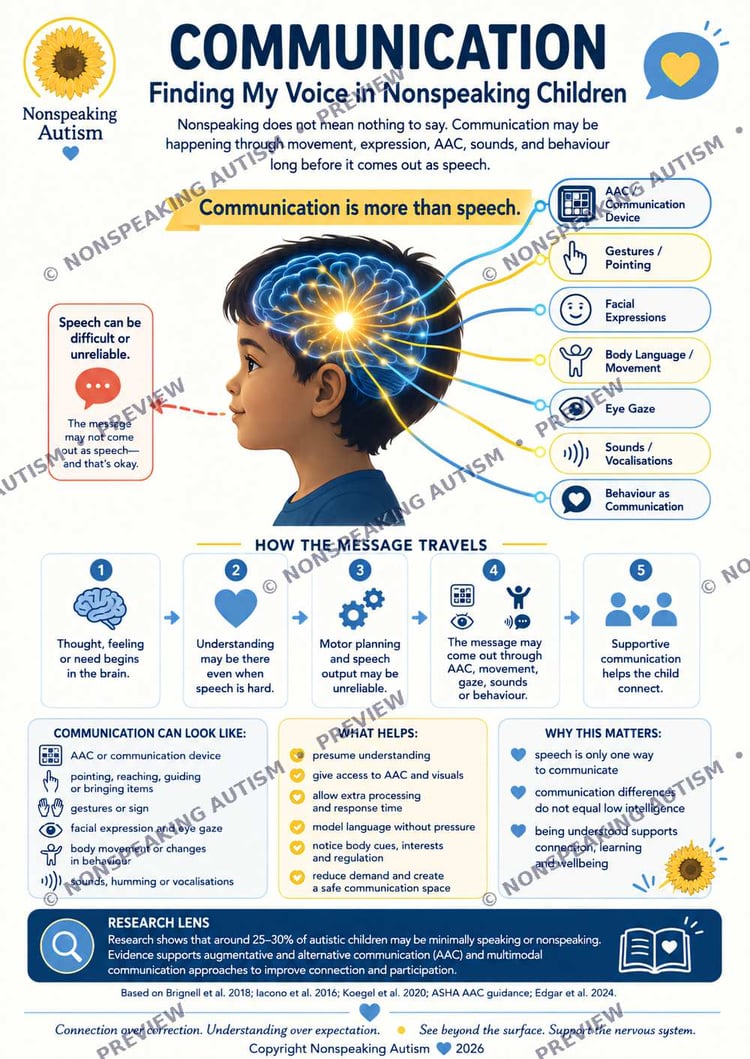
Augmentative and Alternative Communication (AAC) provides another route for a person to express themselves when speech is unavailable, unreliable, difficult or insufficient for everything they want to communicate.
For some people, speech and AAC exist side by side.
For others, AAC may become their primary or most reliable form of communication.
And some people may move between speech, AAC, gestures, vocalizations, facial expression and body language depending on the situation.
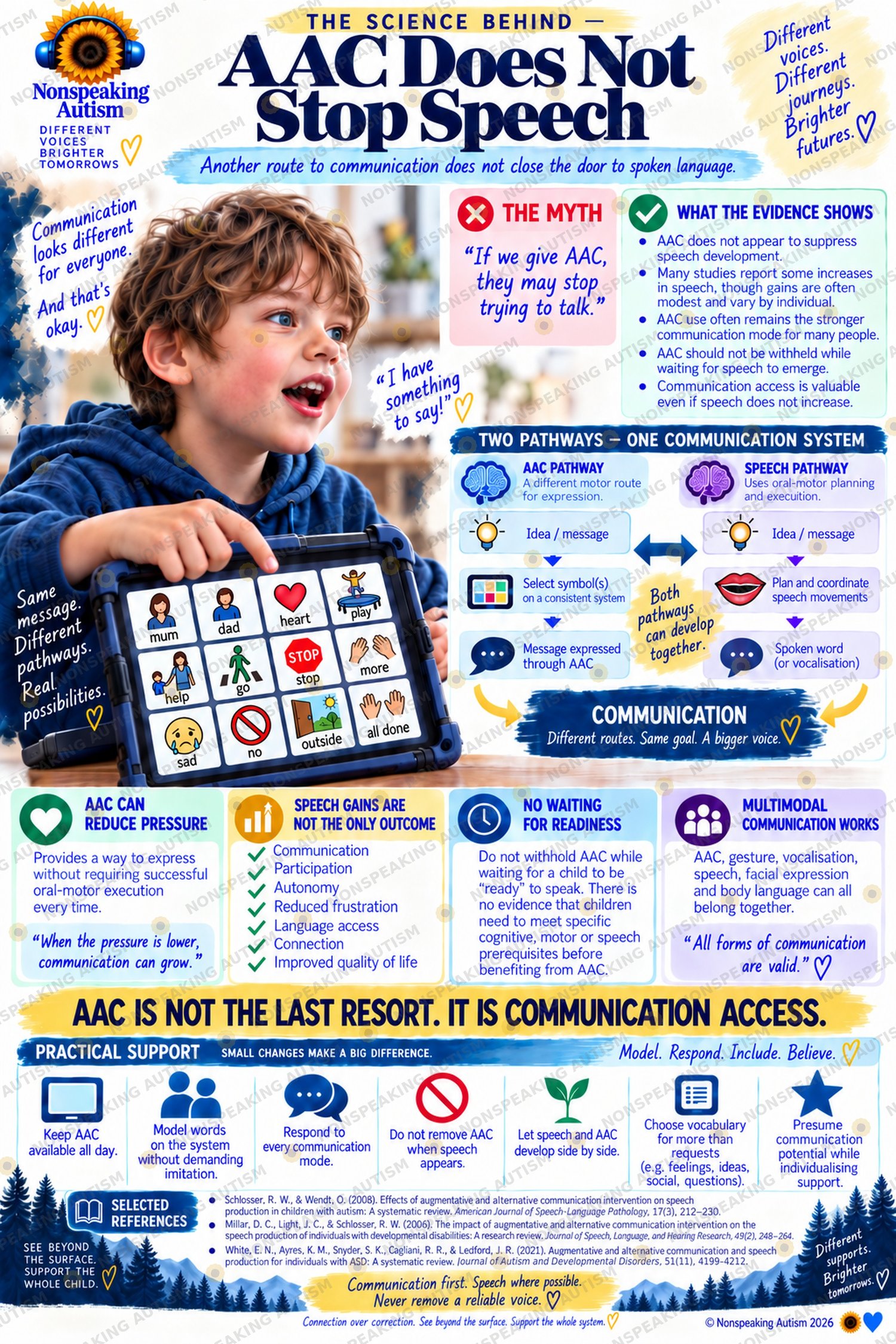
The Science Behind AAC Does Not Stop Speech is a research-informed educational poster designed to challenge the misconception that providing AAC prevents spoken-language development.
Its central message is:
AAC is not the last resort. It is communication access.
🧠 What Is AAC?
AAC stands for Augmentative and Alternative Communication.
“Augmentative” means adding to existing communication.
“Alternative” means providing another way to communicate when speech is not available or sufficient.
AAC can include:
picture or symbol boards
communication books
speech-generating devices
tablet-based communication systems
letter boards or keyboards where appropriate
written communication
signs and gestures
Different people need different systems.
AAC is not one particular app, device or communication method.
Its purpose is to give a person greater access to meaningful communication.
❌ The Myth: “If We Give AAC, They May Stop Trying to Talk”
Families may worry that providing an easier alternative to speech will reduce motivation to develop spoken language.
This concern can lead to AAC being delayed or withheld while adults wait to see whether speech develops.
However, research examining AAC interventions has not found evidence that AAC suppresses speech development.
Systematic reviews have instead reported that speech production may increase for some participants following AAC intervention, although gains are variable and often modest.
That distinction is important.
AAC should not be promised as a method for producing speech.
The evidence supports a different conclusion:
Providing communication access does not require sacrificing the possibility of speech.
✅ What the Evidence Shows
Research examining AAC and speech development supports several important principles:
AAC does not appear to prevent speech development.
Some studies report increases in speech following AAC intervention, although the amount of change varies considerably between individuals.
AAC can remain the person's stronger or more reliable communication mode even if spoken language develops.
Communication access has value whether or not speech increases.
And importantly:
AAC should not be withheld while everyone waits for speech to emerge.
The success of AAC should not be judged solely by whether it produces more spoken words.
🛤️ Two Pathways — One Communication System
The poster illustrates speech and AAC as different possible routes for expressing a message.
💙 AAC Pathway
A person has an:
idea or message
⬇️
selects symbols, letters, words or another representation using an accessible system
⬇️
the message is expressed through AAC.
💜 Speech Pathway
A person has an:
idea or message
⬇️
plans and coordinates the movements and processes required for speech
⬇️
produces a spoken word or vocalization.
These pathways are presented as an educational simplification, rather than literal isolated neurological circuits.
The important point is:
Both pathways can develop together.
A person does not have to choose between being “an AAC user” and “a speaking person.”
Communication can be multimodal.
💬 Same Message. Different Pathways. Real Possibilities.
Imagine a child wants to say:
“I want to go outside.”
They might:
say “outside”
select an OUTSIDE symbol on AAC
point towards the door
sign “outside”
type the word
take an adult to the door
combine speech and AAC
or communicate the message through another established method.
The outward form differs.
The underlying purpose is the same:
communication.
The goal should therefore be to increase a person's ability to communicate what matters — not to restrict them to one acceptable method.
💚 AAC Can Reduce Communication Pressure
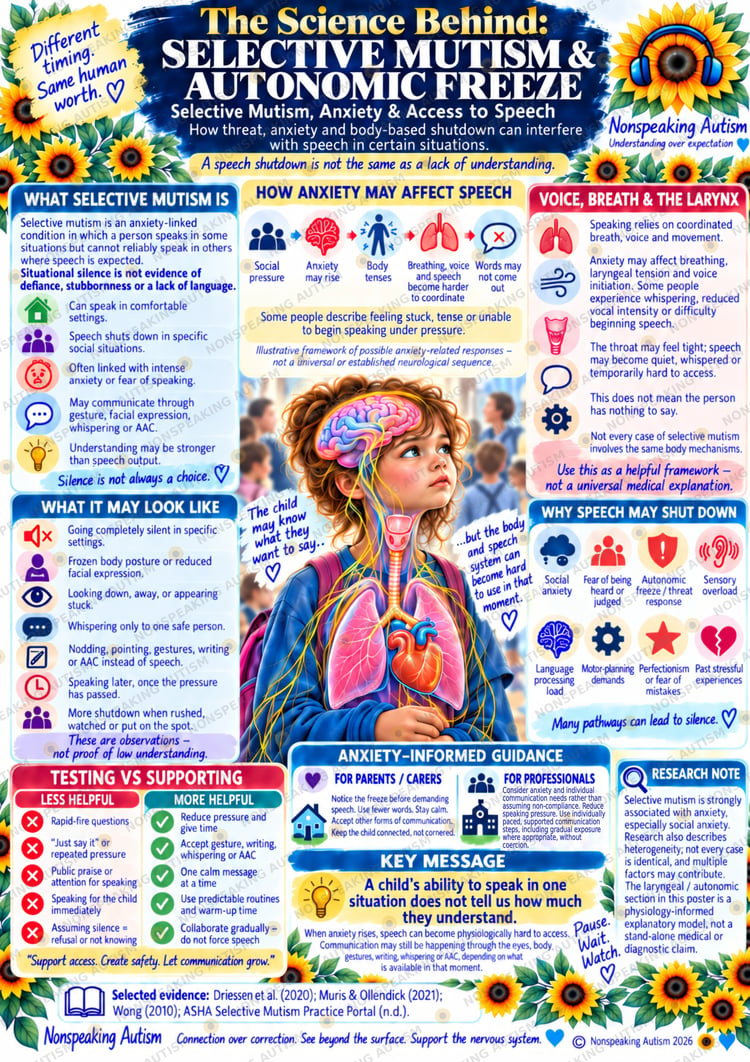
Spoken communication requires successful coordination of multiple processes.
For someone whose speech is unreliable, demanding spoken output every time can create additional communication pressure.
AAC can provide another route.
That can be particularly important when a person's access to speech changes with:
stress
fatigue
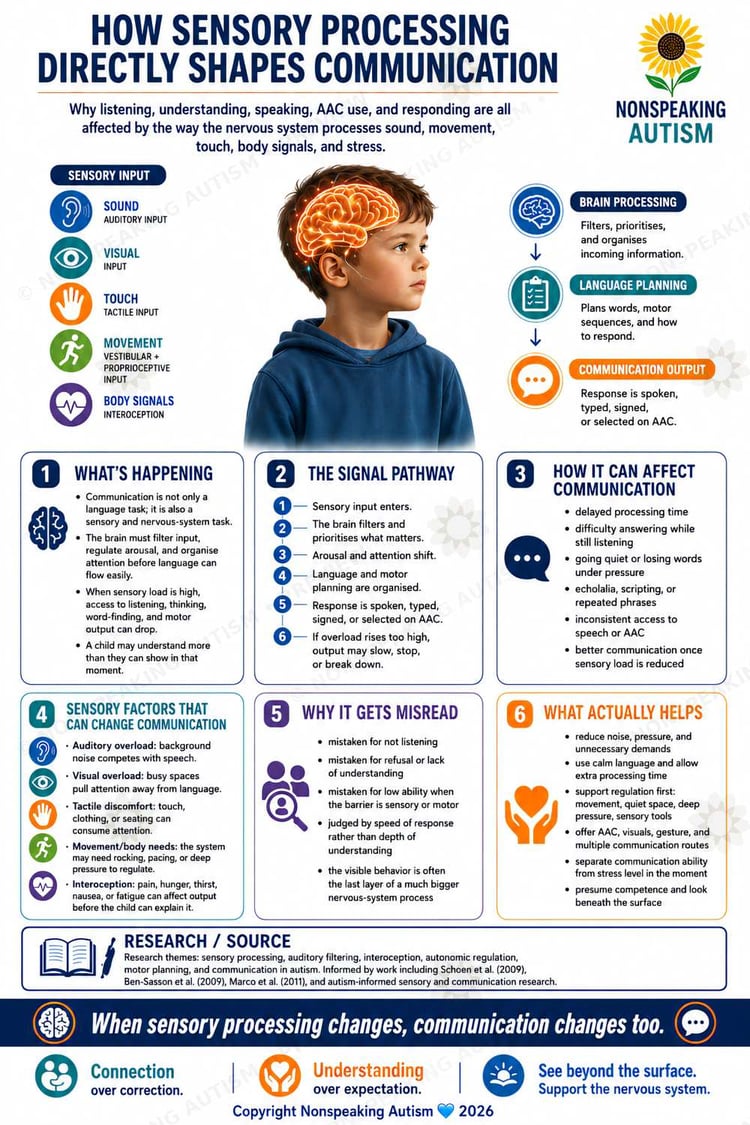
sensory overload
environment
motor demands
processing demands
illness
anxiety
or other circumstances.
Having AAC available means communication does not have to disappear simply because speech becomes harder.
When the pressure is lower, communication has more room to happen.
📈 Speech Gains Are Not the Only Outcome
One of the most important messages on this poster is that AAC should not be evaluated solely according to:
“Did it make them talk?”
Meaningful outcomes can include:
communication
participation
autonomy
reduced communication frustration
greater language access
connection
being able to refuse
being able to ask for help
expressing feelings and ideas
making choices
participating in relationships
improved quality of life
Speech development can be valuable when it is accessible to the person.
But communication is the larger goal.
⏰ No Waiting for “Readiness”
AAC should not automatically be withheld while adults wait for a child to become “ready.”
There is no evidence-based requirement that a child must first demonstrate a particular:
IQ
age
speech level
motor skill
cause-and-effect ability
or other arbitrary prerequisite before being considered for AAC.
AAC assessment and implementation should instead focus on finding accessible ways for the individual to communicate.
Waiting for speech before providing communication support can leave someone without a reliable means to express important messages during a critical period of development.
🌈 Multimodal Communication Is Real Communication
Human communication has always been multimodal.
People communicate through:
speech
gesture
facial expression
body language
writing
pictures
signs
AAC
vocalizations
movement
These modes do not have to compete.
An AAC user may point to a symbol while speaking part of a sentence.
They may type one message and vocalize another.
They may use speech when relaxed and AAC when tired.
They may primarily use AAC throughout their life.
All of these are valid communication possibilities.
🌱 Model AAC Without Demanding Imitation
One practical strategy shown on the poster is modeling.
Adults can use the person's AAC system while they speak, showing how words or symbols can be used in natural communication.
The purpose is not:
“I pressed it, now you have to press it.”
It is to provide exposure to the communication system without turning every interaction into a test.
Language develops through meaningful communication.
AAC should therefore be available during real life, not only during therapy sessions or when someone is being prompted to request something.
Practical AAC Support
The poster highlights several simple principles:
📱 Keep AAC Available All Day
A communication system cannot provide reliable access if it is locked away, left uncharged or only brought out for particular activities.
👥 Model Without Demanding Imitation
Show how the system can be used naturally.
💬 Respond to Every Communication Mode
Speech should not automatically receive more respect than AAC, gesture or another reliable form of communication.
🚫 Do Not Remove AAC When Speech Appears
Someone speaking today does not necessarily mean they will have equally reliable speech tomorrow, in another environment or under stress.
🌱 Let Speech and AAC Develop Side by Side
They do not have to compete.
📝 Provide Meaningful Vocabulary
Communication is about much more than requesting.
People need access to language for:
feelings
opinions
ideas
questions
social interaction
humour
protest
refusal
pain
relationships
and everything else people communicate about.
🛑 AAC Should Not Be a Reward
A person's communication system should not ordinarily be something they have to earn.
Removing access to AAC as punishment can remove access to the person's voice.
Likewise, communication should not be limited to:
“Say it first and then you can use your device.”
or:
“You can talk, so you don't need AAC anymore.”
A person may have speech and still benefit substantially from AAC.
Communication access should follow the communicator.
🗣️ Communication First — Speech Where Possible
Supporting AAC does not mean being anti-speech.
Speech can be a useful, efficient and meaningful communication method for people who can access it.
The issue is making speech the only acceptable route.
The aim is not:
AAC instead of speech at all costs.
Nor is it:
speech instead of AAC at all costs.
It is:
communication first.
Speech where accessible.
AAC where useful.
Multiple modes where helpful.
And a reliable way for the person to express themselves.
🔬 Research-Informed
Research into AAC and speech development has directly examined the concern that AAC might inhibit spoken language.
Systematic reviews have not found evidence that AAC intervention prevents speech development. Some participants demonstrate increases in speech production following AAC intervention, although improvements are variable and should not be guaranteed for an individual child.
Research also supports AAC as a legitimate communication intervention rather than something that must be reserved until other approaches have failed.
The evidence therefore supports a key distinction:
AAC does not need to produce speech in order to be worthwhile.
If AAC gives a person greater access to communication, autonomy, participation and connection, those are meaningful outcomes themselves.
📚 Selected References
Schlosser, R. W., & Wendt, O. (2008). Effects of augmentative and alternative communication intervention on speech production in children with autism: A systematic review. American Journal of Speech-Language Pathology, 17(3), 212–230.
Millar, D. C., Light, J. C., & Schlosser, R. W. (2006). The impact of augmentative and alternative communication intervention on the speech production of individuals with developmental disabilities: A research review. Journal of Speech, Language, and Hearing Research, 49(2), 248–264.
White, E. N., Ayres, K. M., Snyder, S. K., Cagliani, R. R., & Ledford, J. R. (2021). Augmentative and alternative communication and speech production for individuals with ASD: A systematic review. Journal of Autism and Developmental Disorders, 51(11), 4199–4212.
Evidence Note
These studies support the conclusion that AAC does not appear to inhibit speech development.
They should not be interpreted as evidence that AAC will necessarily cause speech to develop or increase for every individual.
The primary purpose of AAC is communication access.
👨👩👧 Who Is This Resource For?
This poster may be useful for:
- autistic children and young people
- nonspeaking and minimally speaking autistic people
- autistic people with unreliable or intermittent speech
- AAC users
- parents and caregivers
- families considering AAC
- teachers and teaching assistants
- SENCOs and SEND professionals
- speech and language therapists
- occupational therapists
- AAC professionals
- support workers
- early-years practitioners
- autism and disability organizations
- communication-training environments
It can be used as a family education resource, classroom poster, staff-training visual or conversation starter when discussing AAC and speech.
📦 What You Receive
Your purchase includes:
1 × The Science Behind — AAC Does Not Stop Speech educational poster
1 × high-resolution printable PDF
The purchased resource is supplied clear and without the promotional preview watermark shown in the Payhip listing image.
Preview watermarks are used for copyright protection only and are not present on the purchased file.
Digital download only — no physical product will be shipped.
⚠️ Important Educational & Communication Disclaimer
This resource is provided for educational and informational purposes only.
It is not a speech and language assessment, AAC assessment, diagnosis, medical advice, therapy programme or individualized communication plan.
Communication needs are highly individual. The most appropriate AAC system, access method, vocabulary and support approach will depend on the person's communication profile, sensory and motor needs, vision, hearing, language, preferences, environment and individual circumstances.
The resource should not be interpreted as promising that AAC will cause or increase spoken language. Research indicates that AAC does not appear to suppress speech development, but individual outcomes vary.
The pathway diagrams on the poster are educational simplifications and should not be interpreted as literal or complete neurological models of speech or AAC production.
A sudden, significant or unexplained loss or change in previously established speech or communication should not automatically be attributed to autism. Appropriate medical or professional assessment should be sought where relevant.
Individualized AAC assessment and support from an appropriately qualified speech and language therapist or AAC professional may be beneficial where needed.
Most importantly, a person's access to a reliable communication method should not depend on whether they eventually develop speech.
💛 The Message Behind the Resource
Imagine knowing exactly what you want to say but having no reliable way to say it.
Now imagine being told:
“We're going to wait before giving you another way to communicate — just in case it stops you talking.”
Communication should not have to wait.
A child deserves a way to say:
Mum.
Dad.
Help.
Stop.
No.
More.
Outside.
I'm sad.
I love you.
And eventually, far more than any small set of functional requests.
AAC can give someone another route to those messages.
If speech develops alongside it, both can belong.
If AAC remains the person's most reliable communication method, that voice still matters.
Because the goal is not to create a particular kind of communicator.
The goal is for the person to be heard.
AAC is not the last resort. It is communication access.
Different voices. Different lives. Different journeys. Brighter futures.
Communication first. Speech where possible. Never remove a reliable voice.
Model. Respond. Include. Believe.
See beyond the surface. Support the whole child.
Connection over correction. Understanding over expectation.
© Nonspeaking Autism 2026 🌻💙