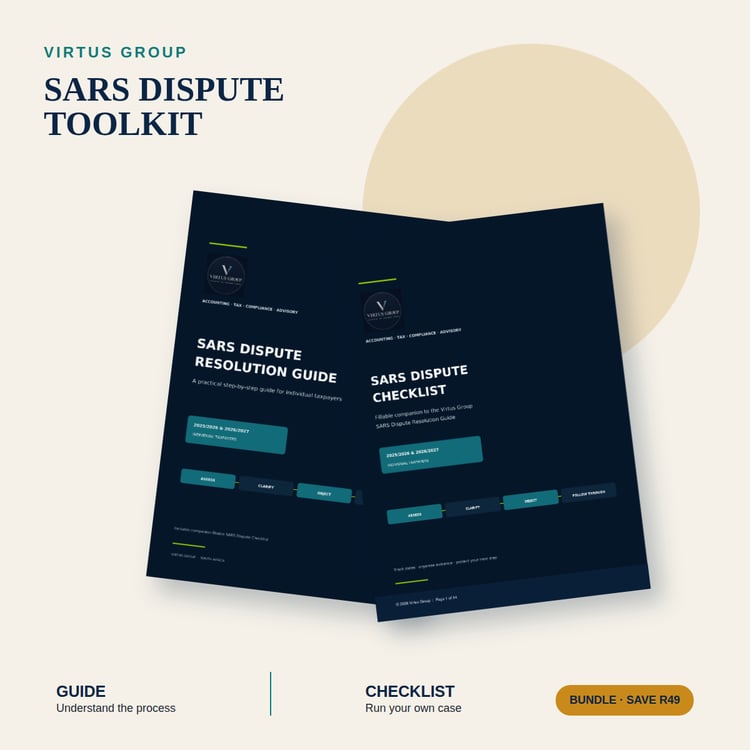

SARS Dispute Resolution Guide | Individual Taxpayers | South Africa | 2025/26 & 2026/27 A 23-page step-by-step guide for individual taxpayers in South Africa. Covers assessments, auto-assessments, requests for reasons, objections, appeals, ADR, suspension
SARS DISPUTE RESOLUTION GUIDE
The step-by-step guide for individual taxpayers in South Africa · 2025/26 & 2026/27 edition
If SARS has sent you an assessment you disagree with — or you're unsure what you've actually received — this guide walks you through the entire dispute process in plain English, from the moment the notice arrives to the final outcome.
The Guide is written for individual taxpayers, not accountants. It explains what each document means, what your deadlines are, what evidence matters, and what each step actually looks like on eFiling. It is a 23-page reference you will return to every time SARS sends you something new.
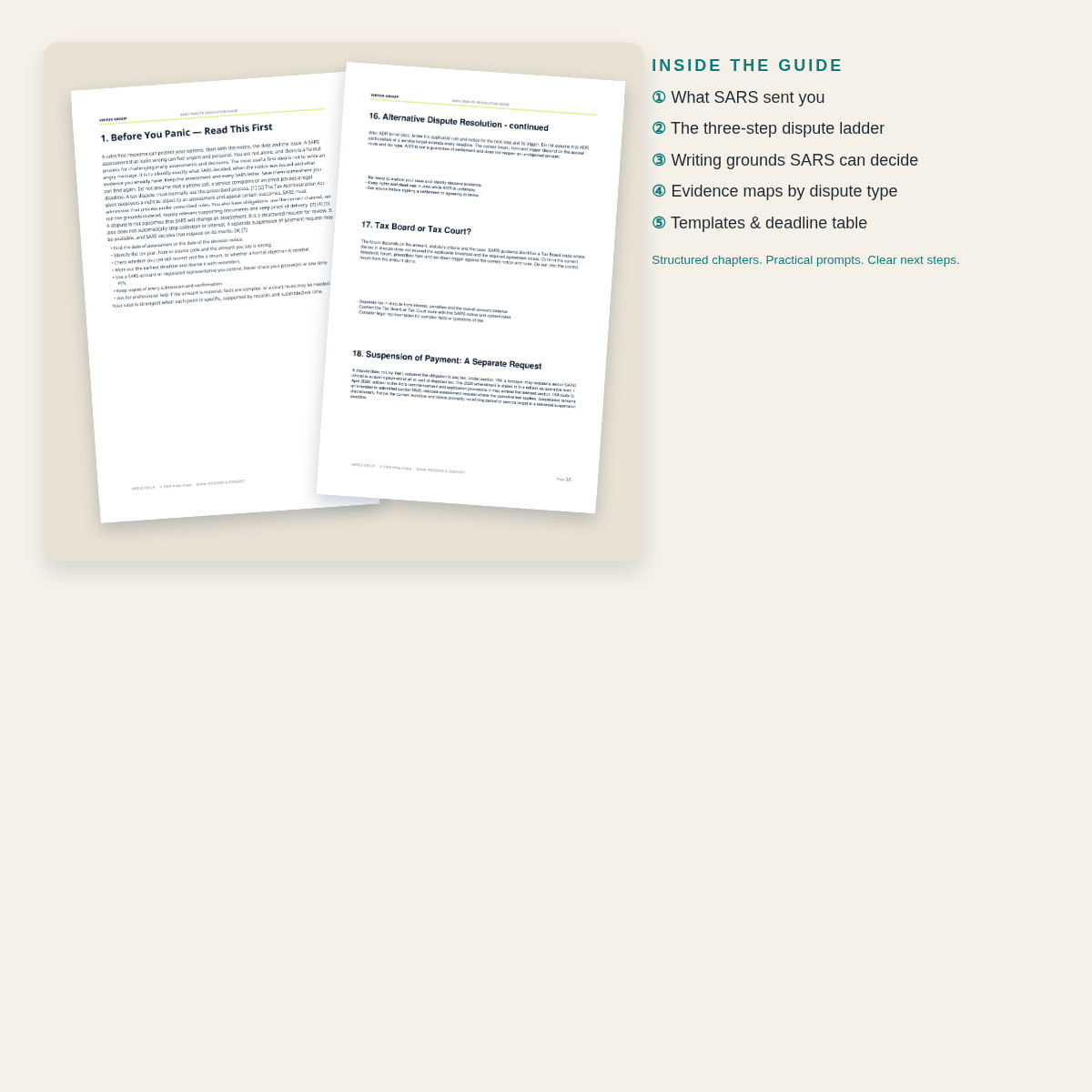
WHAT'S INSIDE
- Chapters 1–7 — Understanding what you received. Assessment vs auto-assessment vs verification vs audit. Correction vs objection vs appeal. Penalties, interest and the remission route. The business-day rule (including the 16 December – 15 January exclusion).
- Chapter 8 — The three-step dispute ladder. Request for Reasons → Notice of Objection → Notice of Appeal, plus how remission and suspension fit in.
- Chapters 9–14 — The objection sequence. How to request reasons, how to write grounds SARS can actually decide, how to build an evidence pack, how to submit and keep proof, and what happens after you submit (including the 60 / 45-business-day objection decision periods).
- Chapters 15–17 — Appeal, ADR and forum. The 30-business-day appeal window, the 21 / 45-day extension rules, the absolute 75-business-day cap, how ADR works, and how to choose between the Tax Board and Tax Court.
- Chapters 18–19 — Suspension of payment. The s 164 route, the 2026 amendment covering s 95(6) reduced-assessment requests, the five statutory factors SARS weighs, and what "temporary collection protection" does and does not mean.
- Chapter 20 — Missed a deadline? The condonation route, the s 104 extension limits, and the exact evidence a successful late-submission request needs.
- Chapters 21–25 — The evidence maps. Income and third-party data, deductions and credits, penalties and delay, and how to organise a case file so a reviewer can find every fact.
- Chapters 26–28 — Templates. Request for Reasons, Notice of Objection grounds, Suspension of Payment request.
- Chapter 29 — Worked example. Two fictional South African taxpayers (Lebo and Thabo) walking through a data mismatch and a disallowed travel deduction, start to finish.
- Chapters 30–32 — Final checks and follow-up. What to confirm before you submit, how to track every event after submission, and what to do if SARS has not responded.
- Chapter 33 — Support and resources. SARS contact details, the Tax Ombud, SAIT and SAICA.
- Chapter 34 — Plain-English glossary.
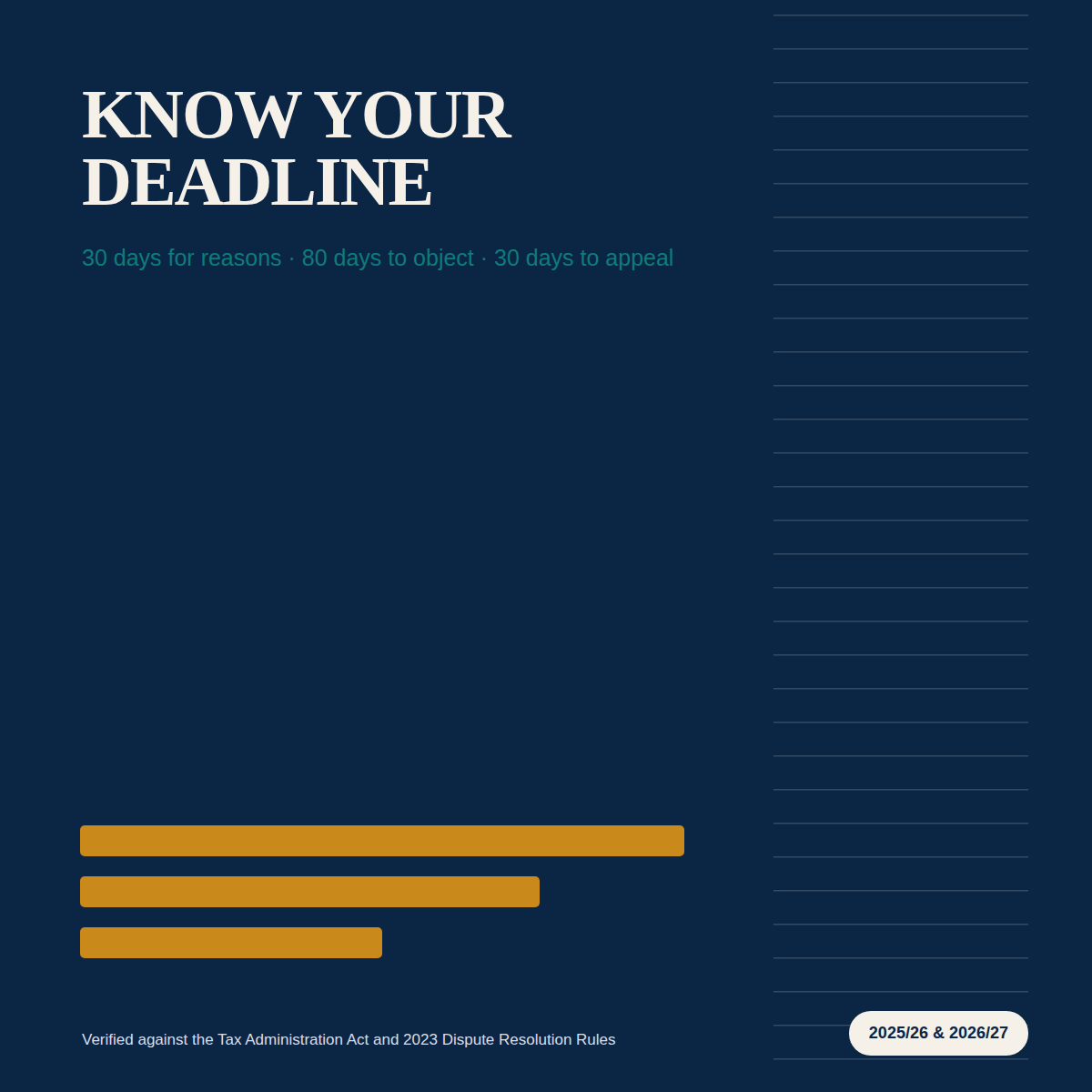
- Chapter 35 — Quick Deadline Reference. One table covering RFR, NOO, objection decision, NOA, condonation and suspension.
- Chapter 36 — Sources, version and use notes. All 15 primary sources listed and linked.
HOW IT HELPS
The single biggest cause of failed SARS disputes is not a weak case — it is a missed deadline or an objection that did not state the disputed amount and grounds clearly. This guide exists to close that gap. Each chapter tells you what to do, what to record, what to keep and what to check before you submit.
WHO THIS IS FOR
- Individual taxpayers who received an ITA34, auto-assessment, verification or audit letter and are not sure what to do next
- Anyone preparing a Request for Reasons, Notice of Objection or Notice of Appeal
- Anyone considering a s 164 suspension of payment
- Anyone who missed a deadline and wants to know whether condonation is available
- Anyone who paid a third party to handle a SARS matter and now wants to understand the process themselves
WHAT IT IS NOT
This is general information. It is not tax, legal or accounting advice, not SARS-approved, and not affiliated with SARS. Every deadline depends on the notice you received, the tax type, the applicable rule and the current SARS procedure. Verify your own trigger date or consult a registered tax practitioner for case-specific decisions.
IMPORTANT NOTES
- Contact email: info@virtus-group.co.za. .
- Digital download. No physical item will be shipped.
- Single-user personal licence. Please do not share or resell the file.
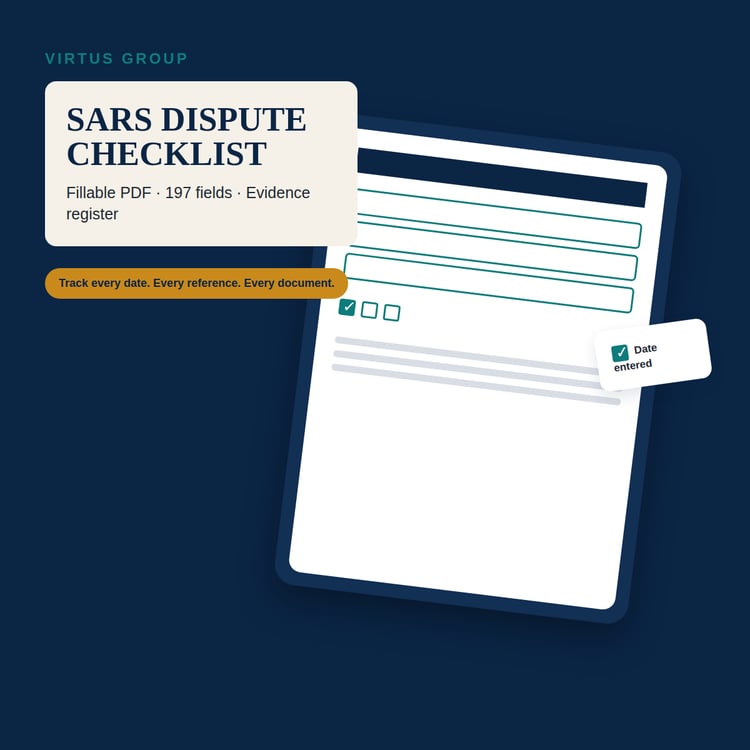
- Companion to the Virtus SARS Dispute Checklist (sold separately) — the Checklist is the fillable tracking tool that pairs with this Guide.
FAQ
Is this SARS-approved?
No. It is a Virtus Group publication. It is not issued by, endorsed by or affiliated with SARS.
Is it written for individuals or for accountants?
Individuals. Every chapter is written in plain English, assumes no tax qualification, and explains what to do rather than just what the rule says.
Does it cover business income, companies or trusts?
The Guide is written for individual taxpayers. It flags specific business, trust and VAT exceptions where they matter but does not go into depth on those tax types.
Does it include the SARS forms?
No. It explains which form to use, the process and the sequence. The forms themselves are on SARS eFiling.
How is it different from the Checklist?
The Guide explains the process. The Checklist is the fillable tool you complete to track your own case. They are designed to work together.
Do I get updates?
The 2025/26 & 2026/27 edition is current as of the release date. Contact Virtus for the latest edition if SARS updates a process.