

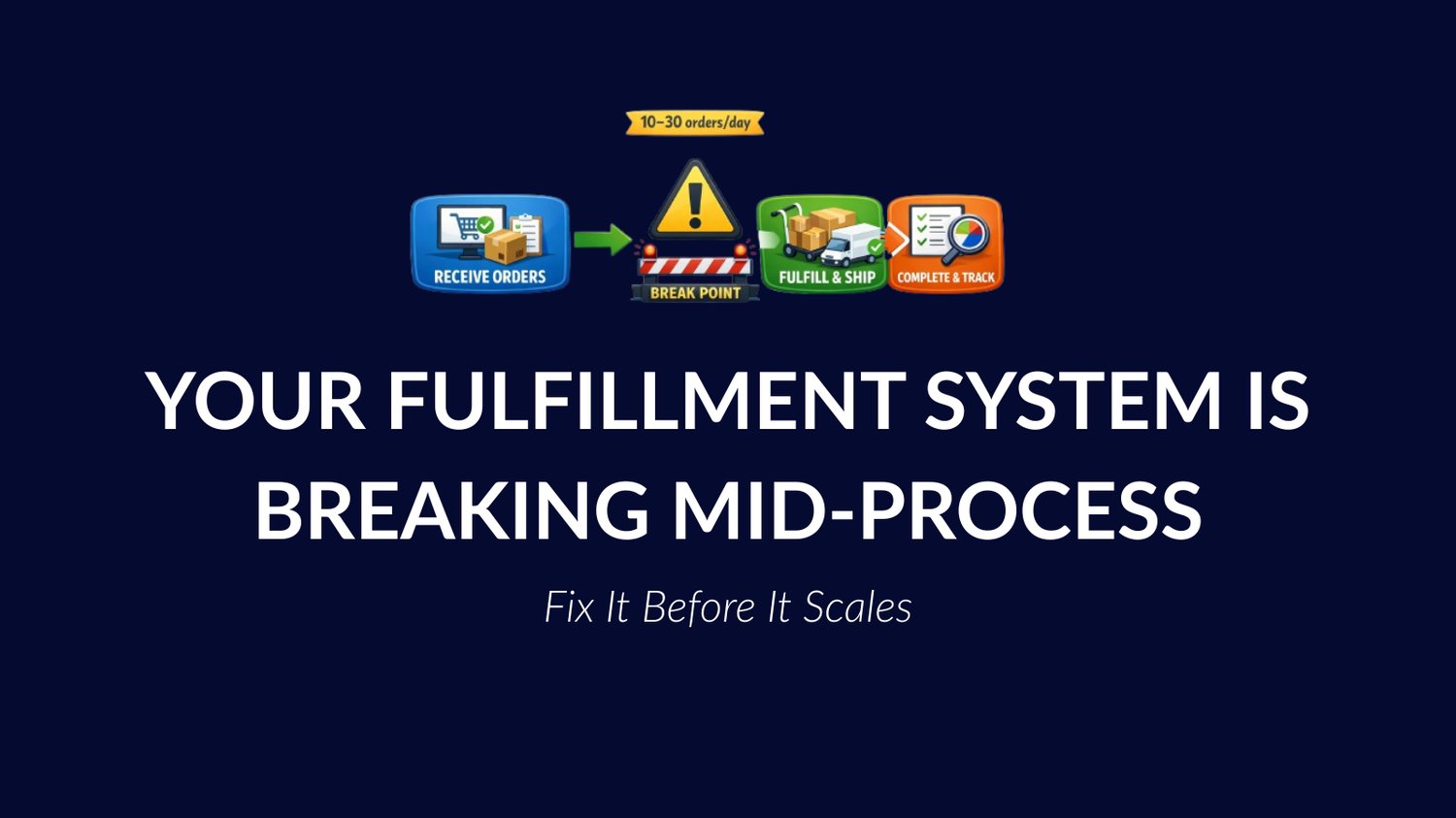
What Happens When Your Operations Break Mid-Process
Most eCommerce stores don’t fail all at once.
They break mid-process.
An order is placed… but not processed on time.
Inventory is updated… but not accurately.
Tracking is uploaded… but delayed or inconsistent.
These are not isolated issues.
They are signs of fulfillment system failure.
And for stores handling around 10–30 orders per day, these failures are often the turning point between:
- manageable operations
- and escalating problems
Especially for sellers on platforms like Shopify and marketplaces such as eBay, mid-process failures are where most operational breakdowns begin.
Download the Free Shopify Fulfillment Risk Audit
If your store processes around 10–30 orders per day and operations feel inconsistent, this audit helps identify where your fulfillment system is breaking mid-process.
👉 Download the free checklist here: Free Shopify Fulfillment Risk Audit
What Is a Fulfillment System Failure?
A fulfillment system failure occurs when a process:
- starts correctly
- but fails before completion
Examples include:
- order confirmed but not fulfilled
- inventory updated but not synced
- shipment created but not dispatched
These failures are difficult to detect early because: 👉 they look like small delays, not system problems
Why Failures Happen at 10–30 Orders/Day
At low volume, issues are easy to fix manually.
At higher volume, systems are more structured.
But at 10–30 orders per day, stores are in a transition phase:
- partially manual
- partially automated
- not fully standardized
This creates:
- gaps between steps
- inconsistent execution
- reliance on memory instead of systems
That’s why this range is where failures start to appear more frequently.
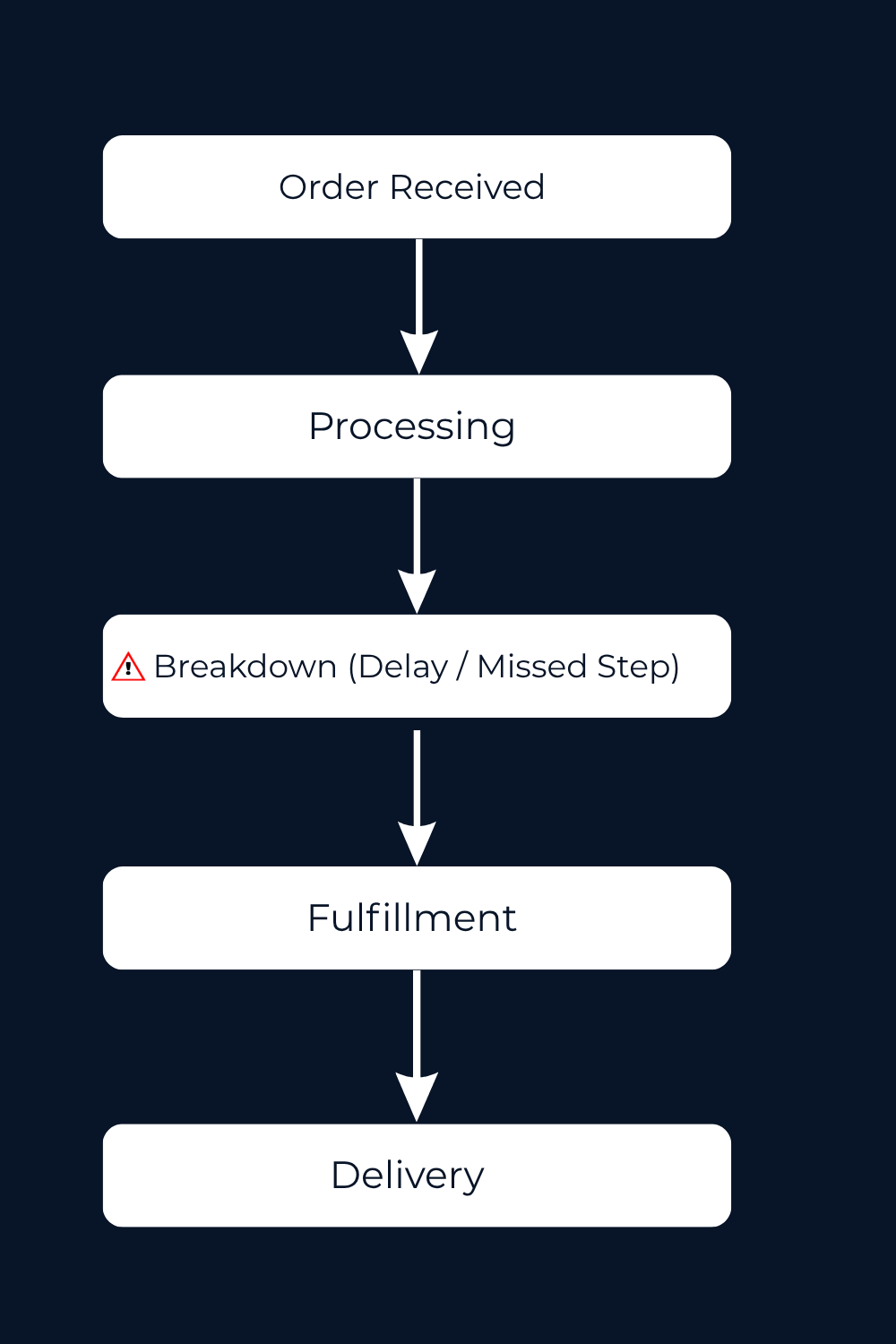
Failures don’t stop the process—they disrupt continuity between steps.
The Most Common Mid-Process Failures
1. Order Processing Gaps
Orders are received but:
- sit in queue too long
- are processed inconsistently
- require manual intervention
This creates delays that affect the entire workflow.
2. Inventory Sync Breakdowns
Stock appears available but:
- is not updated across systems
- reflects outdated quantities
- leads to overselling
This results in cancellations and refunds.
3. Fulfillment Execution Delays
Orders are prepared but:
- not shipped on time
- handled differently depending on the situation
- delayed due to unclear workflows
This impacts delivery expectations.
Get the Free Shopify Fulfillment Risk Audit
Mid-process failures often come from gaps between steps—order handling, inventory updates, and fulfillment execution. This checklist helps you identify where your workflow is breaking.
👉 Get the audit here: Free Shopify Fulfillment Risk Audit
4. Tracking and Communication Failures
Tracking is:
- uploaded late
- missing updates
- inconsistent across orders
Customers are left uncertain, increasing inquiries and disputes.
5. Exception Handling Failures
When something unexpected happens:
- there is no clear process
- decisions are made ad hoc
- outcomes vary
This creates inconsistency and increases error rates.
These breakdowns often originate from earlier workflow inconsistencies (see → Order Processing Bottlenecks in eCommerce ).
How These Failures Escalate
Mid-process failures don’t stay isolated.
They trigger chain reactions:
Order delay → customer inquiry → refund request → negative feedback
Or:
Inventory error → oversell → cancellation → trust loss
This is how small breakdowns turn into:
- operational stress
- customer dissatisfaction
- revenue loss
Why Traditional Fixes Don’t Work
Most stores respond by:
- working faster
- adding more tools
- manually fixing errors
But these are temporary solutions.
They don’t address the root issue: 👉 lack of system continuity between steps
The Role of Resilience in Preventing Failure Impact
Even well-designed systems can fail mid-process.
Resilience ensures that when they do:
- failures are detected early
- recovery is quick
- impact is minimized
This includes:
- fallback workflows
- clear exception handling
- recovery procedures
Instead of stopping operations, resilient systems adapt.
How to Reduce Fulfillment System Failures
Map Your Workflow End-to-End
Identify each step from: order → processing → fulfillment → delivery
Look for gaps between steps.
Standardize Execution
Ensure tasks are handled:
- consistently
- predictably
- without variation
Reduce Manual Dependency
Manual processes increase the risk of:
- delays
- missed steps
- inconsistent outcomes
Build Recovery Processes
Plan for:
- delays
- stock issues
- fulfillment disruptions
This reduces impact when failures occur.
Why This Matters for Scaling
If failures exist at 10–30 orders/day:
They multiply at higher volume.
What feels manageable now becomes:
- operational overload
- customer dissatisfaction
- revenue instability
Fixing these early creates a stable foundation for growth.
Where It Breaks
A store handling around 20–30 orders per day experienced:
- orders confirmed but not processed on time
- tracking uploaded late
- inconsistent fulfillment timing
Nothing appeared “broken.”
But the system wasn’t continuous.
After mapping the workflow:
- gaps between steps were identified
- transitions were standardized
- delays reduced
👉 The issue wasn’t execution—it was lack of connection between steps.
Download the Free eBay Seller Compliance Risk Audit
If your store processes 10–30 orders per day and you’re seeing delays, inconsistencies, or missed steps, this audit helps you identify where your fulfillment system is breaking.
👉 Access the free checklist here: eBay Seller Compliance Risk Audit
 About the Author
I work with eCommerce sellers to identify and fix fulfillment system gaps—especially for stores handling 10–30 orders per day where operations start to break under pressure.
My focus is on building structured systems that not only prevent issues, but also recover quickly when disruptions happen.
If your store is experiencing operational issues:
👉 Download the free fulfillment audit: eBay Seller Compliance Risk Audit
📢 Share This
Found this useful? Share it with other store owners: