
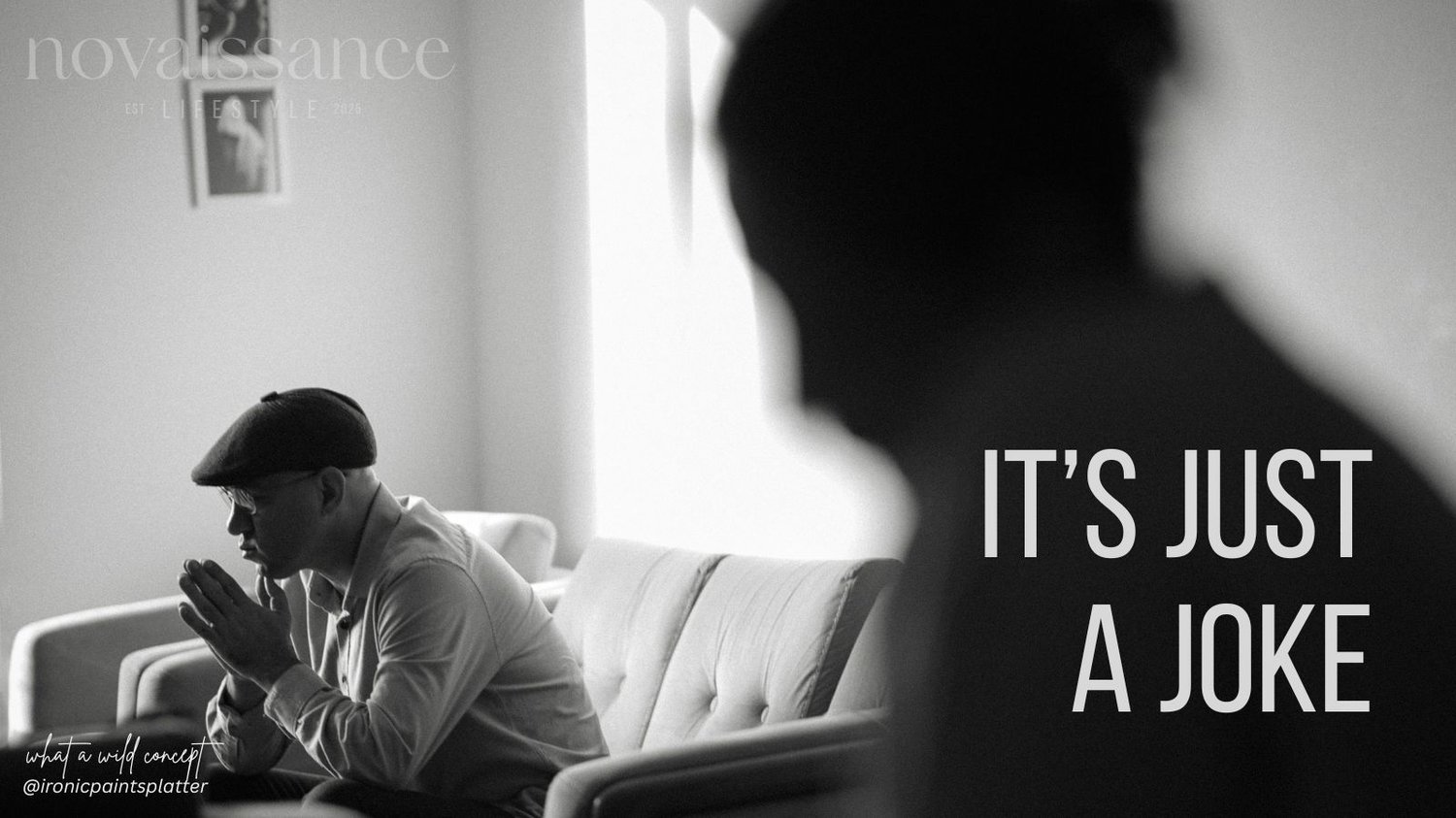
I watched a parody-reel where a woman threatens to burn her husband’s jersey if he doesn’t get home by the end of some song.
I get the “joke”.
It’s not funny.
I do understand that it’s a parody. It’s a skit. They went through considerable effort filming it from several different camera angles with lighting and music and makeup, while a man sprinted heroically through a field like he was escaping from Mordor to save his Blue Bulls jersey.
I get it.
It’s still not funny.
And I know somewhere someone is very triggered now, preparing to type in all-CAPS “OMG IT’S NOT THAT DEEP” …it is.
Disguising unhealthy behaviour as humour, especially when directed at men, is a real problem.
Threatening to destroy someone’s property to force compliance is not healthy relationship behaviour. It’s abuse.
Your Humour Isn’t Humour
Let’s get past the obvious first: it’s not funny. That simple. There are things that are funny, and things that aren’t.
Abuse? Not funny.
Neglect? Not funny.
Molestation? Not funny.
Disrespect? Not funny.
Humiliation? Not funny.
If you’re uncertain – there’s an easy way to tell. Turn that joke on yourself.
Go on. Try it. You’re about to tell a young girl she’s fat – tell it to yourself first.
You’re about to threaten to destroy your husband’s belongings because he dared spend time with his friends watching rugby? Go on, love. Set fire to your expensive handbag or those designer shoes first and see how funny it is, when it’s not being performed for an audience.
Still think it’s funny?
Then maybe stop pretending emotional coercion becomes comedy just because social media wrapped it in a trend.
The Big Problem: Normalising Coercion
My biggest issue with this kind of thing isn’t this one reel.
It’s that it influences normal people’s behaviour. They laugh, share it, repost it, imitate it, absorb it, and then drag pieces of it back into their real relationships.
Because that’s what people do. We imitate culture, but we’re not super selective about what type of culture we’re choosing to appropriate.
Social media culture is now heavily driven by algorithms that reward outrage, humiliation, disrespect, antagonism, and performative dominance.
Coercion and abuse is glamourised by the Algorithm Gods so it must be cool, we must do it.
What did you just glorify?
Coercion. Threats. Manipulation.
And double-standards.
Because if a man publicly threatened to destroy his wife’s possessions unless she obeyed him, people would immediately identify it as controlling behaviour. The whole world would lose their minds.
But it’s okay to do it to a man?
Since when?
Since we collectively decided male discomfort is comedic. Since we normalised treating men as emotionally disposable. Since we decided men are only useful when providing labour, money, attention, emotional stability, entertainment, protection, or validation on demand.
And if they don’t immediately comply?
Punish them.
Mock them.
Threaten them.
Humiliate them publicly.
We made it acceptable to abuse men, to belittle them and treat them like expendable labour and lackeys to jump at the snap of manicured fingers.
And I say “we” because each one of us that has ever shared a video, liked a video, posted a joke, or laughed, is complicit.
All of us.
And until we actively start standing up against this, it will not end.
What you allow is what will continue.
If we allow this kind of behaviour to be normalised, our husbands, fathers, brothers, sons, neighbours, coworkers, and friends, will continue to be degraded, humiliated, portrayed as disposable, or worse – dogs to jump at command.
When Men Say No
What happens when men eventually stop tolerating this?
What happens when they stop accepting humiliation as humour?
When they stop accepting emotional manipulation as “normal relationship behaviour”?
When they stop sacrificing every hobby, friendship, interest, and piece of solitude to keep somebody else emotionally regulated?
People keep treating men like emotional pack mules and then act utterly shocked when men withdraw.
But withdrawal doesn’t happen in a vacuum.
Men don’t just wake up one morning and randomly become emotionally unavailable.
A lot of them learned that vulnerability gets mocked, weakness gets punished, exhaustion gets ignored, and boundaries get treated like personal betrayal.
So eventually they stop talking.
Then society points at the silence it created and says:
“Wow. Men really struggle with emotional expression.”
Let’s Talk About Your Son
Would you be happy with somebody treating your son this way?
Would you be okay watching your son be constantly threatened, mocked, controlled, or emotionally cornered for internet laughs? Would you tell him, “Relax buddy, she’s just joking.”
I wouldn’t.
I don’t have a son, but I have young men in my life that I care deeply about, and the thought of them growing up in a culture that increasingly treats male pain as either inconvenient or hilarious makes me furious.
“But women suffer too!” the chorus cries out.
Yes. Obviously. Nobody said otherwise. But this obsessive inability to discuss men’s suffering without immediately dragging women into the conversation is part of the problem.
Men are allowed to hurt too.
Men are allowed to have boundaries too.
Men are allowed to say: “This behaviour is unhealthy.”
Without being treated like villains for noticing it.
In case you’ve forgotten – men are humans, too.
Performative Empathy Isn’t Empathy
But we, as a species, don’t have empathy anymore. Not true empathy, no.
We have the performative kind. Social media empathy. The kind where people post inspirational quotes and cry on TikTok about kindness, and then goes outside and treats the gardener like dirt.
Every other random person on Instagram is apparently an “empath”. People perform their “kindness” online, and post videos to prove their philanthropy.
It doesn’t matter what you do online. What matters is the real world, outside, beyond the screens. Talk to normal people in the street…that’s where you see it. The rudeness. The lack of compassion and empathy. The selfishness. The disdain and contempt. The blatant lack of basic manners.
Social media is fuelling this erosion.
We are taught, rather aggressively, that disrespect is “empowerment”, cruelty is “confidence” and that abuse is “justified”. Where certain sections of humanity are deemed as less than human because of what’s in their pants.
Men become categories, group, targets, and punchlines.
The effect of this behaviour isn’t found on social media.
It’s found in the suicide statistics, the addiction statistics, the isolation, the lack of social engagements. The exhaustion and the disconnection.
An Eye for An Eye
Just because the previous – and the current – generations are doing this doesn’t make it okay.
It’s not acceptable just because everyone’s doing it.
Are we still in high school? That we must tell actual grown-ass adults that??
People are strapping fireworks to dogs too, is that okay?
People are abusing little children too, is that okay?
So why is this okay?
Because it’s funny?
Go back and read the opening of the article again.
One of the most dishonest ideas we’ve absorbed culturally is that suffering naturally produces cruelty. “Because I suffered, you must too”.
No.
Some of the most violently oppressed people in history didn’t become monsters.
Anne Frank wrote about hope, curiosity, and humanity while hiding in conditions that most adults today would psychologically collapse under in days. Her voice was not bitterness. It was still fundamentally human.
Viktor Frankl survived Auschwitz and concluded that even in the worst conditions imaginable, people still retain the ability to choose their internal response, meaning, and moral direction.
Nelson Mandela endured decades of imprisonment and still actively chose reconciliation over revenge when he could have justifiably chosen otherwise.
Malala Yousafzai was shot for advocating girls’ education and still returned to advocate for education and human dignity rather than retaliation.
These are not people who lacked suffering.
They are people who refused to turn suffering into permission to harm others.
That matters.
Because “I suffered, so you should too” is not wisdom.
It’s damage passed down as tradition.
Systemic Contempt
Men don’t hit back – yet.
The real danger isn’t one joke, it’s the repetition. The acceptance of messaging portraying men as incompetent, disposable, irrelevant, dangerous, pathetic or useless.
We’ve made abuse of men socially acceptable. Before you clutch your pearls in outrage – abuse is abuse. If you don’t want it done to you, then it shouldn’t be done to someone else. Emotional and mental abuse is still abuse. It may not leave bruises, no. But it sure creates a lot of therapy visits and funerals.
Abuse doesn’t suddenly become acceptable because someone added background music and a ring light.
You don’t have to do much. You can literally just…not interact with so-called “jokes” like this. Stop rewarding this nonsense.
Don’t share it.
Don’t glorify it.
Don’t encourage it.
Don’t excuse it because the target happens to be a man.
Let him have his rugby and his friends on a Saturday afternoon without acting like he violated the Geneva Convention.
Surely people have hobbies?
Interests.
Lives.
Personal identities outside of policing their partner’s every movement?
If you take only one thing from this article, let it be this:
Jokes that normalise emotional coercion, humiliation, threats, and disrespect toward men contribute to the normalisation of emotional and mental abuse against men.
That is not empowerment.
It’s just toxicity with better branding.
-Nova

Comments ()