

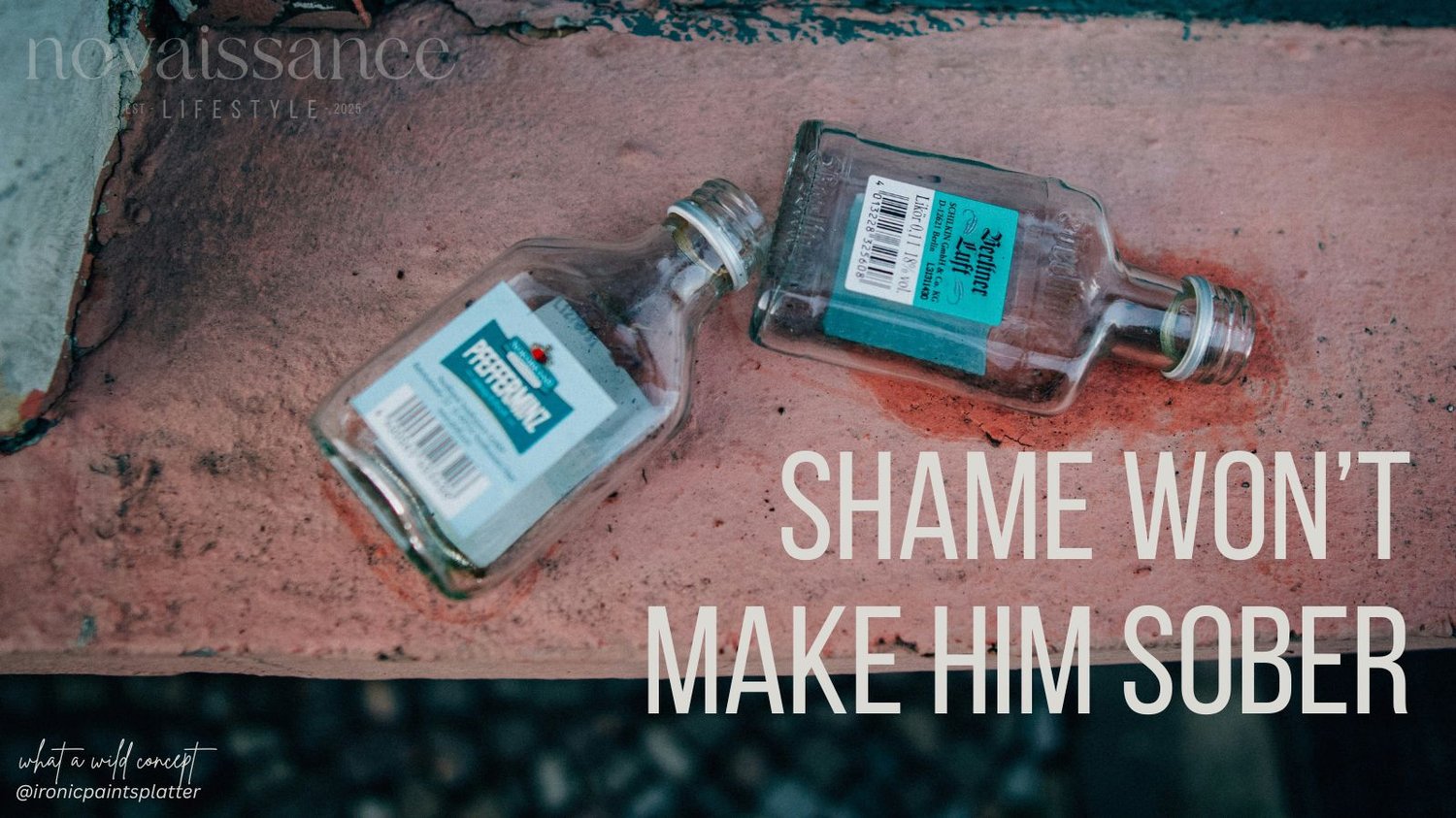
Three empty vodka bottles, set out on display.
That was the first thing Rusty saw when he walked into his room after staying at a friend’s house the night before.
The bottles had been lying, forgotten, under the bed for months. The message was clear. The room had been searched. Evidence had been collected. The verdict had been delivered without a word.
Rusty is forty-four.
Context Matters
After his divorce, Rusty moved back into his parents’ home. The marriage had been strained for years, but he had still done his best to provide for his wife and daughter. He lost his job, tried to start a business, and failed in an economy that is unforgiving even to people who do everything right. A new relationship ended. His world kept shrinking until it was reduced to four walls and 24 LED lights above the closet.
All of this unfolded against the backdrop of long-standing Major Depressive Disorder, quietly eroding his sense of self, his motivation, and his capacity to cope.
Self-care disappeared. Why should he bother? He’s only there to be an ATM or a taxi driver anyway.
Hobbies and interests disappeared. Why should he bother? No-one’s interested in the music he makes or the ideas he has.
Motivation disappeared. Enthusiasm disappeared. Confidence disappeared. Enjoyment disappeared.
He didn’t stop existing. He just stopped living.
What Alcohol Does
Let’s step back for a moment.
Alcohol is a nervous-system depressant, also known as a “downer”. The dangers and downfalls of alcohol abuse is not news to me, having grown up in a home with an alcoholic father.
In fact, I have had long conversations with Rusty about his alcohol use – and I’ve stood by him while he tried to stop.
Rusty doesn’t want to drink, by his own admission. He realizes fully that alcohol abuse is dangerous, expensive and doesn’t solve any problems. He knows this. He’s tried to stop. He managed to quit, cold turkey, and was doing really well – until another passive aggressive confrontation pushed him back into the waiting arms of vodka.
For anyone who’s never struggled with addiction, this may be hard to understand, but that’s not an excuse. Addiction isn’t something that you can shake off with a “positive mindset” and enough willpower. If willpower alone worked, no one would relapse. If you, a healthy and functioning adult, struggle to resist a second piece of chocolate after a stressful day, imagine trying to silence years of conditioning that insists alcohol is the only thing that numbs the pain.
And it’s not just alcohol. Addiction wears many disguises: drugs, gambling, pornography, food, nicotine, even exercise. People are not looking for something to destroy their lives. They are looking for something to make the pain stop.
Motivation Is A Tool, And The Toolbox Is Empty
Motivation is a tool. Coping skills are tools. Emotional regulation is a tool.
If the toolbox is empty, no amount of criticism will magically fill it.
People often ask why someone doesn’t choose healthier coping mechanisms. Therapy. Mindfulness. Yoga. Faith. The answer is usually not defiance or laziness.
I’d hypothesize two reasons.
One - often, these suggestions come packaged with moral superiority, offered by people who have never had to build coping skills from nothing. When you already feel like a failure, being lectured by someone smiling through green smoothies and platitudes is not motivating. It’s alienating.
If you’ve spent nights in the dark searching for God in the dirt next to your bed, the last thing you need is more judgement and Bible-bashing.
If the person suggesting any of the more socially-acceptable coping skills isn’t a proponent of the smugness of wellness culture, the actual skills themselves may be inaccessible, which brings me to the second possible reason.
Many men, like Rusty, grew up without emotional language. Not because they can’t learn it, but because it wasn’t modelled at home, and it wasn’t taught at school. Emotions aren’t named, explored or tolerated. If they feel unsure, scared or overwhelmed, there’s no guidance beyond “run it off” or “man up”. Healthy communication, self-reflection and emotional repair wasn’t demonstrated.
So they learn to endure, not to process. Suffer in silence, because being sad or vulnerable makes him a liability. To survive he suppresses his feelings and instead makes sure that everyone around him is okay – because then they leave him alone. Make jokes and act silly – as long as they’re laughing, they don’t look too closely, so they won’t spot the cracks in the façade.
Coping skills aren’t taught at home or in school, or even socially. Vulnerability is mocked or punished, therapy makes you “weak” and asking for help means you failed at “being a man”.
So when life inevitably collapses, when relationships end, jobs disappear, identity erodes, and the nervous system is in constant distress, there is no internal manual to reach for. No language to describe what’s happening. No tools to regulate it. Just noise, pressure, and the urge to make it stop.
Passive Aggression Is Not Care
If the toolbox, metaphorically speaking, is empty, it’s empty.
Passive aggression won’t change that, no matter how messy, ugly, or socially inconvenient alcoholism feels.
It may feel fleetingly satisfying to roll your eyes, shout or present the evidence of addiction pointedly with disapproving glares and sermons.
But you’ve achieved nothing positive.
You’ve increased the alienation of your child, partner, friend or parent. You’ve increased the resentment, increased the distance between you, and reinforced what they already believe - that they’re a failure.
These things also don’t help:
- Snide, sarcastic comments
- Guilt and shame
- Public humiliation
- Manipulation
- Silent treatment expecting them to “get the hint”
It’s not discipline. It’s avoidance, and it’s childish.
Why Responsibility Falls To You
If you are not the addict, you are likely the more stable person in the room. That doesn’t make you responsible for their addiction. It does mean you are better positioned to initiate change.
Example: the child is an addict and the parents are filled with resentment. The child doesn’t trust his parents, because of their past treatment (like going through his room, not supporting his efforts, being passive aggressive). The parents feel the child is ungrateful and needs to “shape up”.
In many families, resentment runs both ways. Parents feel disrespected and children feel controlled. Everyone feels justified. Making the first move is not surrender. It is leadership.
This is not about blame. It is about capacity.
It doesn’t excuse the behaviour, it opens the door to honest communication. It creates the conditions for collaboration. It restores dignity.
So instead of being passive-aggressive, try this:
- Name the concern clearly and without theatrics.
- Speak about health risks, safety, and long-term quality of life.
- Be specific about behaviours and consequences, not character.
- Set firm, calm boundaries around safety without emotional manipulation.
- Accept that you cannot control their drinking, only your response.
- Be consistent in your boundaries without being controlling.
SERIOUS NOTE: Heroin is hell. Some alcoholics become violent. Violence, severe dependency, and immediate danger are not what I am discussing here. These cases need immediate intervention from trained professionals.
I am not talking about these cases, I am talking about the middle-ground cases, the ones where he doesn’t shout or break things, he just quietly sits in his room and drinks until he’s numb. The ones that doesn’t make the headlines or six o’ clock news.
They’re just silently drowning, while their families watch.
Three Empty Bottles
Three empty bottles on display is an accusation, no matter how you frame it.
It doesn’t help him.
Support is not enabling. Rusty knows how I feel about his drinking. He also knows I will not judge him if he struggles. Because I understand that the alcohol is not the issue. The pain is.
So we go for walks. We talk about music, space, engineering, stories. We create moments where alcohol is unnecessary.
I treat him with respect. I show him that I believe in him.
He wants to live up to that.
So he drinks less. Then stops. And then goes home, to accusations.
And everything collapses again.
The Choice
Loving an addict is brutal. But so is burying him.
In the end, we all have a choice.
We can choose to support our loved ones struggling with addiction without approving their behaviour. We can choose to still see their humanity, and treat them with respect and dignity. We can choose their health and well-being, over image.
Or you can protect appearances, abandon them to addiction and enablers, and accept the likely outcome.
Listen, if I, who survived an abusive alcoholic father, can offer support to a man struggling to quit drinking – then you can find it in yourself too.
If he’s trying…don’t kick him further down. Help him up.
Help him fight, one more day.
-Nova
Comments ()