
What I've learned from reading The Book of Wisdom is that our senses, mind, and even spirit are all more connected than we ever realized. Here's how the book explain it.
Our five senses are the main way our brain figures out what's real. Sight, hearing, touch, taste, and smell — each one is like a doorway. They let our brain take in information from the outside world.
Our central nervous system (brain and spinal cord) does the real work. It picks up light waves, sound vibrations, and other signals. Then it turns all of that into electrical signals. Our brain reads those signals. That's how they become the experience of "seeing" or "hearing" something.
Here's the part that surprised me most: We don't actually touch, taste, smell, hear, or see with our sense organs at all. Those experiences happen because our brain interprets electrical signals.
We see with our brain.
We smell with our brain.
Every sense we have really comes from our brain's processing.
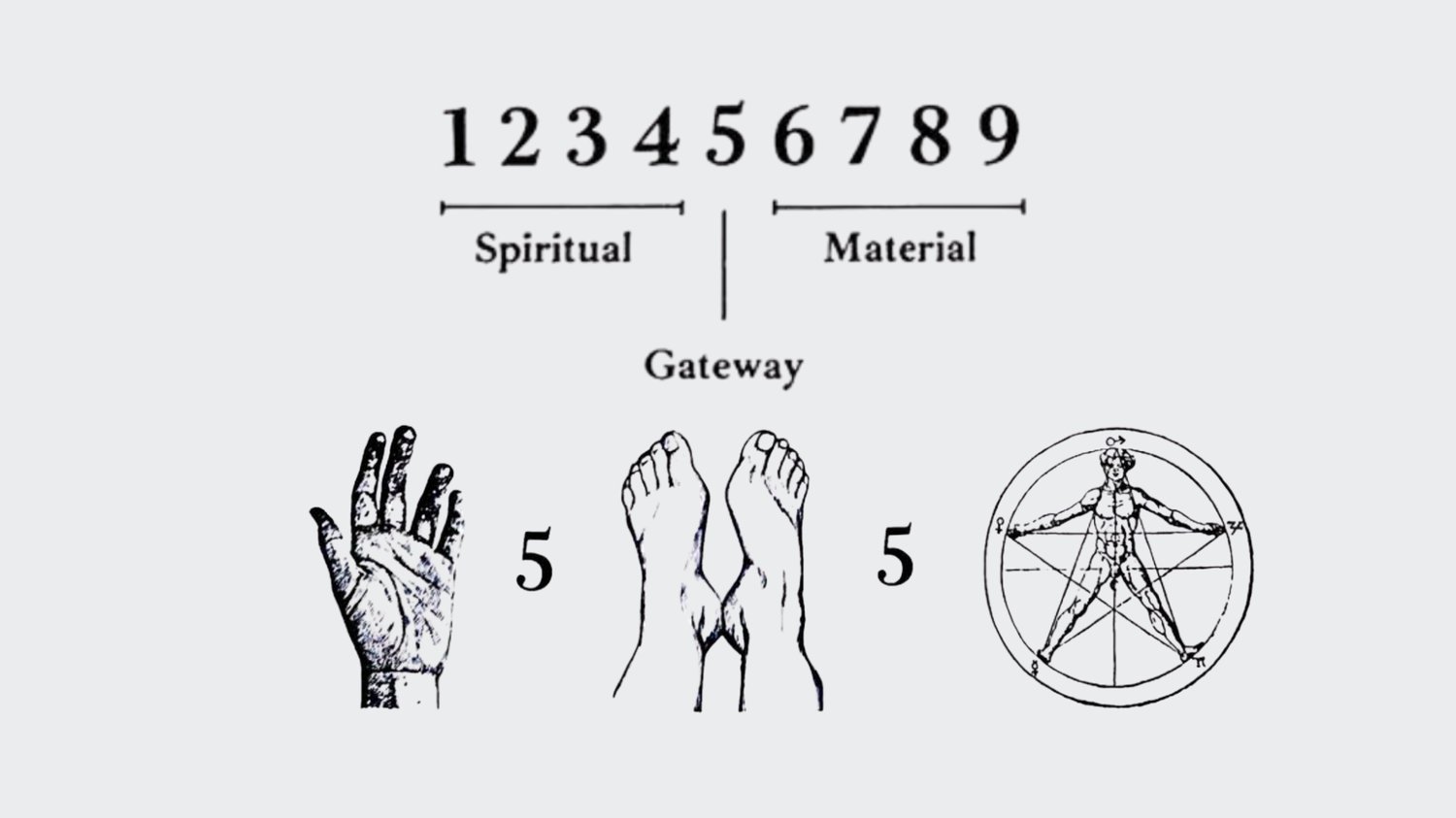
It mentioned that the number five carries a lot of symbolic meaning. It connects to perception and experience. We have five senses, five fingers on each hand, and five toes on each foot.
Five points on our body also form a pentagram (a five-pointed star). Many traditions see deep meaning in that shape.
In numerology (the study of numbers and their symbolic meaning), the number five stands for physical experience. It marks the point where our consciousness — the "I" inside us — meets and interacts with the physical world. Our brain and nervous system carry out that interaction. Because of this, the number five represents the bridge between our inner, private awareness and the outer, physical world. It shows how our senses shape the way we understand and experience reality.
The book also taught me that the number 5 stands for the meeting point between spirit and matter. It works like a bridge. It connects and balances the spiritual and physical sides of life. In many mystical traditions, people see this number as a gateway — where transformation, balance, and unity happen, linking the unseen world with the physical one.
The 5 Senses and The Mind
Next, I learned that our five senses run on electricity. Tiny electrical pulses carry information, just like a wire carries a signal in any electrical machine. Our body works the same way. It doesn't just sense electricity — it actually runs on it.
I learned that when something disrupts this electrical system, we feel it as pain. There's no such thing as "burning out" — what really happens is a break in the electrical flow through our nerves. Pain shows up sharply because the balance has been thrown off.
Compare that to when our body feels calm and balanced. There's no pain at all. Instead, we feel a deep, quiet stillness. That calm shows our body's electrical current is flowing steadily, with no interruptions.
I now understand that every touch, sight, smell, sound, and taste depends on this same steady electrical flow. Each sense is a way of noticing when that flow gets disrupted, in one area or another.
That disruption is what tells us something is out of balance.
This book taught me that our five senses exist to sense and interact with the physical world around us. They're always working — picking up on changes, sending feedback to our brain, and warning us when something's off. When we notice something through sight, touch, smell, taste, or sound, our nerves react. They translate that input into perception. This is how our senses protect us from harm, keep us safe, and help us stay well.
One thing that really stuck with me: by design, our five senses are limited. They can only take in the physical world. They aren't built to grasp the full scope of reality — they're built to help us understand and survive within it. This isn't a flaw. It's the design. These limits push our conscious mind to look past the physical world, toward deeper truths.
Our five senses are naturally built to notice only the physical realm. They're our body's tools for connecting to the material world. But because our mind believes so strongly in this small slice of reality, it stays limited too. I learned that this limit is purposeful — it's meant to push us not to stop at what our senses tell us, but to reach for deeper understanding and expand our mind beyond what we can physically sense.
The most hopeful part is that our mind holds unlimited potential. It isn't stuck within physical limits the way our senses are. It has the power to know and experience the nature of God — beyond what our five senses alone can perceive.
At its core, our mind is made from something bigger than matter. It goes beyond matter, time, and physical limits, reaching toward endless possibilities. While our body is physical, and will one day die, our mind is eternal, boundless, and free.
The biggest takeaway for me: everything we can see started out invisible. Whatever we perceive with our senses is temporary — it comes and goes. But the unseen world lasts forever. What's outside us is always shifting and changing. What's inside us — our deeper self — stays steady and lasting.
This idea connects directly with the ancient Egyptian symbol called the Eye of Ra. It teaches something important: how consciousness (our awareness of ourselves and the world) connects with and takes in the physical world — how spirit meets matter. The ancient Egyptians understood this idea deeply.
At its heart, the Eye of Horus stands for consciousness itself. It's the "I" inside us — our true self. This true self is what feels emotions, thinks thoughts, and senses everything around us. It symbolizes pure awareness, the kind that connects us to the wider universe.
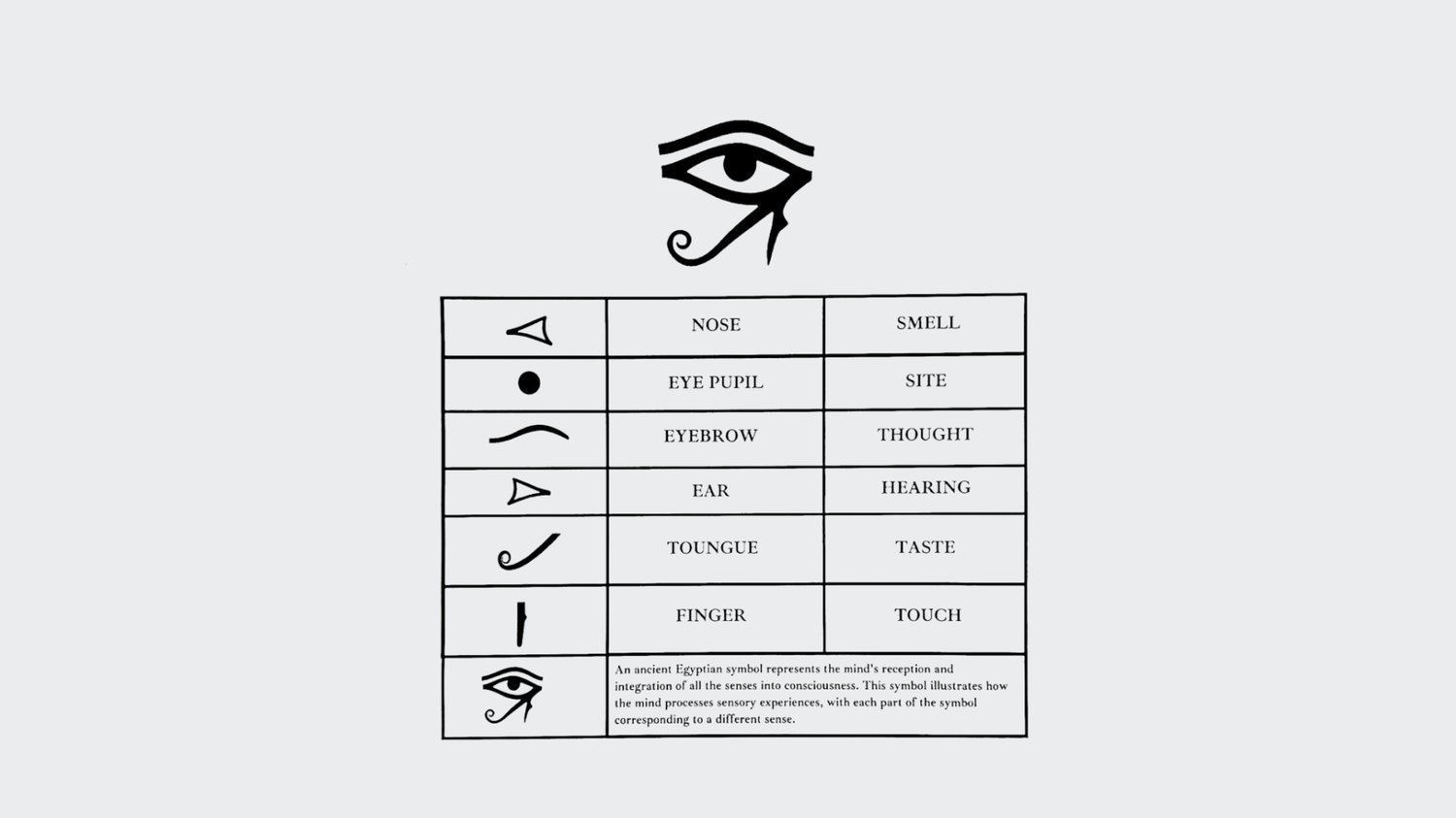
Looking at the symbol, we learned that every part of the Eye of Horus carries its own meaning, tied to how we connect with the material world.
The eye itself stands for consciousness — the inner watcher, the real "us" who takes in and experiences reality.
The eyebrow above the eye stands for thought. This connects to something real: our thoughts often show up as small, unconscious eyebrow movements. In this way, our physical expressions link back to what's happening in our mind.
This is where I began to see the full picture come together. Each of our five senses has its own symbol in this ancient system — the nose for smell, the eye for sight, the ear for hearing, the tongue for taste, and the finger for touch. Even thought gets its own symbol, shown through the eyebrow. When I looked at the whole Eye of Horus as one image, I realized it's a map. It shows how the mind takes in everything we sense and turns it into one single, aware experience — the same idea I'd just learned about consciousness bridging spirit and matter.
If the mind really works like a radio, these five senses are the dials — and the Eye of Horus reminds us that what we're tuning into shapes the whole signal we call reality.
Click HERE to Start Reading