

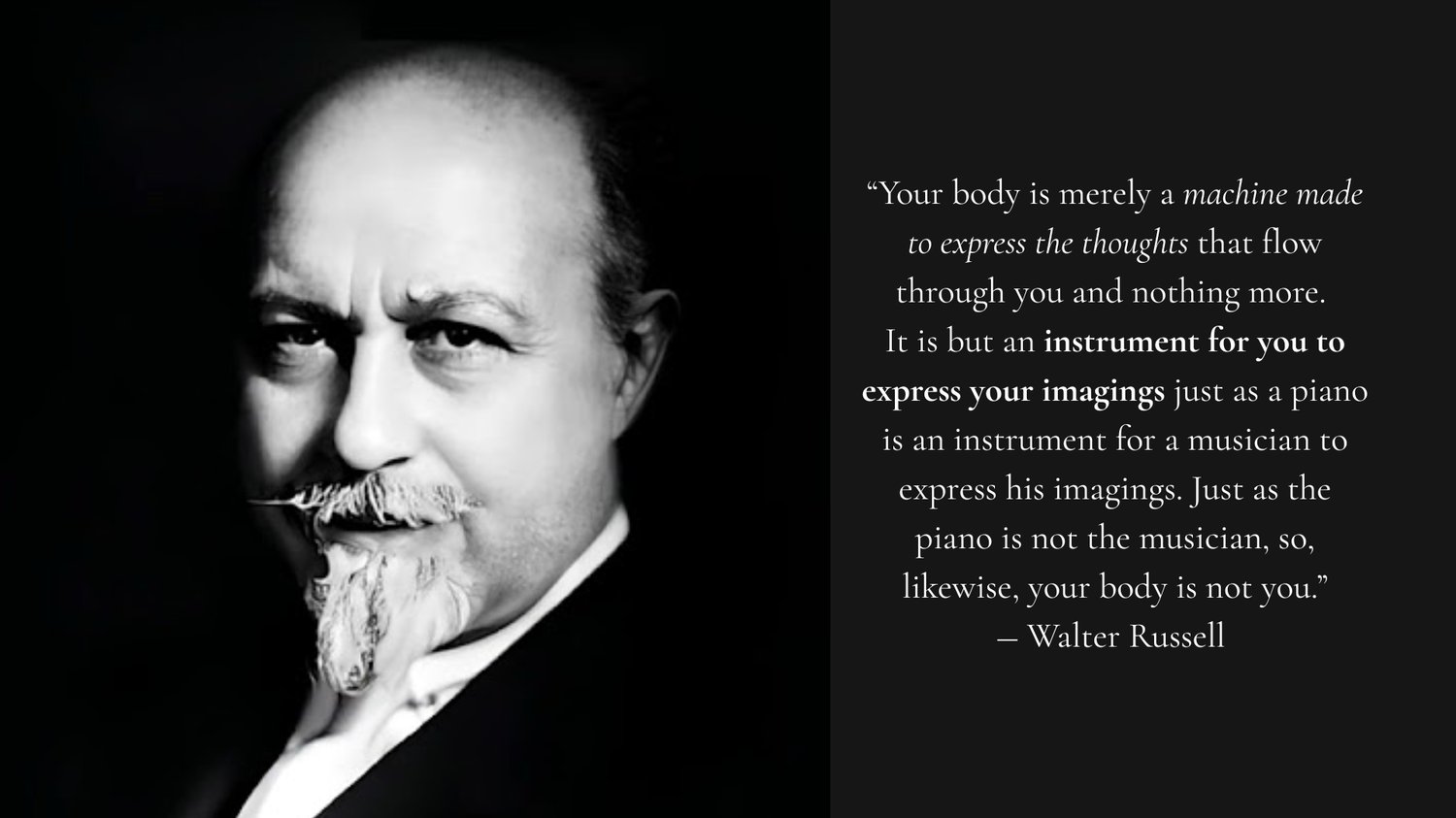
In Russell's framework, a low frequency shows up as "reddish" on the astral plane. Something like reverence or unconditional love climbs higher, toward violet.
It's a strange thing to sit with, because most of us were raised to think of emotion as invisible — something felt, not something that radiates. But Russell's view of the universe doesn't really allow for that separation.
If everything is vibration, and vibration is light, and light is color, then emotion was never invisible at all.
We just haven't had the eyes to see it directly.
That's the part that unsettles me most, actually — not the idea of color-coded feelings, but what's hiding underneath it.
If our inner states are always giving off a frequency, then privacy, in the way we normally think about it, might only be an illusion of the physical world. Somewhere beyond our five senses, we may be exactly as easy to read as the colors we're giving off.
There's something almost comforting in that thought — and something a little scary, too.
The Eye That Doesn't Actually See
The second idea — that we never really see the world "out there" — is one I keep coming back to. It's not just mystical poetry. It's also, more or less, what you'd learn in a first-year neuroscience class.
Light hits the retina as raw electromagnetic information. It gets converted to electrochemical signal, shipped down the optic nerve, and reconstructed — reconstructed, not received — in the visual cortex.
What you call "seeing the room around you" is your brain's best guess, built from partial data, filled in by memory, expectation, and pattern.
Russell takes that biological fact and asks a bigger question hiding inside it: if your brain is building the image on the inside, then who — or what — is actually doing the building?
He's not just talking about the visual cortex as a piece of hardware.
He's asking about something deeper — the "frequency," or state, of the person doing the perceiving.
Consciousness projects itself onto the canvas of reality rather than simply receiving reality — reframes the eye as less of a camera and more of a tuning instrument.
You don't just see the world.
You resonate it into being, according to whatever station your inner dial is set to.
It's closer to this: the world is real, but the version of it you're living in is co-authored.
Two people can stand in the same room and genuinely inhabit two different realities, not because the photons are different, but because the receiving instrument is tuned to a different frequency.
Holograms and Projection
This idea didn't come from meditation retreats — it came from scientists studying black holes. They found something strange: how much a black hole can hold doesn't depend on its size (like a box), but on its outer surface. That's like saying how much fits inside a box depends only on the wrapping paper, not the box itself.
This led some physicists to a bold idea: maybe our whole 3D world is really just information stored on a flat surface far away — and what feels like "depth" is just how that flat information looks from where we stand. In other words, the universe might work like a hologram, where the 3D world we see is generated from a simpler, 2D code.
I don't want to overclaim here. This isn't proof that ancient mystics were "right." It's still just a theory, not a settled fact about our universe. But it's interesting that old spiritual ideas and new physics both landed on a similar picture — that the world we see may be a projection of something deeper.
Maybe the mystics weren't so far off. They may have been describing, in their own way, something science is only now starting to explain.
Tuning Instrument
If the mind works like a tuner instead of a recorder, that means you can change the station. This is where Russell moves from just explaining ideas to actually giving advice: stop relying only on the logical, step-by-step side of your brain — the part that breaks everything into pieces and categories. Instead, try to take in life as a whole, all at once, instead of picking it apart.
This doesn't mean logic is bad. It just means logic isn't everything.
Your logical mind is great at measuring the world — but not so great at truly experiencing it.
And if reality really does respond to your inner frequency — where "heavy" thoughts pull in heavy experiences, and lighter, higher thoughts pull in something better — then the real work isn't thinking harder. It's more like tuning an instrument. You're not trying to think your way into a better life. You're trying to feel your way there, by adjusting your inner frequency.
God Made Flesh, Wiring the Instrument
This brings us to the idea: we are not separate from the source we're trying to perceive.
The brain isn't where consciousness comes from — it's just the hardware.
Think of it like a device that takes something infinite and huge, and turns it down to a level our bodies can actually handle.
In Russell's words, we are "divine sparks" — small pieces of something bigger — using our biology like a translator, turning raw light into the world we experience, moment by moment.
It's a big claim to sit with. But it also turns something as simple as everyday attention into something almost sacred. Every time you choose what to focus on, you're choosing what "frequency" you're sending out — and, in this view, shaping what kind of reality comes back to meet you.
♡𓂃adetriyani
Click HERE to Start Reading