

I came across a TED Talk by Sir Ken Robinson that stayed with me.
He spoke about something that should have shaken the entire education system to its core: schools don't develop creativity. They kill it.
Robinson mentioned that most school systems on earth were built during the Industrial Era, designed to produce workers who could sit still, follow instructions, and perform on command — not people who could think for themselves.
His observation is this: young children are not afraid to be wrong. They'll guess, invent, perform, try something absurd, and laugh about it if it doesn't work.
But modern education tends to prioritize certain kinds of intelligence while giving much less space to others.
Math and reading are at the top of the pyramid.
Art, music, dance, imagination, and creative expression can sometimes be treated as secondary — something children can explore after the "important" subjects are finished.
And somewhere along the way, many children begin to learn an invisible lesson:
There is a right answer.
And if you don't know it, perhaps it's safer not to speak.
Then, somewhere between childhood and adulthood, many people become much more careful.
We think before we speak.
We compare ourselves.
We worry about how we will be perceived.
We stop ourselves before we even try.
That idea really stayed with me.
Perhaps education isn't the only reason this happens. Life, family, culture, relationships, and personal experiences all shape us.
And perhaps the deeper question isn't simply whether schools teach creativity.
It's whether, somewhere along the way, we learn to protect ourselves from being wrong — and, in doing so, become afraid to discover what we might have created if we weren't.
And it makes me wonder:
What if we create an education system that protected more of that natural curiosity instead of slowly teaching children to hide it?
I start to see another connection.
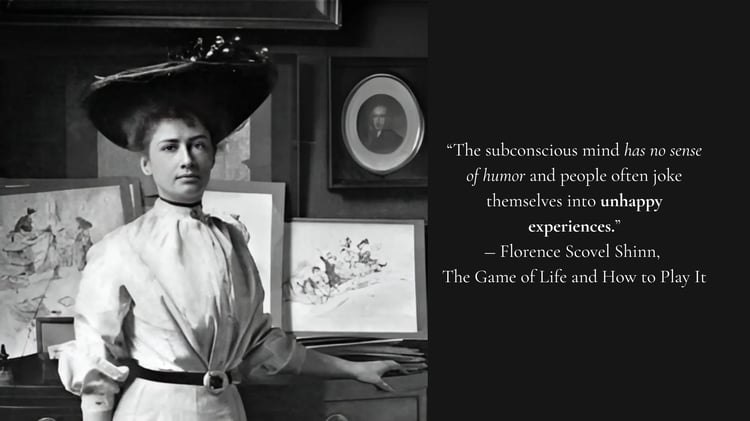
In the piece about Florence Scovel Shinn, we explored the idea of the subconscious mind as something that absorbs what we repeatedly give it — our thoughts, beliefs, emotions, and expectations.
And in the piece about living through three eras at once, we looked at how many of our systems, including education, still carry structures from an older industrial world while the world around us is changing rapidly.
Put those ideas together and a bigger picture starts to form. School isn't just teaching kids math and grammar. It's programming their subconscious mind, every single day, for twelve straight years.
So here's the real question worth sitting with: what happens if we actually changed that? What does the world look like 10, 20, and 30 years from now if schools stopped ranking intelligence and started nurturing it — and if, alongside that, we raised kids who understood something about their own subconscious and superconscious mind, not just their times tables?
10 Years From Now: The First Cracks in the Old System
In a decade, we wouldn't see a fully transformed world. Real change at the scale of an entire generation takes longer than that. But we would start seeing the first wave of kids who grew up in classrooms that treated a painting, a dance routine, or a wild idea with the same seriousness as a math test.
This first group would likely still be finishing school or just stepping into early adulthood, and the difference would show up less in what they know and more in how they carry themselves. Less fear around saying the "wrong" answer. More willingness to try something and let it fail in front of others without falling apart. A far more natural relationship with their own ideas, instead of constantly checking whether those ideas are "allowed."
You'd probably start noticing them in small, specific places — a teenager who mixes three unrelated interests into one weird passion project, a young adult who treats a rejected idea as information instead of proof they're not good enough. Quiet signs, but real ones.
20 Years From Now: A Generation That Doesn't Flinch
Two decades out is where this starts to look like something structural instead of scattered. This is the generation that spent their entire school life — from their very first classroom onward — inside a system built around Robinson's core belief: that intelligence is diverse, dynamic, and different in every person, not a single ladder with math at the top.
Picture what that actually produces. Adults in their twenties who never learned to treat failure as identity-threatening, because nobody ever taught them that being wrong made them stupid. People who move between disciplines easily, because nobody spent years convincing them that the "creative kids" and the "smart kids" were two separate categories.
Now layer Shinn's teaching underneath that. If this generation also grew up learning even a little about how their own minds work — that the subconscious carries out whatever gets repeated with feeling, that appearances aren't the whole truth, that there's a wiser layer of guidance available to anyone willing to get quiet enough to hear it — you'd be looking at a generation that isn't just less afraid of failure.
You'd be looking at a generation with genuine self-trust. People who don't need to be told what to think because they were never trained to fear their own thinking in the first place.
That's not a small shift. That's the kind of thing that changes what an entire society is capable of building.
30 Years From Now: A Different Kind of Civilization
This is where it gets genuinely interesting. Thirty years is enough time for that second generation to be the ones running things — leading companies, shaping policy, raising their own kids, designing the next version of school itself.
If the shift held for three decades straight, we wouldn't just have more "creative" people walking around. We'd likely see the actual structures of society start to bend toward something new — workplaces built around what people are naturally good at instead of standardized output, education systems that treat dance, design, and emotional intelligence as seriously as algebra, communities that value original thinking over obedient thinking.
This lines up almost perfectly with what we talked about in the "three eras" piece — the idea that civilization is slowly being asked to move from control toward adaptability, from rigid certainty toward comfort with possibility. A generation raised without the fear Robinson described, and with some grounding in how their own subconscious and superconscious mind actually work, would be far better equipped to live inside that kind of uncertainty instead of panicking at it.
You could even argue this is what "tuning into the higher blueprint" looks like on a civilizational scale — not one enlightened person here and there, but millions of people who were simply never taught to distrust their own minds in the first place.
Why This Actually Matters Now
None of this is guaranteed, obviously. Old systems don't rewrite themselves just because one talk went viral or one blog post connects a few dots. But it's worth remembering that every big shift in human history — industrial, digital, whatever comes next — started with a change in what a generation of children were taught to believe was possible.
Robinson was pointing at the school system. Shinn was pointing at the mind. Different language, same underlying warning: whatever gets impressed early and repeated often is what eventually gets built into reality — whether that's a child's belief about their own intelligence, or an entire generation's belief about what they're allowed to become.
Ten years from now, twenty, thirty — the shape of the future isn't really a mystery. It's just whatever we're currently teaching kids to believe about themselves, playing out on a longer timeline than we're used to thinking in.
♡𓂃adetriyani
Click HERE to Start Reading