
Have you ever felt like your life is running on two — maybe even three — different clocks at the same time?
Your phone updates every few seconds.
Your inbox never really closes.
Information travels around the world almost instantly.
And yet, many of us are still working within a 9-to-5 structure that was shaped by an industrial world from more than a century ago.
We send our children through education systems built around standardization.
We live in cities designed around systems that were created for a very different kind of life.
Sometimes I wonder if this is part of why modern life can feel so exhausting.
Not because we are necessarily doing something wrong.
But because we are living through several different eras at once.
The more I think about it, the more I see civilization as something that doesn't move forward in one smooth line.
Different parts evolve at different speeds.
And perhaps we're currently living right in the middle of that gap.
Layer One: The World We Still Live In
If you look closely at everyday life, so much of it still carries the logic of the Industrial Era.
Work is often measured through fixed hours, productivity targets, and output.
Education still relies heavily on standardized systems, testing, schedules, and rows of desks.
Economies are built around growth, competition, production, and consumption.
And many of our cities and infrastructures were designed around manufacturing, transportation, and efficiency rather than necessarily around human wellbeing.
At the same time, we carry smartphones in our hands.
We use AI.
We can speak to someone on the other side of the world in seconds.
We can learn almost anything with a few taps.
The tools have changed dramatically.
But many of the structures surrounding us haven't changed at the same pace.
And perhaps that's part of the tension.
We've upgraded the tools without fully upgrading the structures we live inside.
Layer Two: Our Minds Are Living in the Digital Era
Then there is our inner world.
This may be changing even faster.
We now live with constant notifications, endless information, instant answers, and multiple conversations happening at the same time.
We can move between work, family, social media, news, entertainment, and messages without ever physically changing where we are.
We can create identities online.
Find communities we've never met in person.
Learn something new overnight.
Watch a trend appear and disappear within days.
It's an extraordinary time to be alive.
But sometimes I wonder what this pace is asking of us.
Our bodies and nervous systems were not designed with this particular kind of environment in mind. We evolved over a very long period of time in worlds that were, in many ways, slower and less saturated with information.
And now we're asking ourselves to keep up with something that rarely stops.
Maybe that's part of the strange tension we feel.
More information, but not necessarily more wisdom.
More connection, but sometimes a deeper feeling of loneliness.
More choices, but also more exhaustion from trying to choose.
Perhaps we're not becoming weaker.
Perhaps we're simply trying to adapt to a world that is changing faster than our inner systems know how to process.
Layer Three: A Different Way of Seeing
This is where I become interested in the idea of a "quantum era."
I don't mean this purely as a technological prediction. Quantum technology is still developing, and there is a lot we don't yet know about where it will lead.
I'm thinking more about the word as a metaphor for a shift in how we understand ourselves and the world around us. A movement away from some of the old ways of thinking.
From seeing everything as separate toward seeing connection and systems.
From believing we must control every outcome toward learning adaptability.
From needing one certain answer toward becoming more comfortable with possibility.
From thinking in straight lines of cause and effect toward recognizing that life can be much more interconnected and unpredictable than that.
There is something interesting about borrowing this language from physics.
At the quantum level, the universe doesn't always behave according to the assumptions we make from our everyday experience. Things become stranger, less intuitive, and much less fixed than the world appears to us.
I don't think we need to turn that into a spiritual proof.
But perhaps it can give us permission to question some of our own assumptions too.
Maybe life doesn't always have to unfold in the way we've been taught it should.
Maybe there are more possibilities than the ones we were shown.
So Why Does It Sometimes Feel Like Everything Is Falling Apart?
Maybe because several things are changing at once.
And whenever an old way of living begins to meet a new one, there is usually a period where neither feels completely stable.
We saw something similar during the Industrial Revolution, when traditional ways of living were dramatically disrupted. We saw it again with the arrival of the internet, when communication, media, work, and relationships began changing in ways that were difficult to imagine beforehand. And now we're watching AI, automation, economic changes, climate concerns, cultural shifts, and new ways of working all unfold at the same time.
It can feel like too much.
Sometimes it can even feel like the world is breaking.
But perhaps what we're experiencing is something slightly different.
Maybe we're witnessing the discomfort of transition.
The old structures haven't completely disappeared.
The new ones haven't fully formed.
So we're living between them.
And living between things is rarely comfortable.
Maybe Chaos Is Part of the Transition
When you're standing inside a major change, it rarely looks like progress.
It can look like uncertainty.
Confusion.
Loss.
Things no longer making sense in the way they used to.
Perhaps that's why periods of transformation can feel so unsettling.
We don't always recognize the new while we're still surrounded by the old.
And I think this applies to our inner lives too.
Sometimes an old belief begins to fall apart before we know what we're going to believe instead.
A career no longer feels right before we know what we want to do next.
A relationship changes before we understand what the new version of it will look like.
An identity we spent years building suddenly doesn't feel like us anymore.
From the inside, it can feel like something has gone wrong.
But perhaps something is simply being rearranged.
Two Ways of Looking at the Same Moment
There is a spiritual way of looking at all of this that I've been thinking about too.
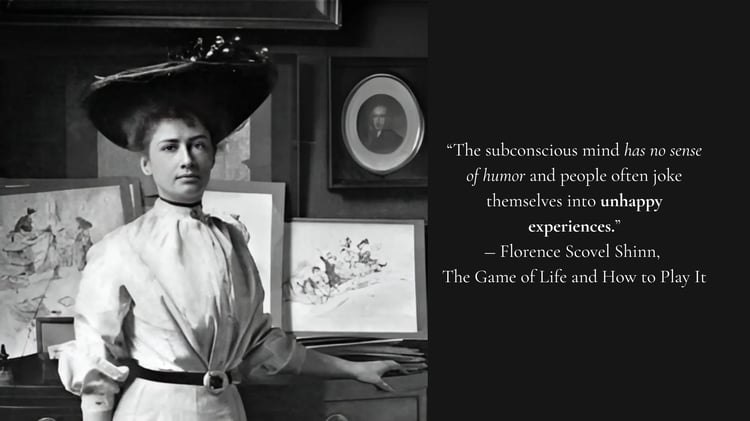
Florence Scovel Shinn wrote about moving away from fear and toward faith, trust, creativity, and alignment.
From that perspective, perhaps what we're experiencing isn't only technological or social change.
Perhaps there is also a shift happening within consciousness itself.
A movement away from living entirely through fear and control.
Toward trust.
Toward creativity.
Toward intuition.
Toward a deeper sense that perhaps we don't need to control every step in order to move forward.
The scientific perspective may describe the same period differently: rapid technological, social, and economic transformation.
Neither perspective necessarily has to cancel the other out.
Maybe they are simply looking at the same moment through different windows.
And perhaps what both are telling us is that the way we have been living is changing.
We Are Living in the Overlap
Maybe that's why so many people feel tired right now.
We are still living inside Industrial Era structures.
Our minds are adapting to a Digital Era.
And at the same time, we're beginning to imagine something beyond both.
Something more connected.
More flexible.
More creative.
Perhaps even more conscious.
We're carrying all of these layers inside the same body, sometimes within the same day.
No wonder it can feel overwhelming.
Maybe we aren't supposed to have everything figured out yet.
Maybe we're simply living through the messy middle.
And perhaps the real work isn't choosing which era we belong to.
It's learning how to move through this one without losing ourselves in the process.
To use the technology without allowing it to consume us.
To participate in the systems without letting them completely define us.
To remain open to new possibilities without needing to understand exactly where they will lead.
And maybe, most importantly, to have a little more compassion for ourselves while we're learning how to live in a world that is changing faster than we've ever experienced before.
We are living in the overlap.
Perhaps that isn't a sign that we're lost.
Perhaps it's simply a sign that we're becoming something new.
♡𓂃adetriyani
Click HERE to Start Reading