
Have you ever wondered why you can know something is good for you and still find yourself doing the opposite? Why you can wake up with the best intentions, say something positive to yourself, and somehow, by the afternoon, find yourself right back in the same old fear or stress?
The answer isn't willpower.
It's structure — the structure of your own mind.
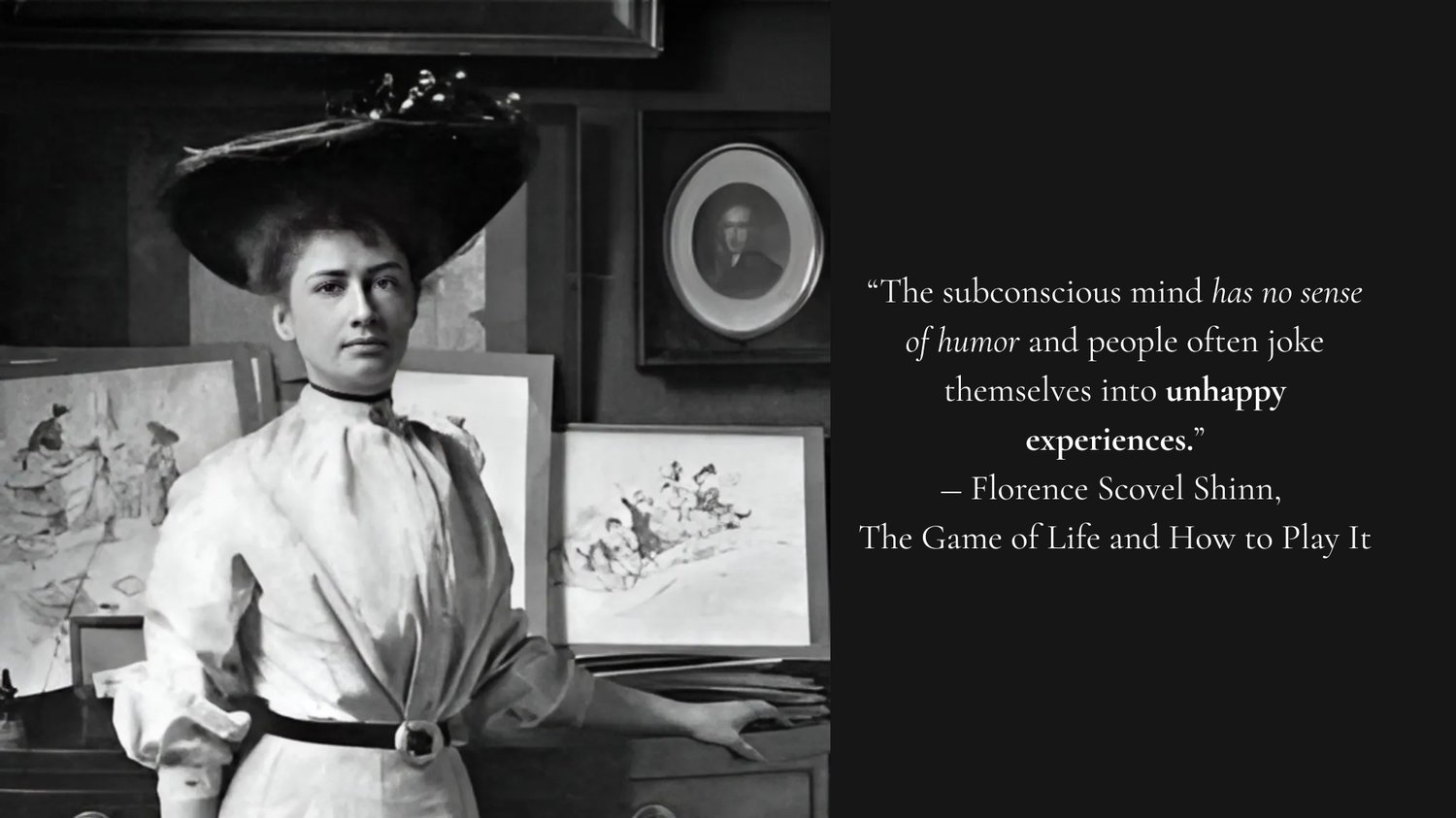
Florence Scovel Shinn, an artist who became a spiritual teacher, wrote The Game of Life and How to Play It. In it, she laid out a simple map of the human mind. She suggested that the mind has three different levels: the conscious mind, the subconscious mind, and the superconscious mind.
I began to see them as three layers, constantly communicating with one another. Each part can either build your life up or quietly hold you back. Once you understand this map, it’s hard to unsee it.
1. The Conscious Mind: The Mind We Live Through Every Day
The conscious mind is the part of you reading this sentence right now. It’s your everyday thinking mind—what Shinn called the “human mind.” It’s the part of us that notices what is happening in the present moment, processes our thoughts, and takes in the world through our five senses.
It sees less money in a bank statement and immediately feels, There isn't enough.
It notices the unanswered message and sees rejection.
It hears the doctor’s diagnosis and feels fear.
It looks at what is happening around us and immediately starts deciding what it means—based on our beliefs, moods, and past experiences.
What it sees isn't always the whole story.
The conscious mind doesn't see the whole truth. It sees the surface.
The situation may be real. But the meaning we attach to it is another layer entirely.
That distinction really stayed with me.
Because so often, I think we mistake what is happening for what it means.
This matters because whatever the conscious mind focuses on with strong feeling gets passed down to the next part: the subconscious.
In other words, your conscious mind is a doorway. What you repeatedly send through that doorway—worry and complaint, or gratitude and hope—becomes the instructions for the rest of your mind.
The conscious mind isn't your enemy, but it's not a fully reliable guide either.
It reports the surface, not necessarily what's underneath.
Learning to question what it tells you—“Is this actually true, or does it just look true right now?”—may be the first real step toward changing your life.
2. The Subconscious Mind: Your Engine, Not Your Judge
She described the subconscious almost like a powerful force—the engine room that doesn't really stop to question the instructions it receives. A raw power with no ability to judge whether an instruction is good or bad for you.
It doesn't argue. It just does what it's told.
It simply carries out the instructions.
Think of it as a control panel running much of your daily life on autopilot: your habits, your automatic reactions, driving home without consciously thinking about the route, flinching at criticism before you even have time to process it, or thoughts like “there's never enough money” and “I always mess this up” running quietly in the background and shaping your choices.
You didn't consciously choose most of that programming. It was repeated so many times that it eventually became automatic.
This is exactly why positive thinking alone often doesn't work.
Saying “I am wealthy” once, without genuinely feeling it, barely makes a dent against years of holding the opposite belief. But an idea you feel deeply, or picture clearly and repeatedly, can begin to take root. And once it does, the subconscious can influence how you perceive situations, make choices, and act in the world—whether that programming helps you or holds you back.
You are always programming your subconscious, whether you mean to or not.
The real question is: who's doing the programming—your fears running on autopilot, or you, on purpose?
3. The Superconscious Mind: The Bigger Picture of Who You Really Are
This is where Shinn's teaching moves from psychology into something closer to spirituality.
The superconscious mind is what she called the God-Mind inside each person — a level that goes beyond ordinary, everyday thinking.
In this space lives what Shinn called the "Divine Design" — a complete plan for your life, your purpose, and your place in the world, one that "no one else can fill." You don't have to invent it or force it into being. It already exists on this higher level. Your job is just to tune in to it, the way a radio tunes into a station that's already broadcasting.
This is why some ideas or chances in life can feel like they come out of nowhere — a sudden moment of clarity, an "aha," a coincidence that feels too perfect to be random. Shinn taught that these moments are the superconscious breaking through, sending down glimpses of that higher plan into your everyday awareness. Often it shows up as an idea that feels "too good to be true" — and that instinct to doubt it usually comes from the conscious mind, which only sees the surface and doubts something the higher mind already knows is real.
The superconscious is your connection to guidance beyond logic. Quiet time, prayer, meditation, or simply calming the noisy conscious mind are what let that guidance come through.
"Most people consider life a battle, but it is not a battle, it is a game." — Florence Scovel Shinn, The Game of Life and How to Play It
Learning to Listen Differently
I've started thinking about the three minds almost like this:
The conscious mind notices.
The subconscious mind remembers and repeats.
The superconscious mind connects us with something greater than our immediate circumstances.
Most people live almost entirely in the loop between the first two: things look a certain way, that creates a feeling, the feeling gets stored in the subconscious, and the subconscious then creates more of the same.
It's a closed loop — which is exactly why life can feel repetitive, like the same problems keep showing up in different forms.
The way out, according to Shinn, is to bring the superconscious into that loop on purpose. Instead of only reacting to what your eyes see, you choose to hold on to the bigger picture — the plan that reflects your true purpose, not just your current situation.
Because once we notice a pattern, we don't have to remain completely unconscious of it.
We can question it.
We can soften it.
We can choose a different thought.
And over time, perhaps a different way of living begins to grow from that.
♡𓂃adetriyani
Click HERE to Start Reading