
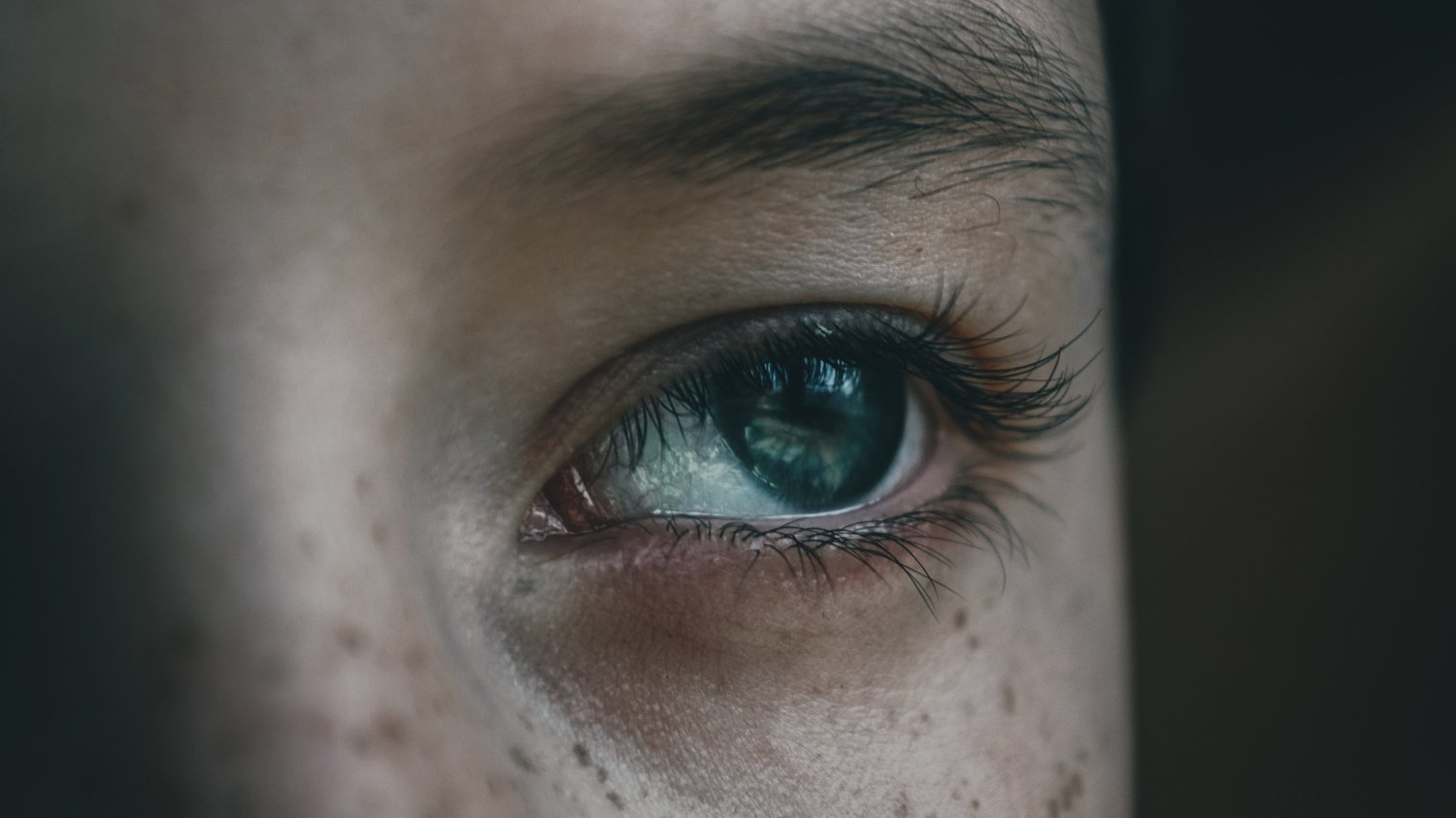
Our eyes don't really "look out" at the world the way we assume. They receive.
Light hits the retina, and the retina's job is to absorb that light as completely as possible so it can be turned into signal, sent down the optic nerve, and handed over to the brain to be built into an image.
That word — absorb — is what caught me.
Not "capture." Not "witness."
Absorb, like a black hole pulling something in and never quite letting it go the same way it came.
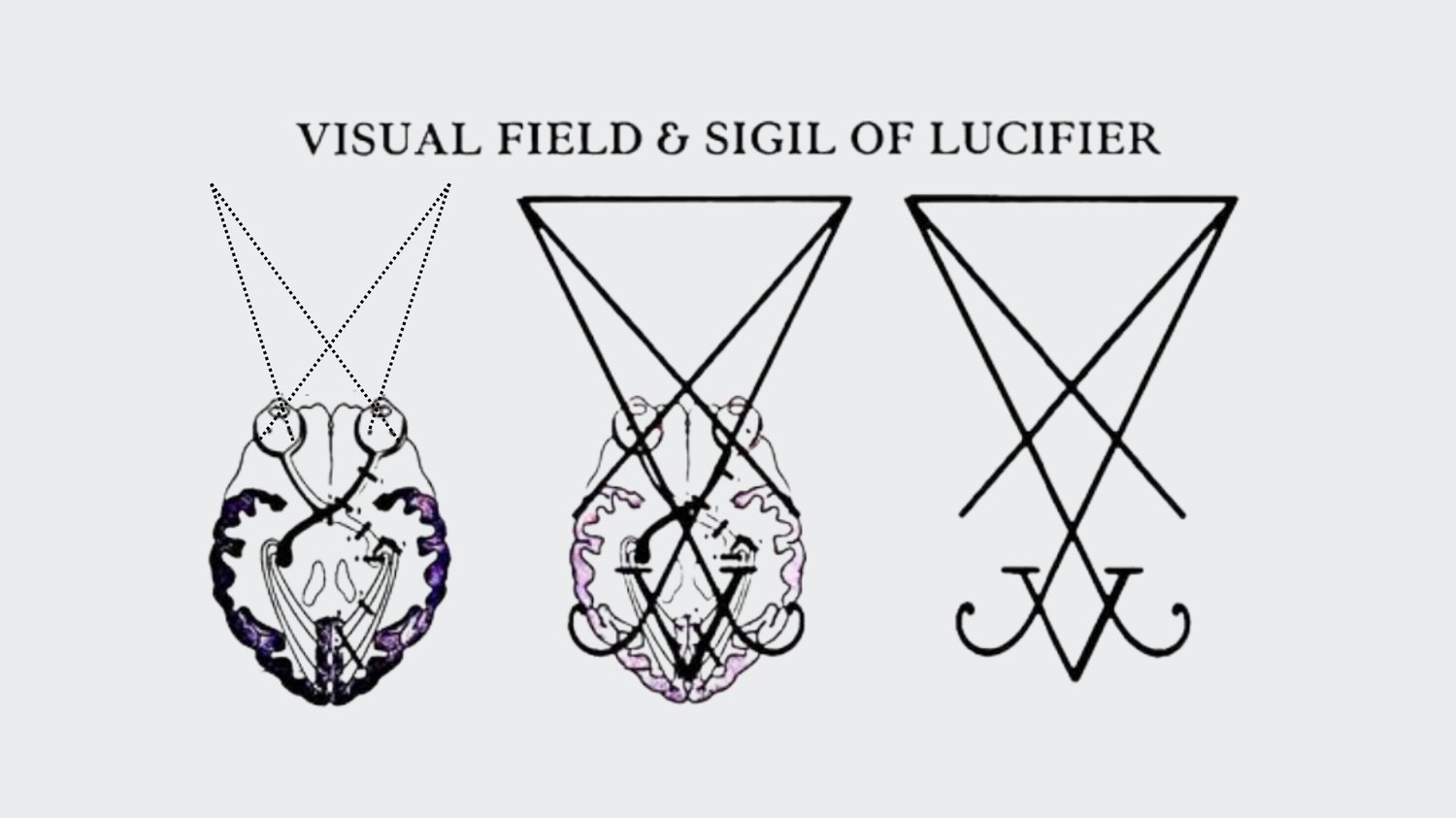
And that's when the article made a comparison I wasn't expecting. It described the retina as functioning almost like a tiny black hole, drawing light inward so it can be processed. Then it connected that to something I'd seen before in passing but never really looked at — the Sigil of Lucifer.
What I Initially Thought
Honestly, my first reaction was skepticism. The name alone puts up a wall for most people, myself included at first. Lucifer. It's a word loaded with centuries of fear and religious warning, and I assumed the article would go somewhere dramatic or fear-based with it.
But then I read the etymology, and I stopped.
Lucifer comes from the Latin lux, meaning light, and ferre, meaning to bring or to bear. Light bearer.
That's it.
That's the literal meaning, stripped of everything that got layered on top of it later by religious tradition. And when I saw the symbol laid next to a diagram of the human visual field — the eyes, the optic nerves crossing at the chiasm, the way the lines converge almost exactly like the geometry of that sigil — something clicked into place that I didn't expect.
What Made Me Look Deeper
It wasn't the symbol itself. It was the realization that whatever meaning humans have projected onto that shape for centuries, the underlying geometry is describing something real and biological. Our eyes are, quite literally, light-bearing organs. They take something invisible and formless — a wave of light — and turn it into the entire visible world we walk around inside of.
I kept coming back to this idea: everything I see is information. Not a mirror of "out there." Information, translated.
The color of the sky, the face of someone I love, the wall of my own room — none of it enters me as a picture. It enters as light. As waves. And somewhere between the retina and the visual cortex at the back of my skull, that light gets rebuilt into something I call "seeing."
Which means the world I experience was never really out there waiting for me.
It was assembled.
In here.
Exploring the Idea
Physicist Amit Goswami said, that consciousness might not be a product of the physical brain but the other way around. That consciousness is the fundamental thing, and matter, the brain, the body, all of it, is what consciousness looks like when it takes shape.
This isn't something science has settled. It's an interpretation, a minority view even among physicists, and I don't think it's fair to present it as proven fact. But the way I started to see it, it doesn't need to be proven for it to be worth sitting with. It's a lens. And once I put it on, a few other things I'd read started to line up in a way that felt less like coincidence and more like a pattern.
There's an experiment in quantum physics — the double slit experiment — where particles behave like waves of pure possibility until the moment someone observes them, at which point they "collapse" into a single, fixed location. Watched, they become definite. Unwatched, they remain a field of potential.
I'm not a physicist, and I don't think it's honest for me to claim I fully understand the mechanics of that experiment or that it proves anything about the nature of the soul. But I can't deny what it made me feel when I first understood the basic shape of it. Because that's what my eyes do to light. That's what my mind does to raw sensation. It takes potential and turns it into a fixed, specific world — my world — the moment I pay attention to it.
The Connection I Started Making
This is where it got personal for me, in a way I wasn't prepared for.
If light only becomes an image once it's processed by my particular brain, then in some very real sense, no two people are seeing "the same world." We're each running our own translation of the raw information reaching us. And if that's true of sight, I started wondering how far that idea actually extends.
What if it's not just light we're translating? What if it's everything — every situation, every relationship, every hard season of life — passing through us and getting shaped by whatever state we're in when it arrives? A wound in someone else's field of vision might just be biology. But the article pointed out something that stayed with me: certain visuals, like blood or injury, don't just get seen, they get felt. They ripple through the nervous system, through the body, as if the information itself carries weight beyond the image.
If that's true even at the level of raw visual data, I don't think it's a stretch to imagine it's true of everything else we take in. The energy of a room. The tone of a conversation. What we choose to look at, day after day, quietly becoming part of what we're made of.
What It Made Me Question
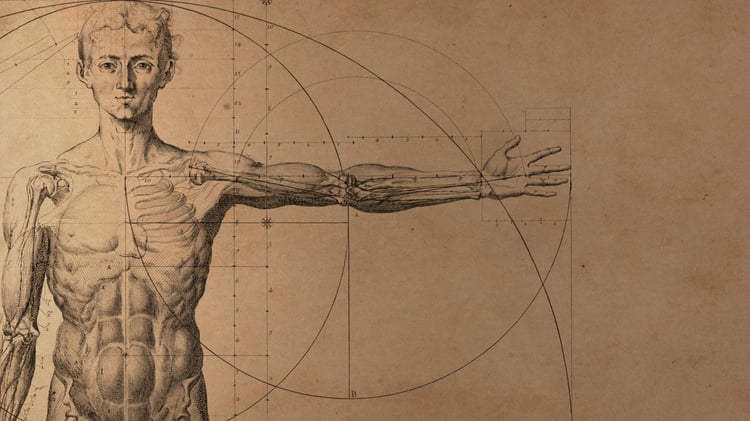
I started questioning something I'd taken for granted my whole life — the assumption that I am a small, separate thing, contained inside my body, looking out at a big indifferent universe that has nothing to do with me.
The World Within in The Book of Wisdom described that worldview as something that took hold a few centuries ago, this idea of humans as isolated physical beings inside a mechanical universe governed by laws that don't know or care we exist. And when I read that, I felt something I can only describe as recognition. That is the story I grew up inside of, even if no one ever said it out loud. Small self. Big empty universe. Watch your step.
But if the world I see is being built inside me, moment to moment, out of light my own body is absorbing and interpreting — then "separate" isn't quite the right word anymore. I'm not just standing apart from reality, watching it happen. I'm part of how it happens. My attention, my state, my openness or fear or love in any given moment, is doing something to the raw material of what I experience.
I don't know if I can prove that with an equation. But I don't think I need to, to notice it's true in smaller ways I can actually observe. The days I walk out anxious, the world looks sharper-edged and more hostile. The days I walk out steady, the exact same street looks softer. Same light. Same eyes. Different me.
How I See It Now
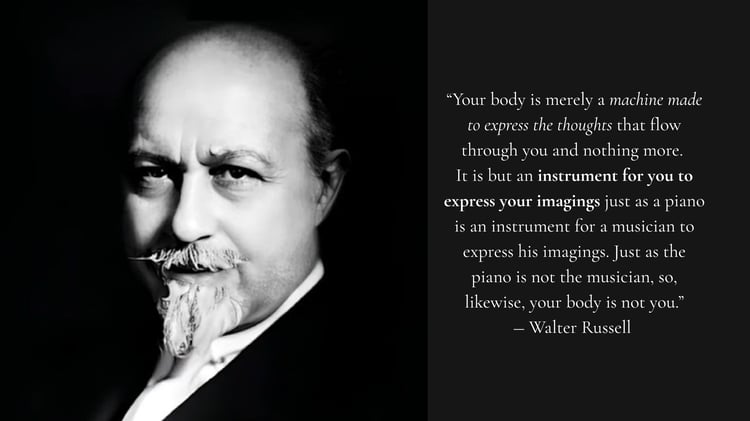
What stays with me now is this idea of the self as something less like a fixed camera recording an external movie, and more like an instrument the universe is using to know itself through. I don't say that to sound mystical for its own sake. I say it because it's the closest language I have for what I actually felt reading this.
If consciousness really is the ground everything else stands on, then my body isn't a cage keeping "me" separate from the world. It's more like a very intricate pair of goggles, letting infinite possibility narrow itself down into a single, specific, textured experience — this life, this face in the mirror, this particular set of griefs and joys — so that something vast can have the very small, very intimate experience of being someone, for a while.
And that reframes everything I do with my attention. What I choose to look at. What I let myself absorb, and what I let myself put back out.
Thought
What strikes me most now, weeks after first reading that line about the retina, is how something so small — a fact about black pigment and how it absorbs light — ended up cracking open a much bigger question I'd been circling for years without knowing it.
Maybe I was never just looking at the world.
Maybe I was building it, one photon at a time, out of whatever I was ready to see.
I don't know that I have all the answers. I'm not sure anyone does. But I know I can't look at a sunset, or a stranger's face, or even my own eyes in the mirror, quite the same way again. Something in me has quietly shifted from what am I seeing to what am I becoming, by choosing to see it.
And once I saw it that way, I couldn't unsee it.
♡𓂃adetriyani
Click HERE to Start Reading