
What is Unstructured Brainstorming?
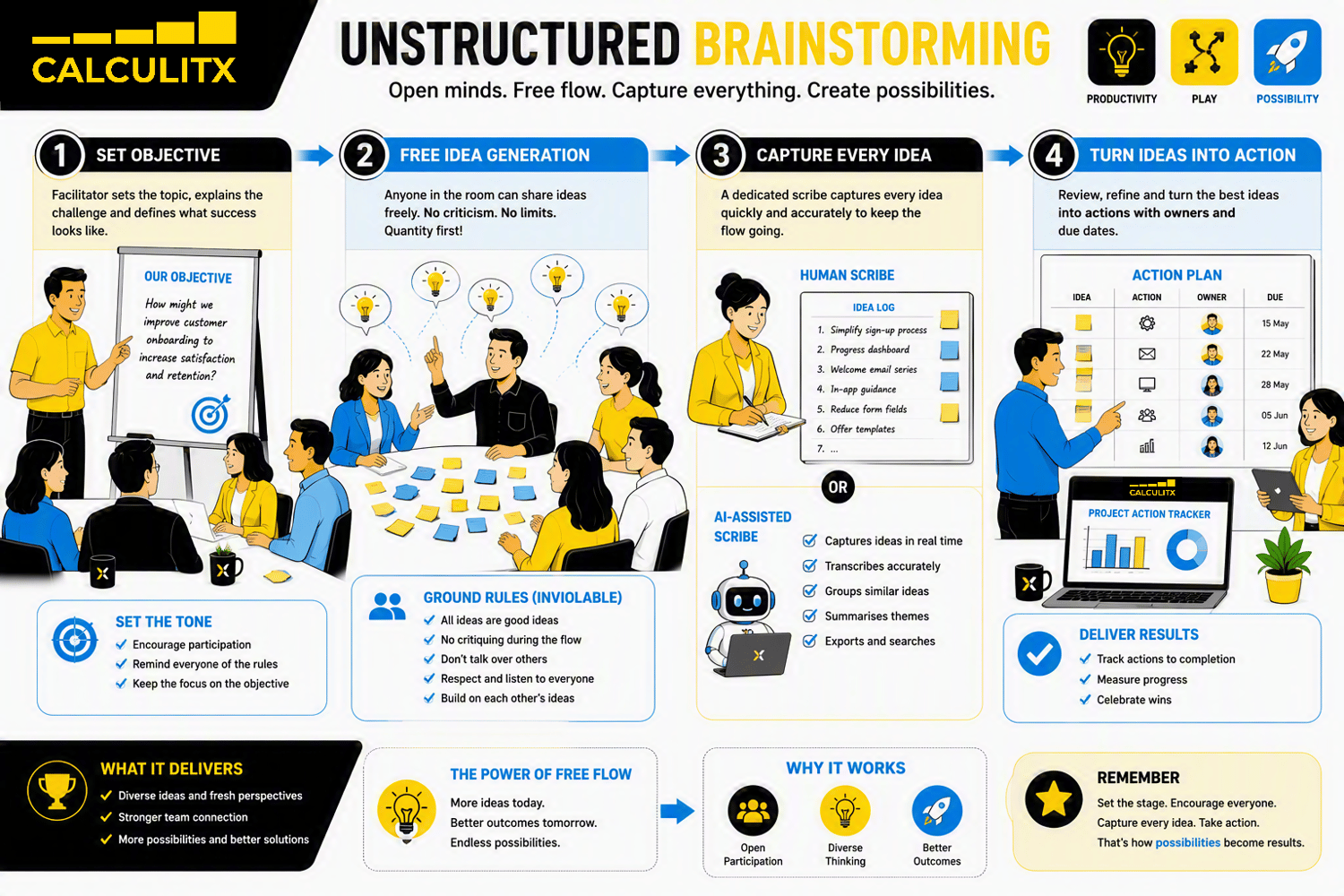
Unstructured Brainstorming is what most of us understand when the word "brainstorming" is mentioned. The facilitator starts by describing the topic. What problem is to be solved? What issue is to be explored? What concerns are to be identified? This sets the objective. Anyone in the room can then offer suggestions, without prompting. Attendees offer their thoughts as they come to mind.
Role of the Scribe and Facilitator
This often results in many ideas in rapid succession. It is important to track each idea quickly so the "flow" of ideas continues. This is best achieved by having a scribe present. Someone who listens well and can transcribe the idea onto paper, or an electronic equivalent, with speed and accuracy.
AI is a fantastic tool to scribe brainstorming sessions if you have the technology to make it work. Modern AI tools can dramatically improve brainstorming outcomes by capturing every idea in real time, grouping similar concepts, producing summaries and generating action lists.
I cannot stress enough that the speed of the scribe can stifle new ideas and interrupt the "flow" of the session. So if you're expecting numerous ideas then the scribe and the facilitator should be different people. This allows the facilitator the freedom to guide the discussion and offer prompts to spur new thoughts whilst the scribe solely focusses on recording the outcomes. The quality of an unstructured brainstorming session is often determined more by the facilitator than the participants.
What it Delivers
30 years ago, this was the only brainstorming tool I knew. It was intuitive and spurred creative ideas. We used it in a research and development environment where we were trying to identify potential solutions to technical problems. It delivered a list of ideas which we built into a plan and subsequently executed over coming months.
A secondary benefit I noticed was that it brought the team together. It helped us understand each other better. This camaraderie continued well after the workshop was complete.
Avoid When…
This technique is hampered by "loud" personalities or senior leaders who like to dominate discussions. People who are quieter or introverted can miss an opportunity to contribute awesome ideas. A skilled facilitator is required to manage people who "hog" the conversation without stifling the entire workshop. One way to do this is to frame the discussion prior to brainstorming by pointing out that in a room of 10 capable people each of us should only expect to have the best answer 10% of the time, so let's give everyone a chance to participate.
This Technique is Best Used When…
- The team already knows and trusts each other,
- The group is relatively small (say 5 or 6 people),
- Fast idea generation is more important than balanced participation, AND
- An experienced facilitator is on-hand (with a scribe for transcription).
My Verdict
Even with a skilled facilitator, "loud" personalities find it difficult to "share the airtime". Thus, I rarely use this method any more. There are other techniques, like structured brainstorming or brain-boarding, which deliver more by fostering all ideas from both the quiet achievers and your "loudest" personalities.
I'm keen for you to share your thoughts on unstructured brainstorming. Did it work for you? Share your thoughts below so others can learn…
…and once you have a list of actions, the CalculitX Project Action Tracker can track each action through to completion and report progress along the journey. Check it out here.
#Brainstorming, #CreativeThinking, #Ideation, #Creativity, #Innovation, #ProblemSolving, #DesignThinking, #IdeaGeneration, #Productivity, #Learning, #UnstructuredBrainstorming, #AIScribe.
Comments ()