

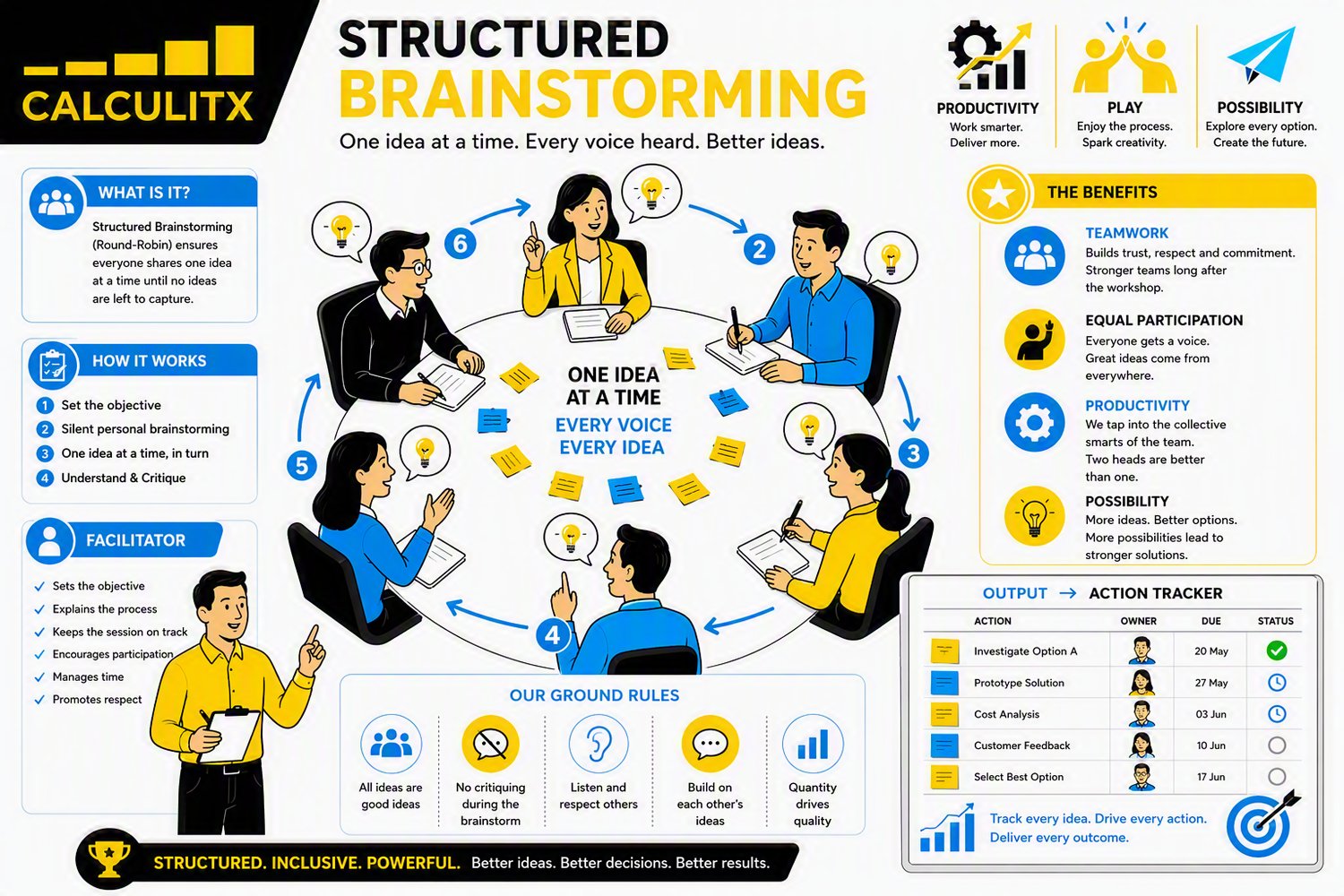
What is Structured Brainstorming?
Structured Brainstorming, (a.k.a. round-robin brainstorming) is where each attendee shares one idea at a time until no ideas are left to capture. The way I run these sessions is as follows:
- Set the objective: what is the topic or problem we're trying to solve.
- Silent personal brainstorming: each person is given a pen and paper and 5 minutes to write down their ideas.
- Pause and instructions: The facilitator stops the group after 5 minutes and informs them that:
- We will be going around the room, one person at a time, to capture one idea at a time. Reassure the group that this time won't stop until all ideas are captured. Ask people to pass once they run out of ideas.
- Don't stop writing: point out that it's OK to keep writing down new ideas. Sometimes someone else's idea will trigger a new idea for you.
- Understand and Critique: as described in "Brainstorming: Setting up for success"
Role of the Scribe and Facilitator
A Facilitator is critical, someone who can direct the workshop, keep track of time and throw in ideas if silent personal brainstorming stalls. The pace of these sessions is slower than Unstructured Brainstorming. It sacrifices speed in favour of completeness and inclusiveness. So it is possible to have a single person who acts as both scribe and facilitator…with the proviso that the facilitator can keep pace with the ideas being presented. It is very important to value the time of the attendees so if you're not able to capture ideas quickly, assign a separate scribe.
What it Delivers
Structured Brainstorming transforms participation from optional to expected. I didn't use unstructured brainstorming again once I learned about Structured Brainstorming. It solves the "loud" personalities issue whilst delivering a strong list of ideas. It also retains engagement of the whole team, because everyone is expected to participate. This builds teamwork which transcends the workshop and continues into the days and weeks ahead.
Avoid When…
This approach takes a lot longer to develop "the list"…BUT "the list" is likely to be broader. I'm prepared to trade off an extra hour in the interests of having a better list with a more engaged team.
This Technique is Best Used When…
- The team is still getting know each other,
- The group is relatively small (say 5 or 6 people),
- Fast idea generation is less important than balanced participation,
- The workshop contains junior and senior participants, AND
- An experienced facilitator is on-hand.
My Verdict
Structured Brainstorming remains one of the most effective techniques for obtaining balanced participation. However, when speed and depth are both required, I find Brain-Boarding delivers even stronger outcomes. For me, Brain-Boarding beats both Unstructured and Structured Brainstorming hands-down…so hang around, because we will get there.
I'm keen for you to share your thoughts on Structured (Round-Robin) Brainstorming. Did it work for you? Share your thoughts below so others can learn…
…and once you have a list of actions, the CalculitX Project Action Tracker can track each action through to completion and report progress along the journey. Check it out here.
#Brainstorming, #CreativeThinking, #Ideation, #Creativity, #Innovation, #ProblemSolving, #DesignThinking, #IdeaGeneration, #Productivity, #Learning, #StructuredBrainstorming, #RoundRobinBrainstorming
Comments ()