

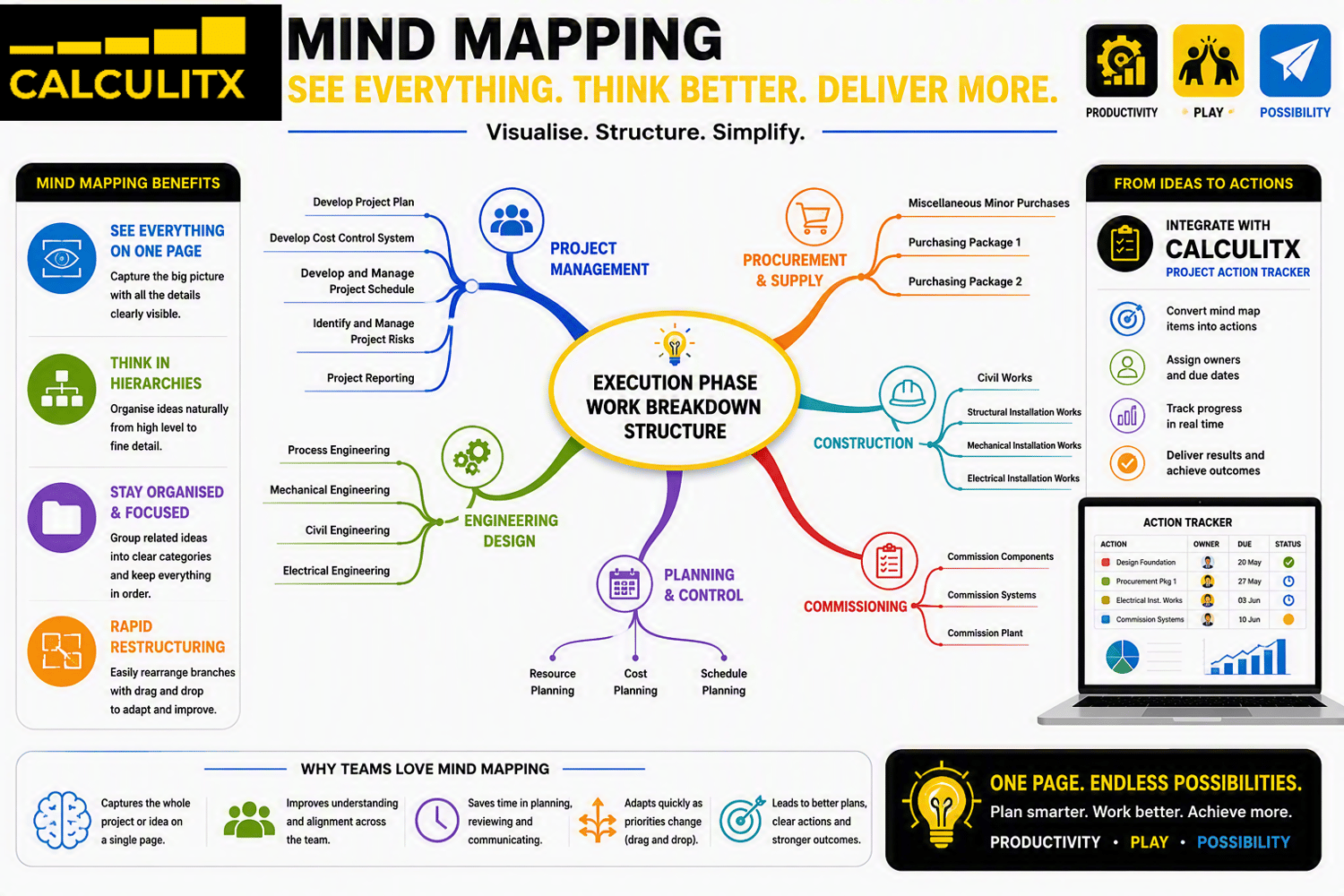
Mind Mapping converts complexity into structure. It allows large amounts of information to be captured, organised and understood on a single page.
What is Mind Mapping?
In Mind Mapping the brainstorming topic is placed centrally. Ideas then branch out from the central topic. Ideas can be organised into groups or categories. The figure below is a simple example of an engineering project work breakdown structure. I use this on all complex projects to describe the project's scope of work.
Role of the Scribe and Facilitator
As a Project Manager I have a tendency to be a control freak so I prefer to facilitate and scribe Mind Mapping Workshops myself. However, if you're using this in conjunction with an unstructured brainstorming approach then having a separate scribe and facilitator is very beneficial. If you choose to both facilitate and scribe a workshop yourself then you must be:
- A proficient typist
- Able to manage multiple tasks simultaneously
Why do I love Mind Mapping?
Because it:
- Allows me to see an entire project or speech on a single page
- Organises and structures my thoughts efficiently
- Is extraordinarily quick to rearrange branches from one category to another (drag and drop)
- Identifies gaps in thinking. Missing branches become obvious.
- Is the way my mind thinks, in hierarchies and groups
Where do I use Mind Mapping?
I first used Mind Mapping (it was called Association Mapping back then) in senior school to plan essays. At the start of every exam I spent 5 minutes creating a mind map per essay (by hand on paper). As I wrote my first essay I added to the mind maps for subsequent essays as ideas came to me. By the time I wrote my second and third essays they were completely planned out and structured.
Then I started using Mind Mapping to lay out speeches. Again, most of these were written on paper. I collected my thoughts on a mind map, then often re-wrote the mind map in the order of the speech. I've delivered many speeches directly from a mind map. This gives great flexibility when an audience member interjects. You can pivot to a separate branch to answer their question and then jump right back to where you left off. It's seamless and appears natural in front of a live audience. It keeps you in control.
When I moved into Project Management I realised that projects were built on a Work Breakdown Structure (WBS). There is no better way (i.m.o.) to brainstorm a project scope than in a Mind Map. If you use software to create the WBS (like Mind Manager (https://www.mindmanager.com/) or FreeMind (FreeMind Download)) then it can be exported to Word as a bulleted list for inclusion in the Project Execution Plan or into Excel to generate a cost estimate. I've used this approach for more than 2 decades in a workshop environment with my team. It's a winner!
Avoid When…
The only caveat with Mind Mapping is that it typically captures only one idea at a time. For the use-cases noted above, it is extraordinarily powerful. However, where you have a topic which can be contributed by multiple people simultaneously then Brain Boarding is faster (though it does require someone to transcribe the notes into something usable). Mind Mapping excels at organising knowledge and structure. Brain-Boarding excels at generating large volumes of ideas rapidly.
This Technique is Best Used When…
- You want a structured/hierarchical output from your brainstorming session,
- The group is relatively small (say less than 10 people),
- You're trying to extract known information from people's minds rather than generate innovative new ideas,
- You need to communicate complex information quickly to stakeholders,
- You need an entire subject area on a single page.
My Verdict
I love Mind Mapping and use it regularly for both personal and group brainstorming: for project work breakdown structures, for presentations, for organisation structures, for speeches, for commissioning breakdown structures, for organising brainstorming lists into structured project plans, and so on. If the goal is structure, organisation and clarity, you can't beat it. Give it a shot!
I'm keen for you to share your thoughts on Mind Mapping. Did it work for you? What software did you use (or did you use paper and pen)? Share your thoughts below so others can learn…
…and once you have a list of actions, the CalculitX Project Action Tracker can track each action through to completion and report progress along the journey. Check it out here.
#Brainstorming, #CreativeThinking, #Ideation, #Creativity, #Innovation, #ProblemSolving, #DesignThinking, #IdeaGeneration, #Productivity, #Learning, #MindMapping, #AssociationMapping, #AMapping
Comments ()