

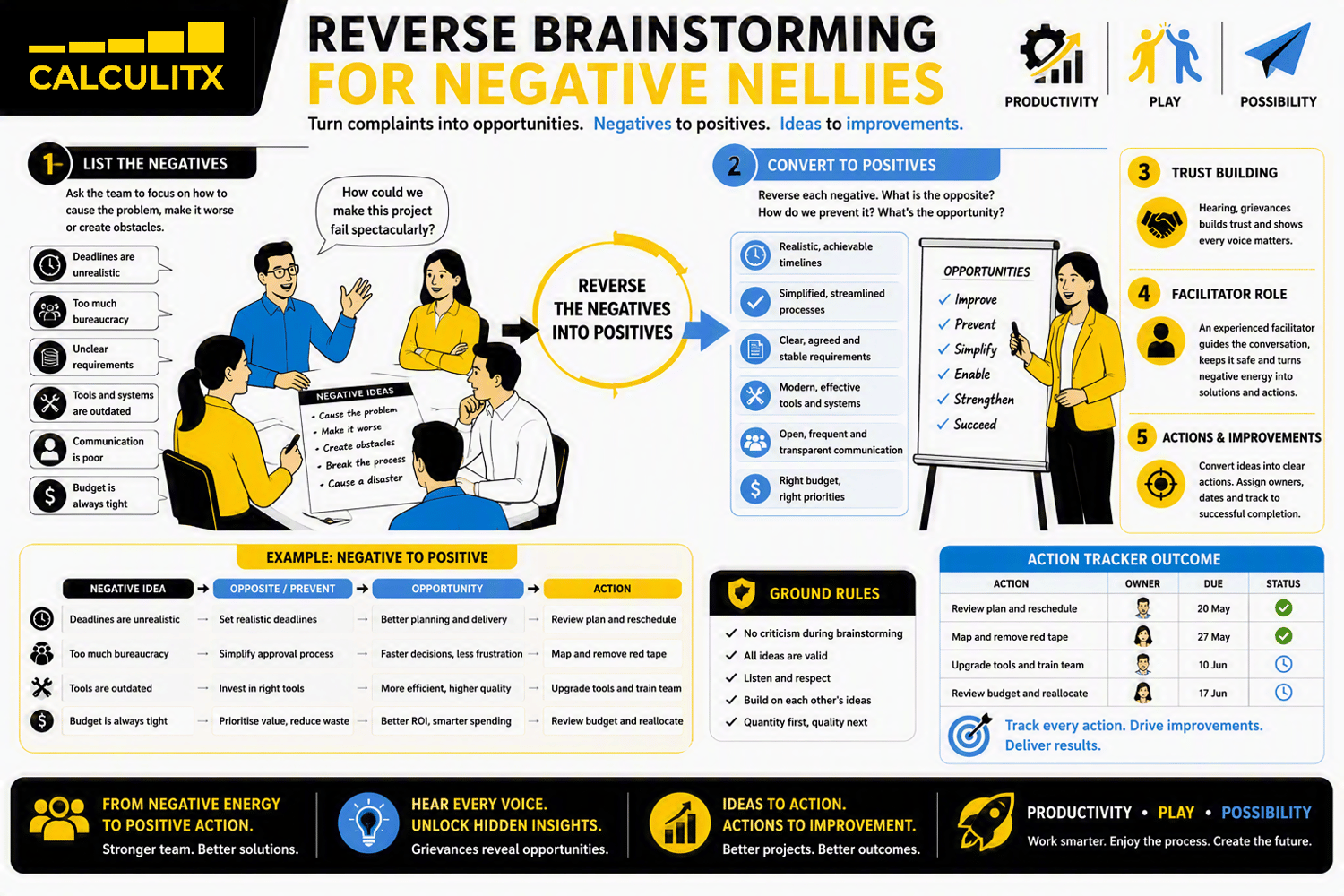
What is Reverse Brainstorming?
In Reverse Brainstorming you ask attendees to focus on how to cause the problem at hand. Then the workshop focuses on how to reverse the ideas (causes) into solutions.
What are the questions to ask?
Try the following:
- How could we cause this problem to occur?
- How could we make the situation worse?
- How could we make the product or production process fail catastrophically?
- How could we cause a disaster?
- You get the idea!
For Example
Question: How could we make this project fail?
Answers
Solutions
Don't communicate
→
Create a communication plan and meet with stakeholders
Ignore risks
→
Maintain a risk register
Under-resource the team
→
Identify the resources required and onboard them
Now you have an actionable list of solutions to move forward with.
Is this a brainstorming method?
Not really. In most cases you would use this approach to develop the "topic" and then use another technique, like structured brainstorming or brain boarding, to run the workshop.
The Workshop Agenda
- Describe the context/objectives of the workshop.
- Brainstorming Session 1: Ask "How could we cause this problem to occur?", or any of the other questions above.
- Brainstorming Session 2: For each idea in session 1 ask:
- How can we turn this idea into a solution?
- What is the opposite of this idea?
- How could we prevent this idea from occurring?
- And so on.
- Understand and Critique each idea as described in "Blog 2: Brainstorming: Setting up for success"
Human Psychology
Reverse Brainstorming works because many people find it easier to identify problems than create solutions. It leverages critique as a pathway to innovation. Throughout my career I've noticed that people are often stronger at critique than creation and this technique capitalises on that human strength to develop "the list".
Avoid When…
I very rarely use this technique. My concern is that it causes people to use "convergent thinking" which can close them off to innovative ideas. In brainstorming sessions I prefer for people to use "divergent thinking" because I'm looking for expansive thoughts that change our paradigm rather than closed thoughts which focus us on what we may already know…but that's just my opinion.
This Technique is Best Used When…
- Your team has been telling you something is just not possible,
- You're trying to build trust by hearing people's grievances,
- The team has become stuck and traditional brainstorming is generating few ideas,
- An experienced facilitator is on-hand. They need to be able to turn people's minds to solutions once the negative ideas are uncovered.
My Verdict
I'm not a big fan of Reverse Brainstorming, but it can be extremely valuable when a team is stuck in negativity or convinced something cannot be achieved. Used well, it transforms criticism into actionable improvement.
I'm keen for you to share your thoughts on Reverse Brainstorming. Did it work for you? Did you use it in conjunction with another brainstorming technique? Share your thoughts below so others can learn…
…and once you have a list of actions, the CalculitX Project Action Tracker can track each action through to completion and report progress along the journey. Check it out here.
#Brainstorming, #CreativeThinking, #Ideation, #Creativity, #Innovation, #ProblemSolving, #DesignThinking, #IdeaGeneration, #Productivity, #Learning, #ReverseBrainstorming
Comments ()