Your Cart
Loading

Ecological Relationship — Remembering Belonging

Human beings do not stand outside the living world.

We are participants in ecosystems, seasons, watersheds, food webs, migrations, weather, decay, growth, and countless relationships we may never fully see.


Ecological Relationship begins by learning to notice those relationships.


Here, natural history and spiritual practice meet through attention. We learn the names and lives of the beings around us, observe habitats and seasonal change, understand ecological relationships, and consider what responsible participation might ask of us.


Nature is not scenery placed around human experience, nor does another being need to become a symbol for us in order for its life to be meaningful.


Knowledge does not diminish wonder. It gives wonder somewhere to belong.


Belonging is not something we earn from the living world. It is something we learn to remember and live responsibly.


Begin Here

You do not need to begin by knowing the names of everything around you.

Begin by noticing where you already are.

What grows outside your door? What birds return each morning? What changes when the season turns? Where does rain collect? Which beings share your neighborhood, garden, street, park, shoreline, or watershed? What happens there when no human being is paying attention?

Observation changes relationship.

The more carefully we notice another being, the more difficult it becomes to reduce its life to scenery, resource, correspondence, or symbol.

You do not need to understand everything you observe. Attention comes before interpretation.

The first practice is simply to notice what is here—and return often enough to notice what changes.

The World We Belong To — A Free Foundation Gift

Seven chapters explore ecology in ordinary places: species and their environments, observation and evidence, ecological relationships, responsibility, and seasonal change. This free 22-page PDF includes field-practice worksheets, journal lines, a stewardship decision framework, a 30-day inquiry, and Sources & Influences. A standalone introduction to Pillar IV — Ecological Relationship, it also accompanies Remembering Belonging, the integrated course book.

Begin the Path — Ecological Relationship

Make belonging a lived practice.


Remembering Belonging is the complete guided course book for Pillar Four. Across ten lessons, an Opening Threshold, and a Closing Threshold, it develops ecological relationship through observation, reciprocity, seasonal attention, responsibility, and return.


Begin where you are. Notice what holds your life. Return with care.

What the Ecological Relationship Path Explores

The Living World Library

Learn the beings with whom we share the world through field guides rooted in identification, natural history, ecology, season, habitat, relationship, and responsible observation.

Seasonal & Lunar Observation

Follow changes in season, weather, light, plant and animal activity, and lunar cycles through sustained observation rather than treating the calendar as something separate from the world outside.

Field Practice & Nature Journaling

Take practice into the places where you actually live. Observe, record, sketch, photograph, identify, question, revisit, and allow repeated encounters to build familiarity over time.

Ecological Living & Reciprocity

Explore how belonging changes ordinary choices around consumption, food, waste, habitat, gardening, conservation, stewardship, and participation in the communities—human and more-than-human—that sustain us.

Place, Habitat & Relationship

Learn to recognize not only individual species but the relationships around them: watersheds, forests, shorelines, wetlands, cities, soils, food webs, migration routes, disturbance, succession, and seasonal change.

Folklore, Symbolism & the Sacred Ordinary

Explore cultural stories, folklore, symbolism, and spiritual relationships with the living world without allowing human meaning to replace the lives of the beings themselves.

Practice With This Pillar

The Living Year: Washington Edition and The Living Year: Wherever You Are support seasonal attention close to home. The Living Earth offers a place for field observations and nature journaling; find it through the Living World Library below.


Ecological relationship becomes real through repeated encounter.

Field journals, observation pages, seasonal records, identification guides, phenology tracking, nature photography, sketching, mapping, lunar observation, and other forms of attentive recording give us ways to return to the same beings and places over time.

A field guide can help us learn a name. A journal can help us notice change. A seasonal practice can help us recognize patterns. None of these replaces the encounter itself.

The purpose of these tools is not to collect nature as information. It is to help attention become familiarity, familiarity become relationship, and relationship become responsible participation.

Take the practice outside. Let the living world remain larger than the page.

Explore the Library

The Living World Library is a growing collection devoted to learning the beings, habitats, relationships, and seasonal patterns of the places we inhabit.

Our Washington Living World Library begins close to home, with field guides and reference works devoted to the plants, animals, fungi, waterways, habitats, and seasonal life of Washington. Regional knowledge matters because belonging becomes particular. We learn relationship by learning the actual place beneath our feet.

As the library grows, Beyond Washington will allow us to explore beings and ecological relationships outside our home region while keeping the same commitment to careful observation, natural history, ecological context, and responsible relationship.

These books may also include folklore, symbolism, cultural history, and contemplative practice where appropriate—but these layers come after we have made an effort to know the being itself.

Know the being before assigning meaning to it.

Explore the Library — Free Beginnings

Begin without a purchase. Ecological Living in the Heart of a City brings attention into everyday places. The Moon & Earth Observation Pages support sustained noticing. Under the Celtic Trees invites seasonal study while keeping observation and cultural interpretation distinct. These free resources offer several ways to begin where you are.

Continue More Deeply

Become familiar with a particular place. The Washington Living World Library gathers field grimoires on birds, trees, flowers, fungi, berries, mosses, liverworts, and hornworts, alongside the Pacific NW and Washington Bryophyte collections. For life beyond Washington, the Living World Library includes wider natural-history and journaling resources. Let reliable identification and repeated observation deepen relationship.

Where the Paths Meet

Ecological Relationship does not exist apart from the rest of life.

As we become more attentive to the living world, we may find ourselves moving naturally toward Healing, Empowerment, Mysticism, or Creative Practice.

Healing may change how we understand separation and relationship. Empowerment may ask how our choices affect the communities of life around us. Mysticism may deepen our experience of wonder, presence, and the sacred ordinary. Creative Practice may give form to what sustained observation has taught us through writing, art, photography, journaling, ritual, or other acts of participation.

We do not need to turn nature into a lesson about ourselves in order for relationship with the living world to change us.

Follow what becomes alive next.

The Five Paths are a spiral, not a ladder.

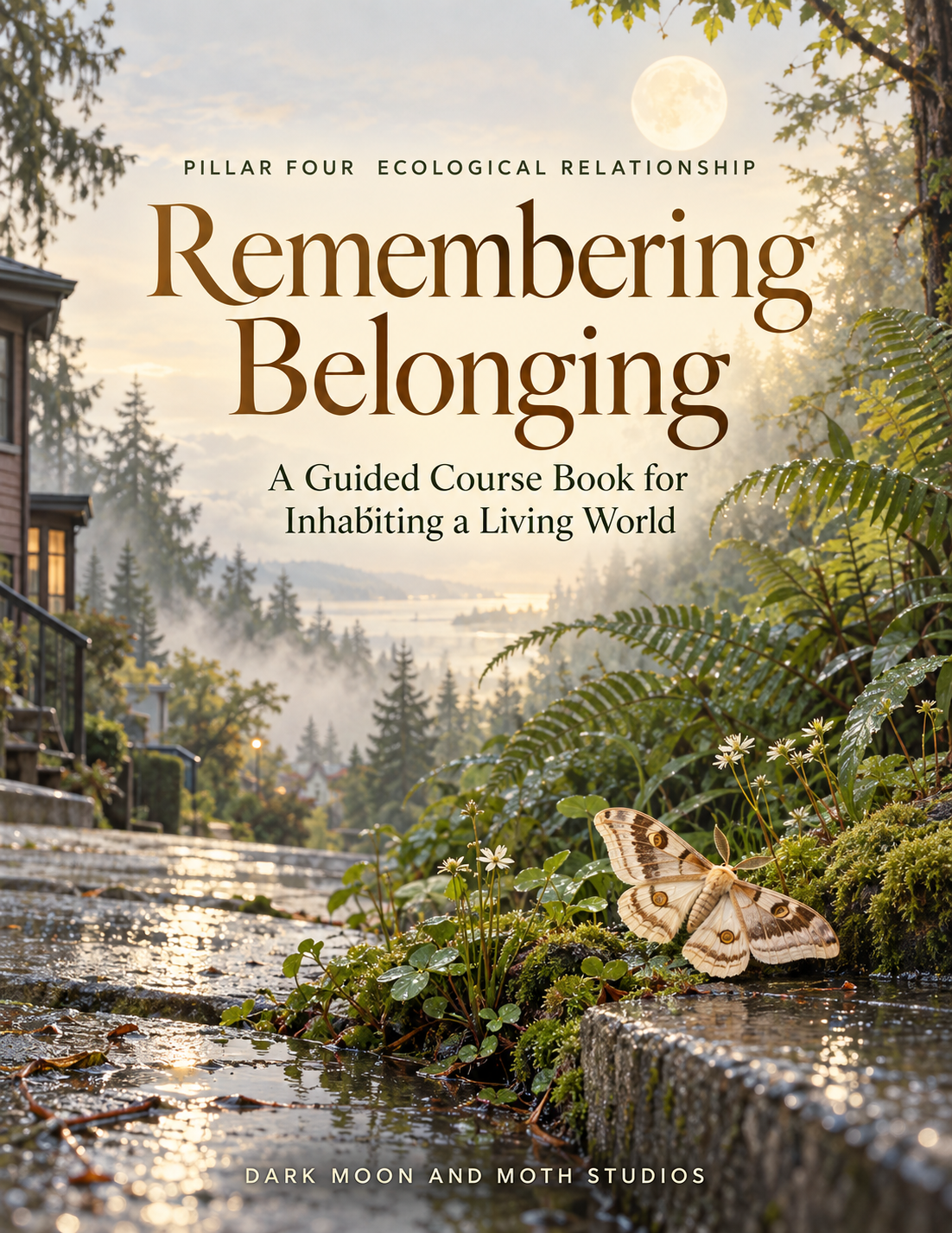
Remembering Belonging: A Guided Course Book for Inhabiting a Living World
On Sale
$18.00
$18.00
Added to cart

Remembering Belonging is an integrated guided course book for developing ecological relationship through observation, reciprocity, seasonal attention, responsibility, and return. Across ten lessons, an Opening Threshold, and a Closing Threshold, the path begins with the truth that the living world is not elsewhere. It is already present within ordinary life, built environments, weather, food, water, materials, labor, and the more-than-human lives around us.


This is not a course in performing ecological purity or claiming ownership of place. It is a spacious, self-paced practice for noticing relationships more clearly, learning from reliable sources, respecting limits, responding proportionately, and returning to see what changes.


WHAT THE BOOK INCLUDES


• 199 pages of teaching, guided experience, practice, reflection, integration, observation, and return

• Ten complete lessons that move from attention and place relationship into reciprocity, seasonal change, repair, collective care, and a sustainable practice of belonging

• Opening and Closing Thresholds that orient the entire path

• The recurring rhythm Learn — Experience — Practice — Reflect — Integrate — Live — Observe — Return

• Integrated writing space, observation records, maps, seasonal practices, and completion reflections

• Practical guidance for safety, access, wildlife boundaries, cultural respect, ecological uncertainty, and collective responsibility

• A thirty-day living practice for carrying belonging into ordinary life


This book may be followed from beginning to end or revisited by need after a first passage. One lesson may take a week, several weeks, a season, or longer. Pausing does not create catch-up debt.


WHO THIS IS FOR


This path is for people who want to inhabit the living world more attentively and responsibly. It welcomes people practicing from cities, apartments, windows, sidewalks, gardens, workplaces, transit routes, and accessible outdoor places as fully as those with wilderness access.


WHAT THIS IS NOT


This is not professional ecological, wildlife, medical, mental health, legal, herbal, foraging, or land-management advice. It does not provide certification or permission to enter restricted places, handle wildlife, harvest natural materials, or reproduce Indigenous ceremonies. No spiritual belief, scientific expertise, expensive equipment, private land, or uninterrupted completion is required.


The living world is not elsewhere. Begin where you are. Notice what holds your life. Return with care.
You will get the following files:
  • PDF (1MB)
  • PDF (16MB)

Coming to the Library

Dragonflies & Damselflies field volume — In Development; the next planned field volume.

Butterflies & Moths — In Development.

Ferns & Horsetails, Shorelife & Tide Pools, Freshwater Life, and Grasses, Sedges & Rushes — Planned for the Library.

These field volumes are not yet available, and no release dates are promised. The Dragonfly Field Notes planner and Dragonflies of the World calendar are already available in Practice Tools.

Stay Connected

Studio Letters carries new writing, field practice invitations, and news from the library. Return to Begin Here or The Practice Library through the navigation above whenever you want to choose another doorway.