
This article is for content creators, businesses, and professionals who care about the quality and impact of their videos—and want to understand why human-translated subtitles are still far superior to AI-generated ones.
As a content creator, you want to get great content out as fast and efficiently as possible—so it’s natural to look for shortcuts wherever you can. Perhaps you’re already automating thumbnails, using AI to clean audio, or relying on templates to speed up editing. Those shortcuts often work beautifully. But subtitles are the one place where cutting corners eventually catches up with you. Automated foreign subtitles might seem “good enough” at first glance, yet viewers notice if the timing feels off, jokes fall flat, idioms sound robotic, or the subtitles simply don’t match what’s being said. And modern viewers’ attention is fragile: once your subtitles become distracting or confusing, people stop watching—not because of your content, but because of how it was presented. That’s why investing in human-made subtitles is not an expense—it’s protection for your content, your brand, and your audience’s trust.
Don’t get me wrong, I do believe AI is great, and can be really helpful in many situations. So, what’s different with subtitles? Do you still need a human translator or a subtitler?
Let me show you something.
Reading the automated subtitles takes 81.5% more time than the professional subtitles. [source]
56% of viewers would prefer to wait a couple of days and view your content with human-made subtitles instead of watching it immediately with automated subtitles. [source]

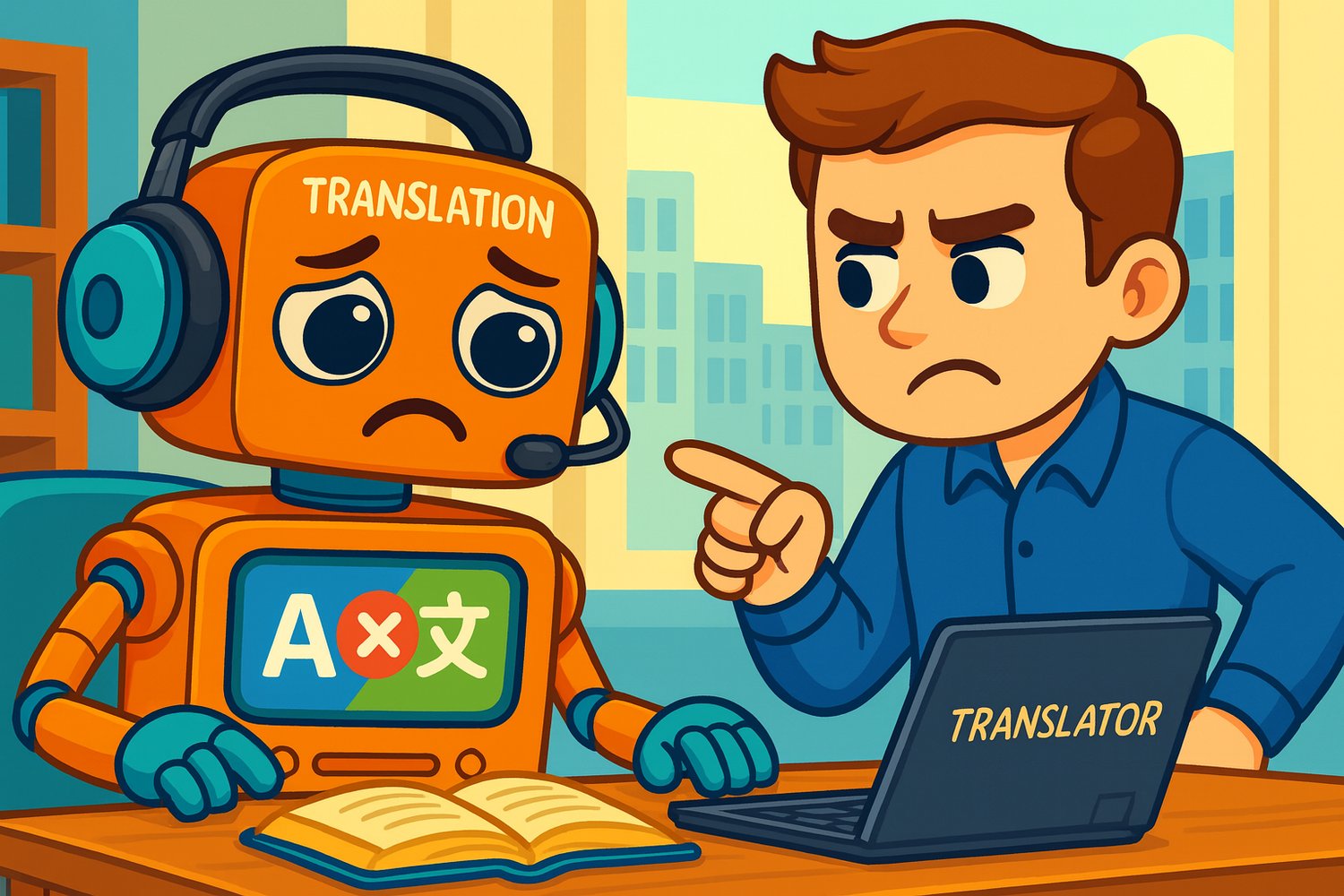
These are your viewers watching your AI-generated subtitles.
See, even if you can tell that the picture above is AI-generated, you still clearly get what I mean. With AI-translated subtitles, however, viewers not only can easily tell they are automated—often they can’t clearly comprehend them.
I’ve researched this topic, and here is why do people prefer human translation:
1. Timing and reading speed
Human subtitlers follow professional timing conventions and adapt them for viewer comfort. AI often syncs text to speech mechanically, leading to subtitles that are too long and flash too quickly, forcing them to pause and go back constantly.
2. Limited understanding of on-screen context
Humans adapt translations based on visual cues — signs, gestures, or context clues. AI doesn’t “see” the scene; it just processes the audio or script. In gendered languages, like Spanish or Polish, speakers are randomly assigned a gender, confusing viewers.
3. Inconsistency
AI struggles to maintain consistent register (e.g., formal vs. casual) across dialogue. Humans intuitively maintain tone continuity.
4. Formatting and segmentation errors
Professional subtitlers know how to break lines naturally and visually balance text on screen. AI can split sentences mid-phrase or at unnatural points, disrupting readability and flow.
5. Lack of cultural and contextual understanding
AI doesn’t truly understand jokes, irony, or subtext. It can miss cultural nuances that a human subtitler naturally interprets — for instance, a sarcastic tone, double meaning, or pop culture reference.
6. Poor handling of idioms and wordplay
Idiomatic expressions (“break a leg,” “spill the beans”) or puns require interpretation, not literal translation. AI often translates them word-for-word, producing confusing or even nonsensical subtitles.
7. Ethical and sensitivity problems
AI can unintentionally produce biased, offensive, or insensitive wording — especially in emotionally charged or politically sensitive content — where a human would exercise judgment.
8. Lack of accountability and quality assurance
Humans review, self-correct, and refine their work. AI doesn’t “know” when it’s wrong, and without human post-editing, even minor errors can damage credibility or viewer experience.
Remember, AI can transcribe—but only a human can translate for real people!
Maybe speakers of some languages aren’t overly picky, but in Poland, believe me, we really care about the quality of the subtitles we watch! And with a population of around 36–38 million, Poland is an important potential audience for you.
Find a subtitle specialist who can fix your timing and create a readable, natural-sounding translation. That way, every new viewer can enjoy your content without frowning—and be far more likely to smash that subscribe button!