

Recently, an agency approached me to perform a non-sworn translation of an official document. I happily agreed and asked one of my standard questions: “What is your house style regarding signatures and government logos?”
They requested that I include all these elements from the source file. That’s when it occurred to me that many language professionals are unaware of the hidden risks of making a translation look “exactly the same” as the original.
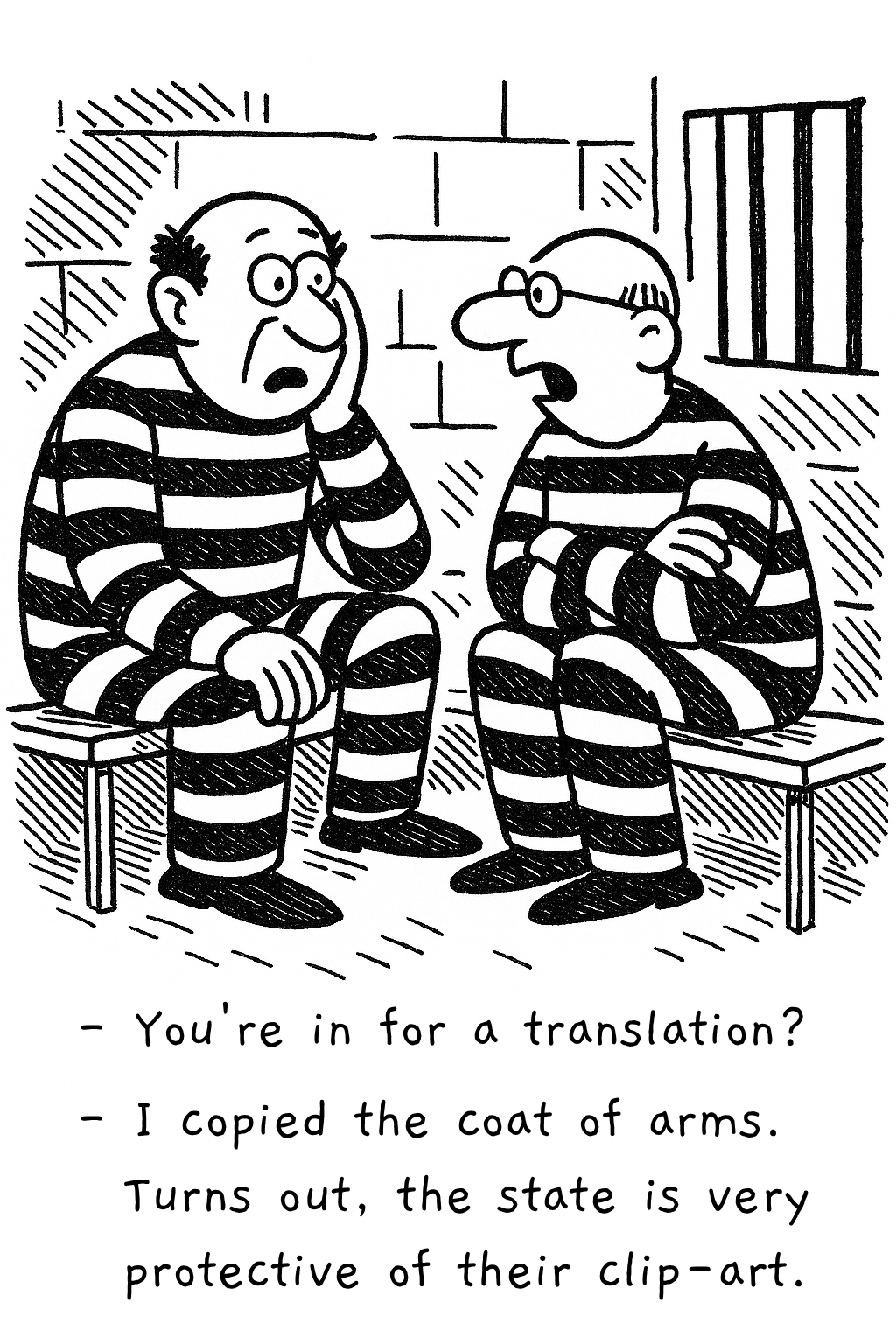
Okay, the illustration at the top is used for dramatic effect—it is highly unlikely that you would face prison time for a well-intended translation. Nevertheless, the legal risks remain.
In the world of official document translation, like birth certificates, court rulings, or social service reports, you are creating a legal mirror of the original. Ideally, this type of content should be handled by sworn translators only. In practice, however, when the translation is needed only for a client’s reference and not to be presented before authorities, it’s often performed by non-sworn linguists, who may lack specialized knowledge in this field and might treat the document like any other regular translation.
One of the most common stumbling blocks for translators is how to handle non-textual elements like logos, wax seals, and signatures. Should you copy and paste them? Omit them? Or maybe describe them?
Here is a guide to professional best practices for handling these elements.
THE GOLDEN RULE: DON’T “COPY-PASTE”
It might be tempting to crop a signature or a government logo from a scan and paste it into your target document to make it look “official.” Don’t do it. Even if your CAT tool preserves these elements automatically, you should remove them. Why?
The signer signed the original document, which they read (or at least were supposed to do this) and agreed to every word in it. Are you sure they are happy having their signature placed under your translation—which they never had the chance to read and understand?
If you intend to copy a seal or a state coat of arms, are you sure you have the proper authorization to do so?
If your translation looks as though it were issued by a foreign authority, are you sure that authority would agree with this representation?
By digitally transferring official emblems or private signatures, you create a “pseudo-original” that may appear as an attempt to deceive the reader into thinking the translation itself is a legal instrument. This can be viewed as forgery or an attempt to create a counterfeit document. Additionally, many state symbols are legally protected, making their unauthorized reproduction a criminal offense in several jurisdictions.
SO, WHAT SHOULD YOU DO INSTEAD?
Use descriptive placeholders in square brackets. This maintains the integrity of the document, indicates that an element exists in that location, and is legally safe.
It’s up to you to decide if you want to use title case or all caps, but do it consistently throughout the document; for longer descriptions, title case typically works best. It is also good practice to use italics to indicate that these elements are descriptions rather than part of the actual translated text.
You can find some examples below.
✍️Signatures
You can use one word or a longer description, depending on whether you can clearly read the name or how precise you want to be.
- [Signature] or [SIGNATURE]
- [Signature: John Doe] or [Signature of John Doe]
- [Handwritten signature]
- [Initials]
™️ Logos and Coats of Arms
Logos are visual identifiers. You don’t need to describe the colors or specific imagery (e.g., an “eagle holding a shield”) but you do need to acknowledge the entity the logo represents. Avoid translating the text within the logo into the target language as if it were part of the document content.
- [Logo: University of Barcelona]
- [Company logo: ABC Ltd.]
- [Coat of Arms of the United Arab Emirates]
- [Logo with the text: “Universität Wien”]
㊙️ Stamps, Seals and Notes
Stamps often contain critical information, such as dates, notary names, or attestations. These must be translated. If a stamp is faded or blurry, do not guess and translate only what is clearly visible. To visually mimic a stamp without using the actual image, you can place your translated description inside a text box with borders.
- [Round seal: Ministry of Justice, Republic of France]
- [Round stamp: District Court of Warsaw, Civil Division]
- [Stamp: John D... (remainder illegible)]
- [Illegible seal]
- [Handwritten note: “Approved”]
- [Watermark: “Confidential”]
WHAT TO DO IF YOUR CLIENT WANTS YOU TO KEEP THE ORIGINAL LOGOS AND SIGNATURES?
Explain the “Legal Forgery” Risk
Most private clients, and even some translation agencies, don't realize that “copy-pasting” an official seal can be interpreted as document fraud or forgery. You may need to explain this clearly: while an identical look is a nice-to-have, reproducing official graphic elements and signatures is generally prohibited, as authorities may view it as an attempt to create a counterfeit document.
Maintain the Formatting
If you remove all legally sensitive elements mentioned above, keeping the original formatting can be safe (*see the next point). There is a great chance it will be sufficient to satisfy the client’s needs. It also demonstrates your professionalism and technical proficiency.
If your CAT tool preserves the original layout, only minor adjustments may be needed. Otherwise, you’ll need to use tables and text boxes in Word, and try to guess the fonts, colors and formatting in order to mirror the original design.
When you use descriptive elements in brackets, place them in the same position as the original logos or signatures. Ensure that each translated paragraph corresponds to its location in the source and that the information matches page-for-page. If necessary, adjust wording, font size, or line spacing. This helps readers to easily find and compare counterpart source and target statements.
Note that this level of formatting is a DTP (Desktop Publishing) service, not pure translation. That means you can charge an additional fee for this work.
Indicate That It Is a Translation
Officials and judges must be able to see immediately that the document is a translation. The most conservative approach is to disregard all formatting entirely and to translate everything with a single font size, no bold text, no underlines, and above all—no graphic elements.
If your client requests a mimicked layout, you can agree, but you still need somehow to indicate that the document is a derivative work. Some ways to achieve this include:
🔹 Header with language service provider details
Instead of going full-page with your translation, scale it down and use the top of each page (or at least the first page) to include the word “Translation” along with your name as a freelance translator or the name and contact details of the agency.
🔹 “Translation” watermark
Placing a semi-transparent watermark across the background of each page is one of the most effective visual cues. However, it is also the most intrusive option, so it should be used carefully to avoid obstructing readability.
🔹 Black-and-white formatting
If the original document uses colors, consider removing them. Converting the file to a simple black-and-white format strips away the “official” look while keeping the text and layout intact.
🔹Disclaimer at the end
Add a short note at the bottom of the document stating that the text is a translation provided for informational purposes only. This clarifies that the translator does not claim the authority of the original issuing body.
🔹 Certificate of Accuracy below the translation
Attach a statement confirming that the translation is a true and accurate representation of the source document. Placing this directly below the translated text or on a separate final page creates a clear boundary between the translation and the original document.
🔹 Combine these methods
Using a combination of these measures is the safest approach. For example, pairing a header with a disclaimer provides an additional layer of protection against claims of document forgery and helps eliminate ambiguity.
Get It in Writing
If an agency insists because their end-client demands it, you need to protect yourself.
Ensure that both your concerns and the agency’s specific instructions to include images are documented in a clear email thread. You might suggest adding a header or watermark as a compromise to distinguish the document from the original. Also, if you are providing a Certificate of Accuracy, consider including a disclaimer such as: "Logos and signatures have been reproduced at the specific request of the client for layout purposes only."
Be extra cautious regarding reproducing security features like wax seals or holograms, as these are highly sensitive. Finally, never agree to introduce substantive changes, such as altering the wording or adding a signature where none existed in the source document.
Did you find this article helpful? It’s just one of dozens of practical tips and best practices included in my guide Become a Freelance Translator—From Language Lover to Location-Free Career , where I break down real-world translation challenges and show how to handle them professionally and safely.

visualization by MockupFree.co
What will you find in this guide? Click Preview on the product page and browse a sample.