
Know your Risks- Hypertension (High blood Pressure) or Hypotension (Low Blood Pressure)
January 03, 2026
Blood Pressure....
the goldilocks effect Too High, Too Low never just right ....
Know your Risks - Hypertension ( High Blood Pressure) or Hypotension (Low Blood Pressure)
Blood pressure is essentially the force of your blood pushing against the walls of your arteries.1 While your body naturally fluctuates based on activity and stress, consistently being at either extreme—too high or too low—can lead to serious health issues.2
High Blood Pressure (Hypertension)
High blood pressure is often called the "silent killer" because it rarely presents symptoms until it has caused significant internal damage.3
Symptoms (Often only in emergencies)
In most cases, people with high blood pressure feel perfectly fine.4 However, if your blood pressure reaches a hypertensive crisis (typically 180/120 mmHg or higher), you may experience:5
- Severe headaches (often at the back of the head).6
- Chest pain or shortness of breath.7
- Vision changes (blurred vision or seeing spots).8
- Nosebleeds or blood in the urine.9
- Pounding sensation in the neck, chest, or ears.10
Getty Images
Long-Term Health Effects
If left untreated over years, the constant pressure damages your arteries and organs:11
- Heart Disease: The heart has to work harder, leading to heart failure or thickened heart muscles.12
- Stroke: Damaged arteries in the brain can burst or become blocked.13
- Kidney Damage: Hypertension is a leading cause of kidney failure.
- Aneurysms: Constant pressure can cause a weak spot in a blood vessel to bulge and potentially rupture.14
- Vision Loss: It can damage the delicate blood vessels in your eyes.15
Low Blood Pressure (Hypotension)
Low blood pressure is generally defined as a reading lower than 90/60 mmHg.16 For many people (like athletes), low blood pressure is normal and healthy.17 It only becomes a medical concern when it causes symptoms.
Symptoms
Symptoms usually occur because the brain and other vital organs aren't receiving enough oxygen-rich blood:18
- Dizziness or lightheadedness (especially when standing up quickly).19
- Fainting (syncope).20
- Blurred or fading vision.
- Nausea.21
- Fatigue or lack of concentration.
- Pale, cold, or clammy skin.22
Long-Term Health Effects
- Falls and Injury: The most immediate long-term risk is injury from fainting or dizziness, particularly for older adults.
- Organ Damage: In chronic, severe cases, vital organs (like the brain and kidneys) can suffer from a lack of oxygen, potentially leading to permanent damage.23
- Cognitive Issues: Some studies suggest chronic low blood pressure in seniors may increase the risk of dementia due to reduced blood flow to the brain.24
When to Call for Help
Knowing when a reading is "concerning" versus an "emergency" is vital.
ConditionCall 911 / Emergency Services If:Contact Your Doctor If:High BPBP is 180/120+ AND you have chest pain, shortness of breath, numbness, or trouble speaking (signs of a stroke or heart attack).Your BP is consistently above 130/80, even if you feel fine.Low BPYou show signs of shock: confusion, cold/pale skin, rapid/shallow breathing, or loss of consciousness.You experience frequent dizzy spells, unexplained fatigue, or fainting episodes.
Understanding what is going on in your body is half the battle....communicating with your medical team can be difficult. There's a lot of moving parts Cardiologists, Neurologists, General Practictioners, Hospitalists, Nurses, Physical therapists, clerks and so on the list is endless...so trying to get everyone on the same page can be difficult from a patients point of view especially if you aren't feeling well. With that in mind...knowyourself.news is pleased to announced the first issue of Manage Your Own Blood Pressure large print guidebook. Every thing you need to know , communication tools for your medical team, and easy techniques for you as the patient to manage your own blood pressure.
With that in mind, knowyourself.news has created four different plans each involving different levels of support. See below for a description of all four and which is right for you. Start today managing your own blood pressure.
Our Monthly feature is our Subscribe and Save Plan:
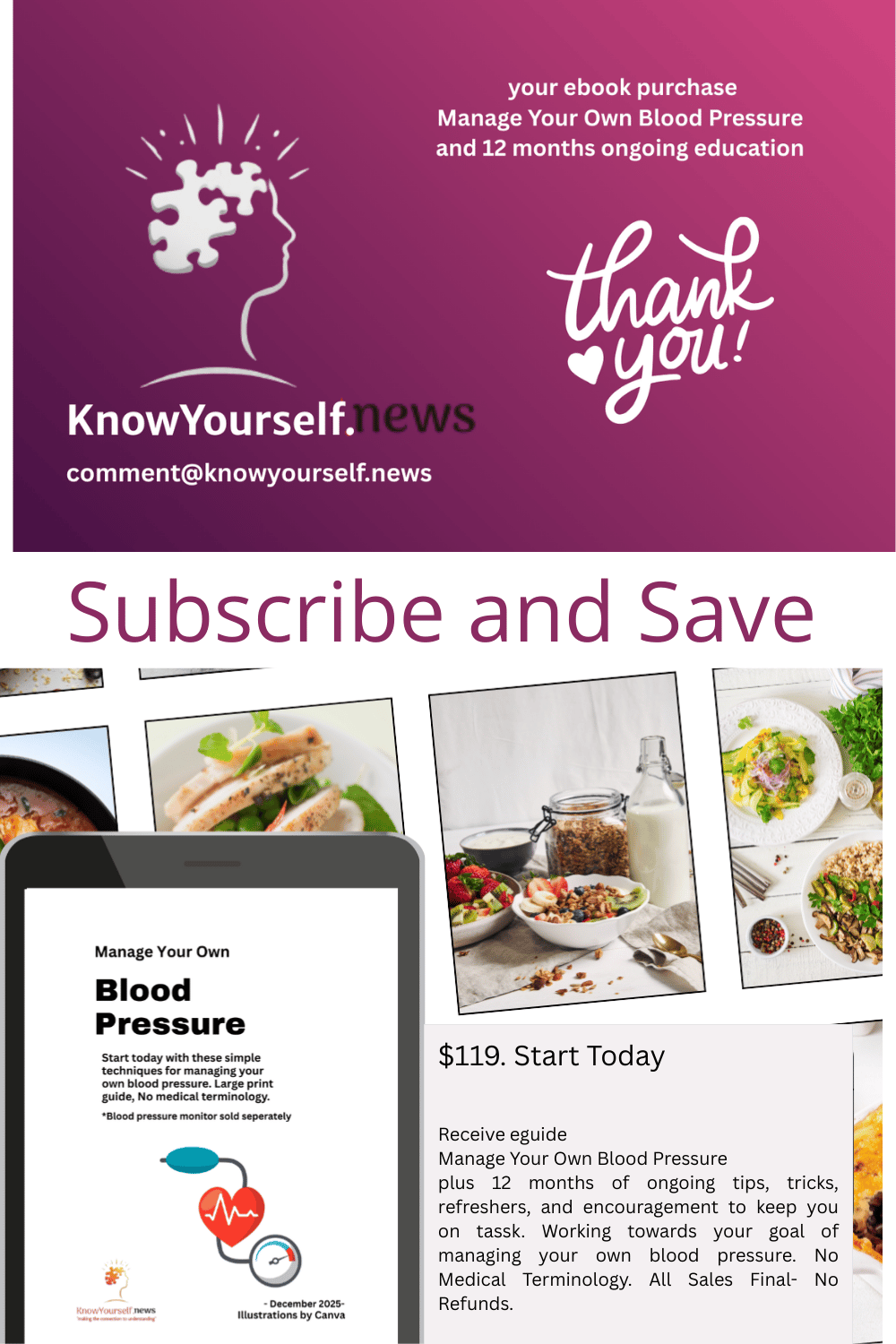
Get started today Subscribe and Save includes: click
your Large Print guidebook Manage Your Own Blood Pressure
12 Refresh and Learn Lessons go at your own pace
ongoing subscription to Knowyourself.news a monthly newsletter offering tips and tricks, encouragement, and support to keep you focused on your goal of managing your own blood pressure.
and if simple isn't your way, we have the science....check out "I didn't know that" on our site Knowyourself.news
$119. cdn
Get Started today: Manage and Save includes: click
your Large Print guidebook Manage Your Own Blood Pressure
12 Refresh and Learn Lessons go at your own pace
and if simple isn't your way, we have the science....check out "I didn't know that" on our site Knowyourself.news
$99cdn
Get Started today: Manage Your Own Blood Pressure large print guidebook click
and if simple isn't your way, we have the science....check out "I didn't know that" on our site Knowyourself.news
$79.cdn
Get Started today: Knowyourself.news quarterly subscription
receive monthly encouragement, tips, tricks, education and of course if simple isn't your way, we have the science...check out "I didn't know that" on our site Knowyourself.news, two products getting you on the way to managing your own blood pressure, for only
$12. cdn quarterly
According to Henry Ford,
”Nothing is particularly hard if you divide it into small jobs. “ -Henry Ford “ It is a sign of strength, not of weakness, to admit that you don't know all the answers."
As always wishing you a healthy future from all of us at knowyourself.news and Manage Your Own Blood Pressure.
data provided by google gemini ai
Comments ()