
Small Business SOPs: How to Write Standard Operating Procedures That Actually Get Used
If your business depends on you remembering every step, answering the same questions, or fixing the same mistakes over and over, you do not just have a time problem. You have a process problem.
Standard operating procedures, or SOPs, turn repeatable work into a documented system. A good SOP gives someone a clear, repeatable way to complete a task without needing to ask what comes next every single time.
For a small business, SOPs do not need to be corporate, complicated, or fifty pages long. The best SOP is the one your team can actually follow.
What Is an SOP?
An SOP is a written set of instructions for completing a recurring business task. It explains what needs to happen, who is responsible, what tools are used, and what “done correctly” looks like.
- Responding to a new customer inquiry
- Onboarding a client
- Sending invoices and following up on unpaid balances
- Processing refunds
- Publishing social media content
- Handling customer complaints
- Training a new employee
- Updating customer records
Why SOPs Matter for Small Businesses
Small businesses often run on memory, texts, sticky notes, and “the way we have always done it.” That may work for a while, but it becomes expensive as the business grows.
- Reduce preventable mistakes
- Train people faster
- Create more consistent customer experiences
- Make delegation easier
- Identify wasted steps
- Protect important knowledge when someone is unavailable
- Spend less time answering repeat questions
- Build systems that can grow with the business
Start With the Right Process
Do not try to document your entire business in one weekend. Start with a process that is repeated often, easy to perform inconsistently, responsible for delays or mistakes, dependent on one person, or closely connected to customers and cash flow.
A useful question is: “If I could not do this task tomorrow, would someone else know exactly how to complete it?”
How to Write an SOP in 7 Steps
- Define the outcome. Write one sentence explaining what successful completion looks like.
- Identify the owner. Use the responsible role when possible instead of one person's name.
- List the tools and information needed. Include software, templates, customer information, files, checklists, and anything else needed before starting.
- Write the steps in order. Use short, action-focused instructions instead of vague directions.
- Add decision points. Document what should happen when the process takes a different path.
- Define the quality check. Explain how someone knows the task is complete and correct.
- Test the SOP. Have someone who did not write it follow it without extra instructions, then fix anything unclear.
Keep Your SOP Simple
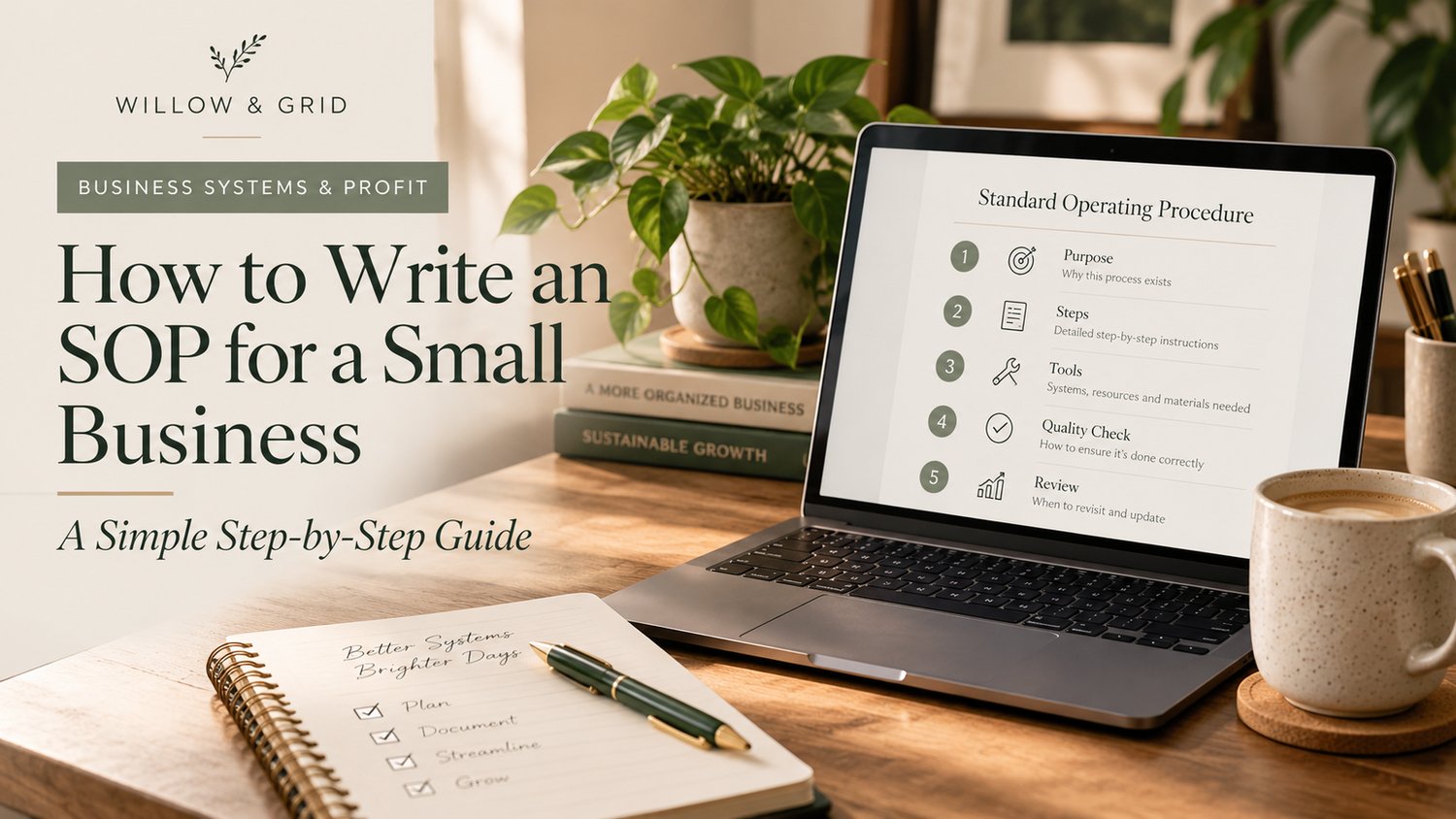
A practical small-business SOP can often fit into seven parts: purpose, owner, tools needed, step-by-step instructions, decision points, final quality check, and last updated date.
Add screenshots, scripts, links, or examples only when they make the process easier to follow.
Simple SOP Example
Here is what a basic SOP might look like for responding to a new customer inquiry:
Purpose: Respond to new inquiries quickly and consistently.
Owner: Customer Service or Sales
Tools Needed: Business email, CRM or customer tracking system, approved response template
Steps:
- Review the customer's inquiry and contact information.
- Enter the lead into the customer tracking system.
- Send the approved initial response.
- Record the date and method of contact.
- Schedule the appropriate follow-up if the customer does not respond.
Quality Check: Confirm that the customer received a response, the lead was recorded correctly, and the next action is documented.
Your SOP does not need to be long. It needs to give someone enough information to complete the process correctly without relying on memory.
What Should You Document First?
- Lead follow-up
- New customer onboarding
- Quotes and proposals
- Invoicing
- Payment follow-up
- Customer support
- Order fulfillment
- Refunds
- Employee onboarding
- Recurring weekly administrative tasks
SOPs Are Not “Set It and Forget It”
Processes change when your software, team, offers, or workflow changes. Review important SOPs periodically and update them when the real process changes.
Not sure whether a full SOP is necessary for every task? Read our guide on SOP vs. Checklist to see when your small business should use each one.
Build Your First SOP Faster
If you know you need documented processes but do not want to build the structure from scratch, the Willow & Grid Small Business SOP Builder - Standard Operating Procedure Template Kit gives you a ready-to-use framework for organizing repeatable business processes.
If you want a simple structure to follow, see our SOP Template for Small Business guide with examples.
Once you have documented individual procedures, see our How to Systemize a Small Business Without Expensive Software guide to connect those SOPs into a broader operating system.
Get the Small Business SOP Builder
Start with one process. Make it clear. Test it. Improve it. That is how a collection of simple SOPs becomes a business system.