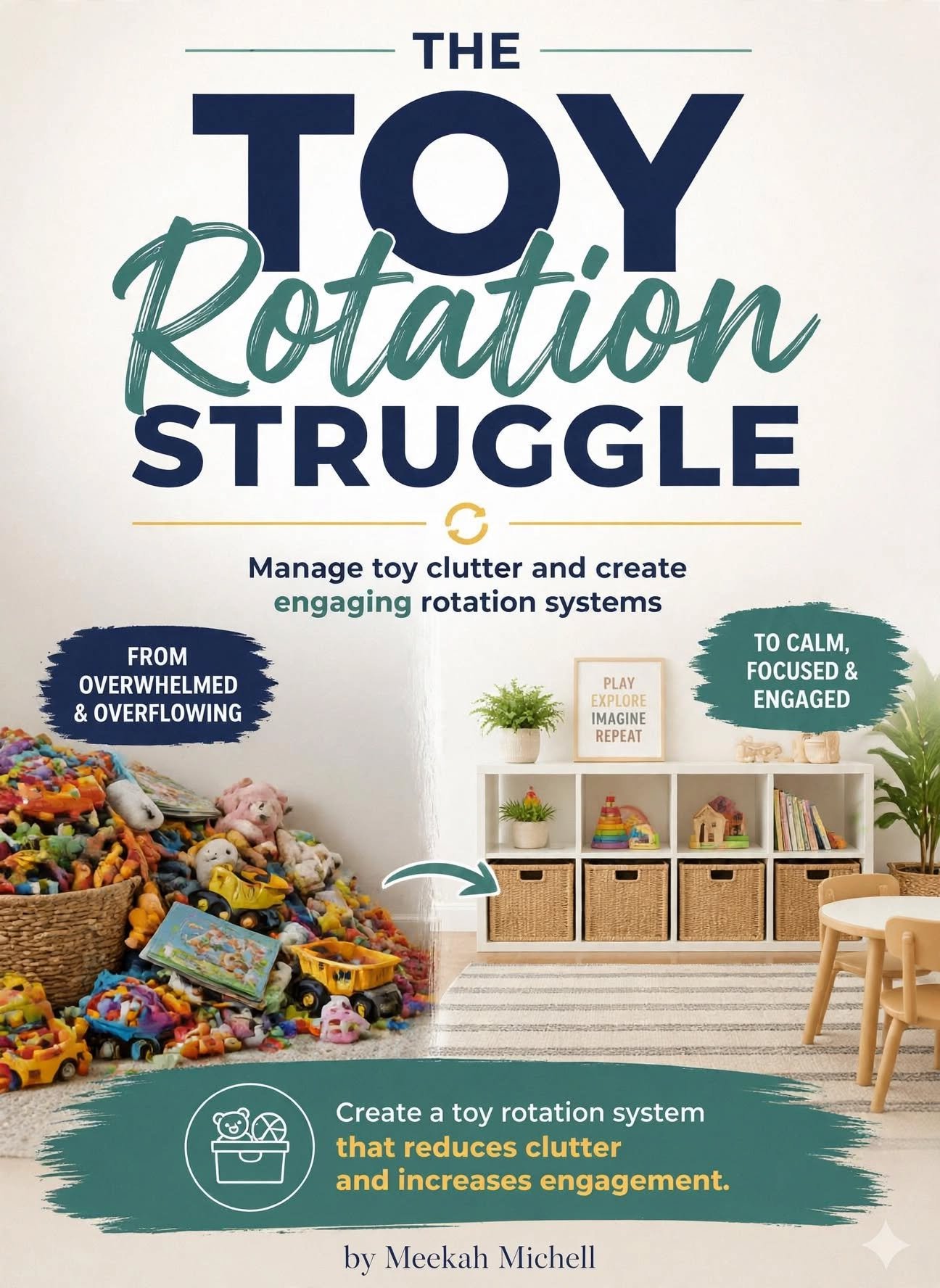
The Toy Rotation Struggle
Standing on a Lego at 6 a.m. Wondering How They Can Have This Much and Still Be Bored.
WHAT THIS IS
This is not about throwing everything away. It is not a minimalist manifesto, a guilt trip about too much plastic, or a demand to build an Instagram playroom with wooden toys and neutral baskets. It is a system for making what you already have actually work — because right now your child is standing in the middle of a room full of toys complaining there's nothing to do, and you are standing in the same room wondering how that's physically possible.
Inside, you'll find:
• **The Choice Paralysis Effect** — The research-backed truth about what too many toys actually does to your child's brain. Forty options doesn't produce forty ways to play. It produces flitting, frustration, and the sentence "I'm bored" — and it isn't ingratitude. It's overwhelm.
• **The Five Toy Inflows** — Birthday gifts, hand-me-downs, impulse buys, subscription boxes, educational guilt. You only control one of these. Understanding where the volume comes from removes the shame of having it.
• **The Three-Pile Sort** — Keep, Rest, Release. Not a declutter. Not a purge. You're deciding what to work with. The sentimental rattle goes in a memory box, not the rotation. The broken car goes in the bin. The untouched thing goes to the charity shop. You are allowed to let go.
• **The Five Toy Categories** — Open-ended, Skill, Imaginative, Comfort, Noise. Each has a different rotation value, a different shelf life, and a different role in your rotation backbone. Sorting by type — not by brand or by who gave it — is what makes rotation work.
• **Your First Rotation** — Step by step. Eight to twelve toys for toddlers, ten to fifteen for preschoolers. Display, don't dump. Each one with its own space. Visible means chosen. Crowded means ignored.
• **The Rotation Rhythm** — When to swap and how to know. Four signals: flitting, chaos, "I'm bored," clinginess. Swap a third, not everything. Keep the favourites. Replace the ignored. Five minutes, next-up shelf, no overthinking.
• **Other People's Toys** — Grandparents, gifts, and the guilt loop. How to redirect with love, curate with confidence, and stop carrying shame for a volume you didn't choose.
• **The Four-Week Reset Plan** — Week 1: The Sort. Week 2: The Storage. Week 3: The First Rotation. Week 4: The First Swap. One step at a time, in that order, always that order.
Your child doesn't need more toys. They need fewer out at once. That's the single most powerful change you can make.
WHO THIS IS FOR
This is for the woman who:
• Has stepped on a Lego at 6 a.m. and thought — there has to be a better way
• Looks at a living room that looks like a toy shop after a sale and wonders how it got like this
• Has a child who flits from thing to thing without settling and then declares "I'm bored" in a room full of options
• Has tried bins, baskets, toy boxes, and shelving — and the mess always wins
• Feels guilty about having too much and guilty about getting rid of anything because it cost money / was a gift / might be needed
• Keeps buying one more toy hoping this one will finally hold their attention — and it doesn't
• Watches her child play deeply with something and notices it almost always happens when there are fewer things out
• Dreads birthday parties and Christmas because of the volume that will arrive and the space it will take
• Has a partner or parent who says "just get rid of it" as if the feelings were that simple
• Has been told her child is "spoilt" for not appreciating what they have, when the real problem is that no brain can commit to forty things at once
• Knows instinctively that less might be better but can't find a system that doesn't feel like deprivation
• Wants to see her floor again — not for Instagram, just to walk across the room without navigating a sea of plastic
If you've ever looked at the toy pile and thought "I didn't ask for this" — you're right. You didn't. And there is a way through it that doesn't involve bin bags or tears.
WHY YOU SHOULD BUY THIS
You have been told the problem is volume — too many toys, too much stuff, not enough discipline. The real problem is that too many choices is the same as no choice. When everything is available, nothing is special. When every surface is covered, play doesn't happen — overwhelm happens. Your child isn't ungrateful or spoilt. They are a brain drowning in stimulus, and the solution isn't less love or fewer toys overall. It's fewer toys out at once. Rotation takes what you already own and makes it work again. The toy that's been untouched for months becomes brand new when it reappears after three weeks in storage. That's not magic. That's how novelty works.
✅ You stop stepping on toys because the floor isn't covered in them
✅ You stop buying new toys hoping this one will finally hold their attention — rotation makes the old ones work again
✅ You break the guilt cycle of too much → try to declutter → feel guilty → keep everything → still too much
✅ You watch your child actually play — building, narrating, lost in it — instead of flitting and complaining
✅ You stop carrying the shame of a messy house that was never really a tidiness problem in the first place
✅ You get your living room back — not bare, just curated, the way a gallery shows more by putting less on the wall
The goal is not an Instagram playroom. The goal is a home where your child actually plays and you can see your floor.
WHAT'S INCLUDED
• 10 chapters covering the full rotation system — from why you have so many toys to the mindset shift from more to enough
• The Choice Paralysis Effect — what toy clutter actually does to your child's play, with the restaurant-menu analogy that makes it click
• The Five Toy Inflows — the five channels bringing toys into your home, and what to do about each one
• The Three-Pile Sort — Keep, Rest, Release, including how to handle the emotional attachment problem
• The Five Toy Categories — Open-ended, Skill, Imaginative, Comfort, Noise, with rotation values and handling instructions for each
• Storage Before Rotation — how to build a storage system that works in a real home (clear boxes, labels, photos on your phone)
• Your First Rotation — step-by-step setup with exact numbers by age
• Rotation by Age — what changes from babies to school-age, including sibling sharing and older children's ownership
• The Rotation Rhythm — the four swap signals and the five-minute swap method
• Rotation Logistics — making it easy enough to actually maintain, including the next-up shelf
• Other People's Toys — grandparents, gifts, and the guilt loop, with scripts and redirect strategies
• The More Isn't Better chapter — the core mindset shift from quantity to curation
• Your Rotation Quick Card — print it, photograph it, stick it inside the storage cupboard
• Questions I Get Asked Most — 6 FAQs including sibling sharing, storage limitations, missed toys, and professional guidance disclaimers
• The Rotation Audit — a four-week reset plan (Sort, Store, Rotate, Swap)
• The Toy Rotation Checklist — set-up, swap, and monthly audit checklists
• Chapter-by-chapter reflection questions, journal prompts, and "3 Quick Things" action steps
Fewer toys out. More play happening. Less mess on your floor. Get the system and take back your living room.
Get the rotation framework and put three things in a cupboard tonight.