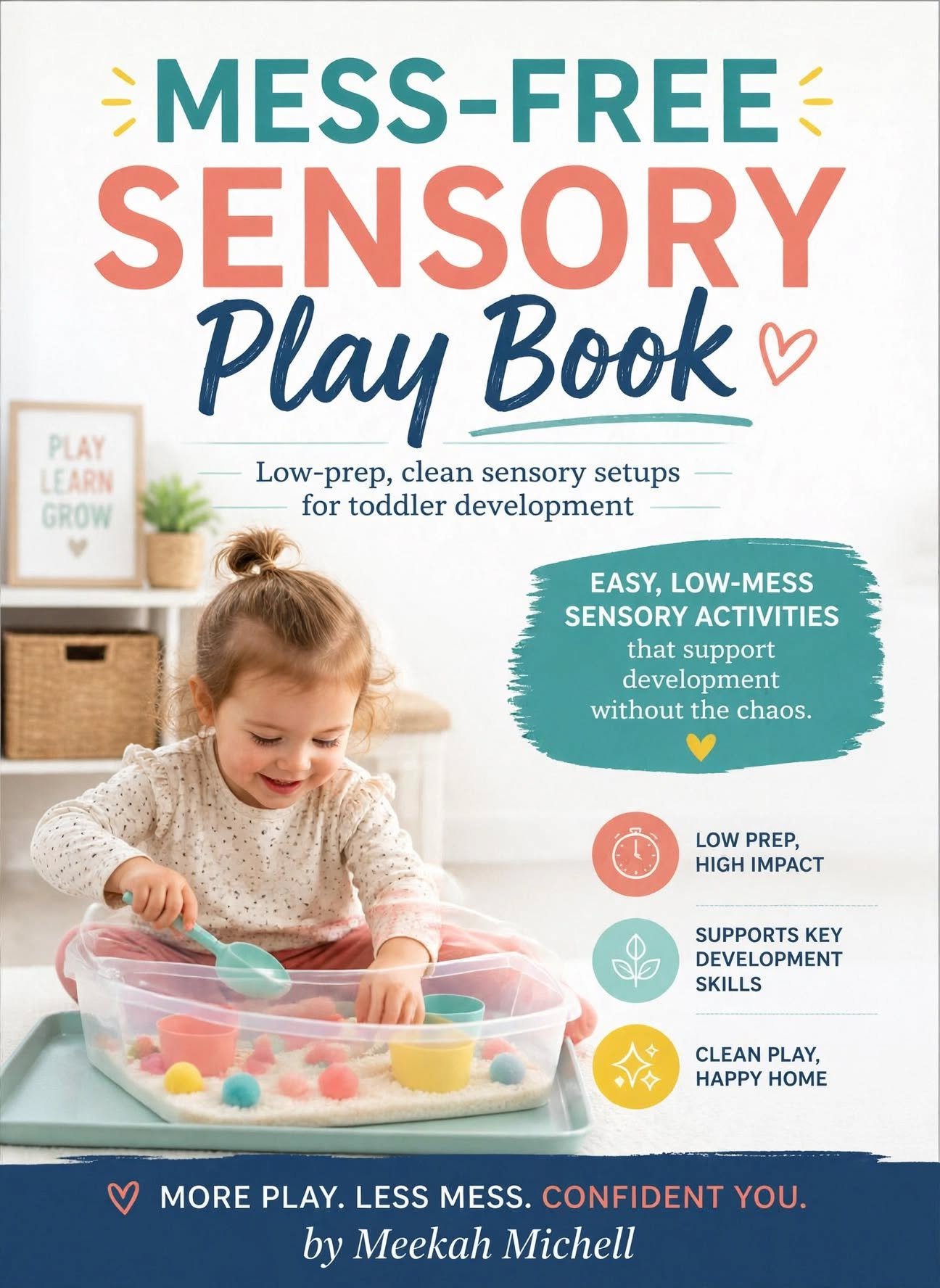
Mess-Free Sensory Play
You Scrolled Past Another Spaghetti-on-a-Tarp Post and Thought: I Cannot Do That Today. You Don't Have To.
WHAT THIS IS
This is not a Pinterest sensory play guide. It is not forty-minute cloud dough recipes, colour-coordinated rice bins, or activities that take longer to clean up than your child spends playing. It is a practical method for giving your toddler rich sensory experiences without destroying your kitchen, your sanity, or your evening.
Inside, you'll find:
• **The Containment Principle** — The single most important concept in this book. If you set up the activity in a defined, bounded space, the play stays in that space and the cleanup stays minimal. A tray, a bin, a bathtub, a table mat. The container does the work. You just have to use it.
• **The Mess Myth** — The belief that sensory play has to be messy to be valuable is a lie sold by engagement algorithms. Dramatic photos get shared. Subtle ones don't. Your child's development is not measured by how long you spend cleaning up after it. Good sensory play needs varied input, open-ended exploration, enough time, and a calm container. None of those require a tarp.
• **Kitchen Sensory** — The best materials are already in your cupboards. Rice, dry pasta, oats, cereal, yoghurt, jelly, ice cubes. No shopping list, no special supplies, no prep beyond opening a container. The five-minute setup rule: choose a container, choose a base, add two or three tools, set it on a cleanable surface, invite your child.
• **Tabletop Play** — The floor is where sensory play goes wrong. The table is your ally. Your child in a chair, the activity bounded by the table surface, materials that fall stay on the table, you sit across and actually rest. One damp cloth, done. Play dough on a silicone mat, kinetic sand on a baking tray, washi tape on a place mat, sorting pasta into an ice tray.
• **The High Chair Hack** — For babies and younger toddlers, the high chair is the perfect sensory station. Tray contains everything, child safely strapped in, hose it down afterwards. Yoghurt painting, edible finger paint, ice cubes, sticker play, cereal scooping.
• **Bath and Water Play** — Sensory that cleans itself. Add one thing to tonight's bath: food colouring, cups, sponges, bath crayons, foam shapes. Zero extra cleanup. The water drains away. Your child gets ten minutes of rich sensory input, and you lean on the door frame and breathe.
• **The One-Bucket Sensory Bin** — Container plus dry base plus three to five tools. Fill one-third full. Rotate tools every few days. Base material lasts weeks. Cleanup: put the lid on.
• **Taste-Safe Options** — When everything goes in the mouth, you need materials that will not harm. Cereal, oats, yoghurt, jelly, baby rice paint — complete age-by-age taste-safe reference chart inside.
• **Sensory on the Go** — Ziplock bag of dry material, silicone place mat, stickers, a fidget tool. Keep it by the door. Grab it on the way out. Waiting rooms, restaurants, car journeys — portable sensory play without the portable mess.
• **Troubleshooting** — When your child refuses it, flings it, eats it, cries, or gets overstimulated. The thirty-second reset: pause, name what happened, offer a choice. Scripts for every moment your brain goes blank.
Your child's sensory development does not require your exhaustion.
WHO THIS IS FOR
This is for the woman who:
• Scrolls past sensory play posts thinking "that looks like a disaster I do not have the energy to clean up" — and is right
• Feels the specific guilt of knowing sensory play is important for her child's brain but cannot face another rainbow rice situation
• Has tried sensory activities that took longer to prep and clean than her child spent playing
• Already carries an enormous physical and mental load and refuses to add cleanup duty on top of it — which is not laziness, it's self-preservation
• Watches her child flit between activities without settling and wonders if something is wrong, when really the room is just too loud with options
• Has a toddler who puts everything in their mouth and worries about rice, beans, and small parts
• Lives in a home where the floor is carpet, the space is limited, and the garden is not an option right now
• Sees Pinterest sensory bins and feels both desire and dread in equal measure
• Wants to say yes to play but keeps saying no because the cost in cleaning always feels too high
• Needs her child to play independently for fifteen minutes so she can sit down without hovering over a potential mess
• Has a partner who questions the mess or a mother-in-law who doesn't understand why the lounge looks like a craft cupboard
• Knows that any sensory activity she offers needs to clean up in under two minutes or she will stop offering it — which means her child loses out
If you've ever wanted to say yes to sensory play but the mess kept saying no for you — this is your way around it. The play is non-negotiable. The mess is optional.
WHY YOU SHOULD BUY THIS
You've been told that good sensory play requires effort — the forty-minute cloud dough, the coloured spaghetti, the themed seasonal bins with matching wooden scoops. That version performs beautifully online. It does not perform beautifully in a real home at 4 p.m. on a Tuesday when you've had four hours of sleep. The mess myth exists because dramatic content gets engagement. Subtle content scrolls past. But your child's neural connections do not care about drama. They care about texture, temperature, weight, sound, and enough time to explore. Those things can happen in a shoebox of rice with a spoon. They can happen at the kitchen table. They can happen in the bath. The containment principle doesn't restrict your child's experience — it focuses it. When a child knows where the play space begins and ends, they engage more deeply with what's inside it. Boundaries create safety. Safety creates exploration. An unbounded activity creates anxiety — yours and theirs — because neither of you knows where the mess will end.
✅ You stop avoiding sensory play because the cleanup feels worse than the benefit
✅ You stop believing that more mess equals more developmental value
✅ You start offering sensory experiences you can actually sustain — not the Instagram version you'll abandon after two tries
✅ You give your child deeper, longer play because the environment supports focus instead of overwhelm
✅ You get fifteen minutes where your child is absorbed and you can actually sit down without hovering
✅ You let go of the guilt that you're not doing enough — because rice in a bin is enough, and now you know that
The best sensory play is the play that actually happens. Not the play you planned and abandoned because it was too complicated. The play in your actual home, with your actual child, on an actual Tuesday.
WHAT'S INCLUDED
• 11 chapters plus introduction and conclusion — covering every type of mess-free sensory play from kitchen to bath to tabletop to outdoors
• The Containment Principle — the four rules of containment and the best containers you already own
• Kitchen Sensory — complete dry and wet materials guide with age ranges and setup times
• Tabletop Play — 8 specific tabletop activities with cleanup times under two minutes
• The High Chair Hack — 5 baby and toddler sensory stations that wipe clean
• Bath and Water Play — add-one-thing method with 10 bath upgrade ideas
• The One-Bucket Sensory Bin — the complete system: container, base, tools, rotation, and storage
• Taste-Safe Options — age-by-age reference chart from 6 months to 18 months+
• Outdoor Sensory — zero-prep, zero-cleanup nature activities
• Sensory on the Go — the sensory go-bag: what goes in, how to use it, where to keep it
• Troubleshooting — refusal, throwing, eating, crying, overstimulation, and the thirty-second reset
• Scripts for the Moments You Need Them — word-for-word responses when your brain blanks, including partner pushback and guilt spirals
• Frequently Asked Questions — frequency, reuse, space, additional needs, tactile defensiveness, and the guilt question
• Your Mess-Free Sensory Play Starter Kit — 6 at-a-glance setups you can return to anytime
• Professional support resource list (UK helplines and organisations)
• Chapter-by-chapter reflection questions, journal prompts, and "3 Quick Things" action steps
Your child's brain needs sensory play. Your floor doesn't need a disaster. Get the framework and say yes to the play without saying yes to the mess.
Get the containment system and set up one bin tonight. Ninety seconds of cleanup. Twenty minutes of peace.