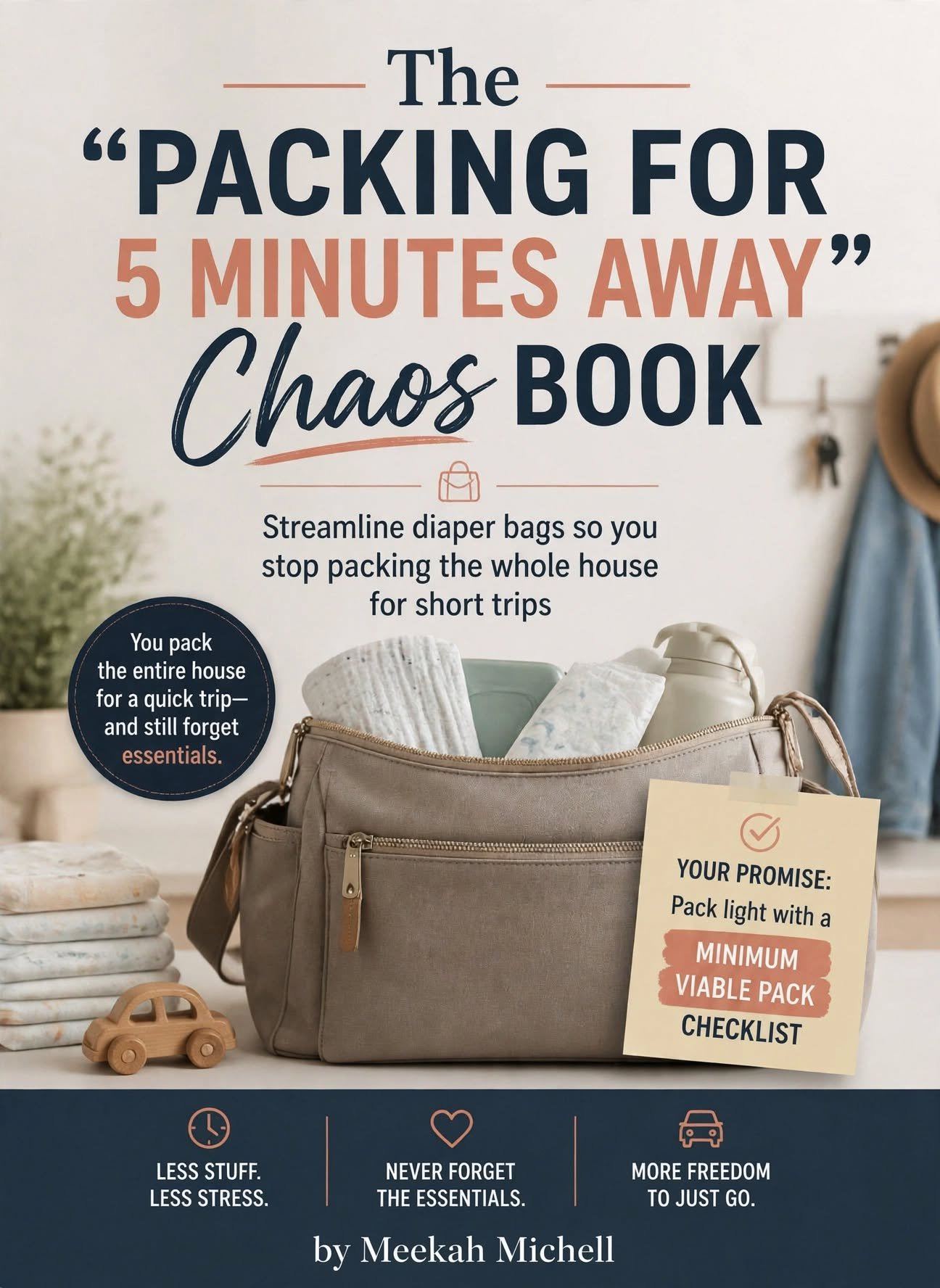
The "Packing for 5 Minutes Away" Chaos
Packed the Whole House for a Trip to Tesco — and Still Forgot the One Thing You Needed? Overpacking Isn't Preparation. It's Anxiety With a Zip.
WHAT THIS IS
This is not a list of what to put in your changing bag. It is not a Pinterest aesthetic post about matching pouches and colour-coded compartments. It is a system for stopping the cycle of packing your entire house for a trip that lasts eight minutes — and then digging through a bottomless bag while your child screams because you cannot find the one thing that would actually help.
Inside, you'll find:
• **The Minimum Viable Pack (MVP)** — Not packing less for the sake of it. Packing exactly what you need so you can find it, carry it, and use it. For any trip under two hours, your bag should contain only what your child would need if you were at home for two hours. One nappy per hour, not eight. One snack, not a buffet. One change of clothes, not a full wardrobe. The MVP is about precision, not deprivation.
• **The Grab-and-Go Bag System** — The biggest time waster is packing from scratch every time you leave. Your bag is always packed with the MVP. It stays packed between trips. You never stand in the living room scanning the room and second-guessing again. You grab. You go. Two minutes, not twenty.
• **The Car Stock System** — The biggest fear about packing less is: what if I need something? The answer is not to pack more in your bag. The answer is to put the extras in the car. Full pack of wipes — boot. Spare nappies — boot. Full change of clothes — boot. Calpol — glove box. Your bag stays light. Your backup stays ten steps away. The car stock lets you pack light without packing scared.
• **The Nappy Bag Audit** — Empty every pocket. Sort into categories. Count every item. Ask the ruthless question: have I used this in the last two weeks? You will probably find expired snacks, outgrown nappies, clothes that no longer fit, and items from a specific trip three weeks ago you never removed. The audit is not judgement. It is data.
• **Separating Anxiety from Need** — The hardest chapter in the book. You do not pack four snacks because your child might eat four snacks. You pack four snacks because your brain is running disaster scenarios. Each item in your bag answers a fear, not a need. And the fears stack. The anxiety loop: you feel anxious, you pack more, the bag is heavy and chaotic, you cannot find what you need, the fear of being unprepared grows louder, next time you pack even more. More packing does not reduce the anxiety. It feeds it.
• **The Three-Bag System** — MVP Bag for short trips under two hours. Nursery Bag with MVP plus nursery-specific items. Day Trip Bag with expanded MVP in a bigger bag. Three bags. Each pre-packed. Each labelled. Grab the one you need.
• **Breaking the "Just in Case" Cycle** — Your brain does not weight probability. It weights drama. The one time your child had a nappy explosion at the supermarket feels more likely than the ninety-seven times nothing happened. The probability check: run the numbers. And the backup plan: shops exist. The car has stock. You have a phone. You are not stranded in the wilderness. You are ten minutes from Tesco.
• **What Children Learn From the Bag** — Overpacking teaches your child that the world is dangerous, that they cannot trust themselves to cope, that preparation means stress, that their needs are a burden. The MVP teaches them the world is manageable, they are capable, leaving the house is normal, and their needs are simple. Every time you choose the MVP over the overpack, you are teaching your child something — not with words, with the weight on your shoulder.
The weight of your bag is not the weight of your love. It is the weight of your worry. And worry deserves a system, not a heavier bag.
WHO THIS IS FOR
This is for the woman who:
• Packs three snacks, two outfit changes, a full pharmacy, four toys, and a blanket for a ten-minute trip to the corner shop — and still forgets the one thing she actually needs
• Stands in the living room before every outing, scanning the room, adding things to the bag, second-guessing, and taking fifteen minutes to leave for something five minutes away
• Cannot find the wipes when her child has a meltdown because they are buried under spare socks, a spoon, expired calpol, and a toy that hasn't been touched in three weeks
• Knows the bag is too heavy and feels ridiculous carrying it but cannot stop adding things because her brain keeps saying "what if"
• Feels the physical ache of a bag digging into her shoulder every time she carries it while wrangling a toddler — and has accepted this as normal
• Has apologised to herself, out loud, in the car, for forgetting something she packed the whole house but still managed to leave behind
• Packs from scratch every single time she leaves the house because she never trusted the bag to stay ready between trips
• Feels the guilt paradox: carrying too much feels excessive, carrying less feels negligent — and there seems to be no middle ground
• Has a partner who says "just take less" and wants to scream because it is not that simple — it's not logic, it's anxiety
• Recognises that every item she packs is answering a fear, not a need — but cannot seem to translate that knowledge into a lighter bag
• Would like to leave the house like a normal person — keys, wallet, child, small bag — instead of preparing like she's emigrating
If you've ever dug through a bottomless changing bag while your child screamed and thought "I packed everything and I still can't find the one thing I need" — this is for you. Overpacking is not the same as packing well. It is the opposite. And it is fixable.
WHY YOU SHOULD BUY THIS
You think the problem is that you need a bigger bag, or a better organiser, or more compartments. The problem is that you are packing for fears, not for trips. Every extra item in your bag answers a "what if" scenario, not a real need. And the more you pack, the less prepared you actually feel — because a giant bag doesn't say "I have everything." It says "I might need all of this and I don't know which bit." You can't find anything when you need it. The wipes are under three nappies, a muslin, a spoon, and a toy. The snack is crushed at the bottom. The spare outfit is tangled around a blanket you haven't used since February. The bag that was supposed to make you feel prepared is actually making every outing more chaotic. The Minimum Viable Pack flips the logic. When you carry only what you will use, everything is accessible. When the bag is small, you can find the wipes in three seconds. When the extras live in the car, your shoulder doesn't ache. And when your brain says "what if," you have an answer: it's in the boot. Shops exist. I can handle this.
✅ You stop packing the whole house for a trip to the shop — and actually find what you need when you need it
✅ You stop standing in the living room for fifteen minutes before every outing, scanning and second-guessing
✅ You break the anxiety loop — pack less, feel more prepared, because chaos was never the same as readiness
✅ You stop carrying guilt disguised as stuff — the weight on your shoulder is worry, not love
✅ You leave the house with keys, wallet, child, and a bag you can actually carry without wincing
✅ You teach your child that the world is manageable — not that leaving it requires armour
The right bag should make leaving the house easier, not harder. A lighter bag is not less love. It is less fear. And you deserve to carry less fear.
WHAT'S INCLUDED
• 15 chapters plus introduction and conclusion — covering the full journey from understanding why you overpack to maintaining a system that runs forever
• Why You Pack the Whole House — the anxiety behind overpacking, the paradox of more feeling less safe, the real costs of carrying too much
• The Minimum Viable Pack — the MVP rule, the complete short-trip checklist, what not to pack, and the proportional scaling for longer trips
• The Grab-and-Go Bag System — setup instructions, the replenish rule, and the three-bag solution for different trip types
• The Car Stock System — full list of boot and glove-box essentials, the car stock rule, and the monthly check protocol
• The Nappy Bag Audit — step-by-step audit process, what you will probably find, and the ruthless questions
• Separating Anxiety from Need — the anxiety loop, how to break it with evidence, the guilt of packing less, and when lighter means better
• Seasonal Bag Updates — the quarterly swap checklist for weather, clothing sizes, and changing needs
• What Your Child Sees When You Pack — the quiet lessons about stress, control, and trust that children absorb from the packing process
• The Partner and Village Problem — when other adults pack the bag and get it wrong, and how to share one system
• The New Baby Multiply Effect — managing the bag explosion when a second child arrives
• The Going-Home Reset — the return routine that keeps the system alive, including the bad-day minimum
• Breaking the "Just in Case" Cycle Forever — the probability check, the backup plan, and the truth about shops
• What Children Learn From the Bag — overpacking vs. MVP as teaching, and the long view on your child's relationship with the world
• Your Maintenance Rhythm — daily, weekly, monthly, and quarterly touchpoints with time estimates
• When You Need More Than a Bag — recognising when overpacking is part of something bigger and where to get real support
• Frequently Asked Questions — genuine need, medical conditions, judgement, partner disagreements, and why this time is different
• Scripts for the Bag Moments — word-for-word responses for partner pushback, child refusal, outside comments, overwhelm, and asking for help
• Professional support resource list (UK helplines and organisations)
• Chapter-by-chapter reflection questions, journal prompts, and "3 Quick Things" action steps
You're going five minutes away. Not moving house. Get the system and leave the house with a bag you can actually carry.
Get the MVP framework and walk out the door in two minutes — not twenty.