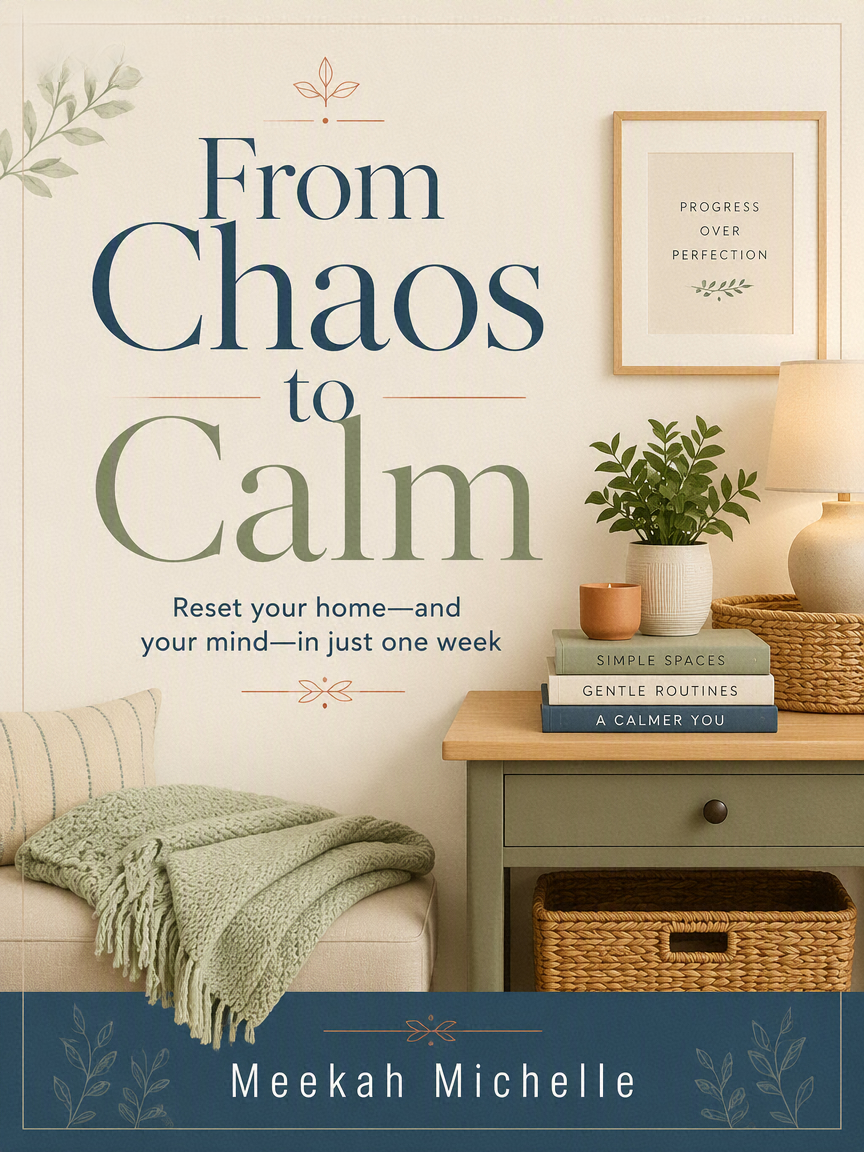
From Chaos to Calm
Reset your home — and your mind — in just one week
WHAT THIS IS
"From Chaos to Calm" is a short, honest, seven-day reset for the woman who walks into her own home and can't pick up a single thing — not because she doesn't care, but because everything is equally urgent and nothing tells her where to start.
This isn't a declutter challenge. Nobody is going to ask you to hold your possessions and thank them, or to fill fifteen boxes, or to get up at five. There's no shopping list of baskets. You will not need a free weekend, because you haven't got one. This book addresses the real reason your house feels out of control: it's not one mess — it's three piles piling up at once, and you've only been fighting one of them. Twenty to thirty minutes a day, for seven days. And on the seventh day, the job is to rest.
Inside, you'll find:
- The Three Piles Framework — Your chaos isn't one thing. It's stuff on the surfaces, undone jobs without a decision, and the forty things you're carrying in your head at 3 AM. Most advice only addresses the first pile. This week deals with all three — and that's why two of the seven days aren't about cleaning at all
- The Four Rules — Twenty minutes then stop. One zone, not one room. Nothing leaves the room. Surfaces only, cupboards never. These four rules are the difference between a reset that holds and a Saturday that ends in tears at half past ten — and the women who finish the week aren't the disciplined ones, they're the ones who kept the rules
- Why You Freeze Instead of Starting — When you walk into a room that's badly out of hand, you don't see forty separate small jobs. You see one enormous undifferentiated problem with no honest first step. You are not avoiding the work. You're avoiding the decision about which work comes first — and this week, that decision has already been made for you
- The Seven-Day Reset — One zone a day, twenty minutes, decided in advance by someone other than you. Day 1: the kitchen counter. Day 2: the room you sit in. Day 3: your head (a brain dump that sorts the mental pile into Now, Diary, Someone, and Later). Day 4: the bedroom, for you. Day 5: paper, post, and the hallway. Day 6: the five things that hold a house. Day 7: rest, deliberately
- The Five Things That Hold It — Five short jobs pinned to events, not clock times. Kettle on, bed made. Plates go, counter wiped. Coat off, post in the tray. Door shuts, cups out. Sunday, fifteen minutes. These five things are what keeps a calm house calm — not a six-hour Saturday, not a bin-bag rampage, not a storage-container shopping trip
- The "Bad Day" Minimum — Because some days even twenty minutes is too much. Clear one counter, ten minutes. Cups and plates out of the room you sit in. That's it. The rest waits, and waiting is allowed
- Why Gentle Beats Hard — Every hard reset fails for the same reason: the first day was so brutal that the second day never came. Gentle isn't softness for its own sake. Gentle is what makes Day 5 happen. Stopping while you still have something left is exactly what makes tomorrow possible
The book is short on purpose — because you're reading it in a house that's already too much. One zone, twenty minutes. That's the whole of it.
WHO THIS IS FOR
This is for the woman who:
- Stands in her own hallway with her coat still on, looking at everything at once, and can't pick up a single thing — not because she's lazy, but because there's no obvious first move
- Has tidied for an entire Saturday and woken up on Sunday feeling exactly the same, because the pile she can see isn't the only pile, and nobody told her about the other two
- Walks into the kitchen six times a day and every single trip presses down on her slightly — the blocked counter, the washing-up that never ends, the sense that the house has got ahead of her
- Sits down at nine in the evening in the only unclaimed hour she gets, and instead of resting, just sees everything undone in every direction she looks — so she reaches for her phone, not because she wants it but because it's the only place nothing is asking her for something
- Has been told to "just do a bit each day" and wants to explain, calmly, that the problem is not the doing — it's the deciding. When everything is equally urgent, nothing is, and her brain does the sensible thing and declines
- Feels like she's running and the floor is moving faster — however much she does today, the amount undone doesn't visibly change
- Carries forty things in her head at 3 AM — the form that's due, the appointment she hasn't booked, the thing she forgot to buy, the email she didn't send — and nobody counts that as work because it doesn't look like work
- Has bought storage containers thinking they'd help, and now has tidy-looking objects sitting on top of the same mess she was trying to fix
- Apologises for the state of her house before anyone's said a word, and then apologises for apologising, and knows deep down that the state of her home is not a moral document but still can't shake the feeling that it is
- Has tried the blitz, the big weekend, the midnight rampage — and watched it all slide back within a week, because lowering the water without installing a drain means it fills right back up at exactly the same rate
- Is not looking for a show home. She's looking for a kitchen where she can put a bag down, a room she can sit in without being asked for anything, and one place where the school form lives
If you've ever walked into a room in your own home and felt your brain simply switch off — not because you don't care, but because there's no honest first step — this book was written for you.
WHY YOU SHOULD BUY THIS
Because the answer to "why is my house always a mess?" isn't "try harder." It's "you're fighting one pile when there are three."
You've been told your house is a tidying problem. A motivation problem. A "just do fifteen minutes" problem. A "get the family to help" problem. And maybe some of those things are true. But the real reason your home feels out of control — the reason a whole Saturday of effort leaves you feeling exactly the same on Sunday night — is that you've been fighting the wrong pile. The stuff on the surfaces is visible. The undone jobs and the forty things in your head are invisible, and they're half the weight.
This book names all three piles — stuff, undone jobs, held-in-head things — and gives each one its own day and its own fix. Because here's the thing nobody explains: you can clear every surface in the house and still feel wretched if the mental pile is still running. You can declutter the loft and still feel overwhelmed if the jobs without decisions are still stacking. The pile that's loudest isn't always the one making you tired.
Here's what changes when you run this reset:
✅ You stop freezing and start moving — the decisions are already made. One zone, one day, one sequence. You get to be the pair of hands; somebody else carries the deciding, which was always the heavy end
✅ You stop fighting one pile and start fixing all three — this week gives the mental pile its own day and the undone-jobs pile its own day, because two of the seven days aren't about cleaning at all and that's why the calm holds
✅ You stop blitzing and breaking — twenty minutes then stop, even mid-flow, especially mid-flow. Stopping while you still have something left is what makes tomorrow happen. A half-cleared counter is still a better kitchen than the one you woke up to
✅ You stop expecting a show home and start aiming for calm — calm isn't empty and it isn't tidy all the time. Calm is walking into your kitchen and being able to put a bag down. Toys on the floor at six is a house with children in it. Nothing about this week is meant to change that
✅ You stop the mess from coming back — Day 6 installs the drain. The Five Things That Hold a house are five short jobs pinned to events, not clock times, and they're the reason a calm house stays calm without anyone trying very hard
✅ You finally understand why "just do a big weekend" never worked — because a blitz changes a house without changing anything about how you live in it. Seven small days change how you live in it. That's the difference, and it's why gentle beats hard every single time
You don't need a free weekend. You don't need bins and baskets. You need one zone, twenty minutes, and someone to tell you where to start. This book gives you all three.
WHAT'S INCLUDED
- 8 focused chapters plus Introduction and Conclusion — from understanding why it feels out of control to running your seven-day reset one small zone at a time
- Reflection questions, journal prompts, and 3 Quick Things at the end of every chapter — five minutes with a pen, and they're where the week stops being tidying and starts being change
- The Seven-Day Card — the whole week on one page. Copy it, stick it inside a cupboard door, cross the days off. Your reset at a glance, including the Four Rules, the Five Things That Hold, and the Bad Day Minimum
- Questions I Get Asked — honest answers to: "My house is much worse — will twenty minutes really do anything?" "What if I miss a day, or three?" "Can I do more than twenty minutes if I've got the energy?" "The rest of the family undo it within a day — what do I do?" and "I did this last year and it slid back — why bother again?"
- Your Own Reset Plan — fill-in sheet for your seven zones, your twenty-minute slot, the room that bothers you most, your five things that hold, and how you start again on a bad Tuesday for the rest of your life
- Thirty Days of the Five Things — daily tracker with done/mood/win columns, a two-line check-in at Day 14 and Day 30, and a line for the day it stops being a plan and becomes just how your house works
You don't need a free weekend.
You need one counter and twenty minutes.
Don't wait for the energy that never comes. Start tonight.
Get the reset and finally walk into a room that isn't asking you for anything.