

Both at Once: AuDHD in Teens
When autism and ADHD overlap in the teen years, and why it matters.
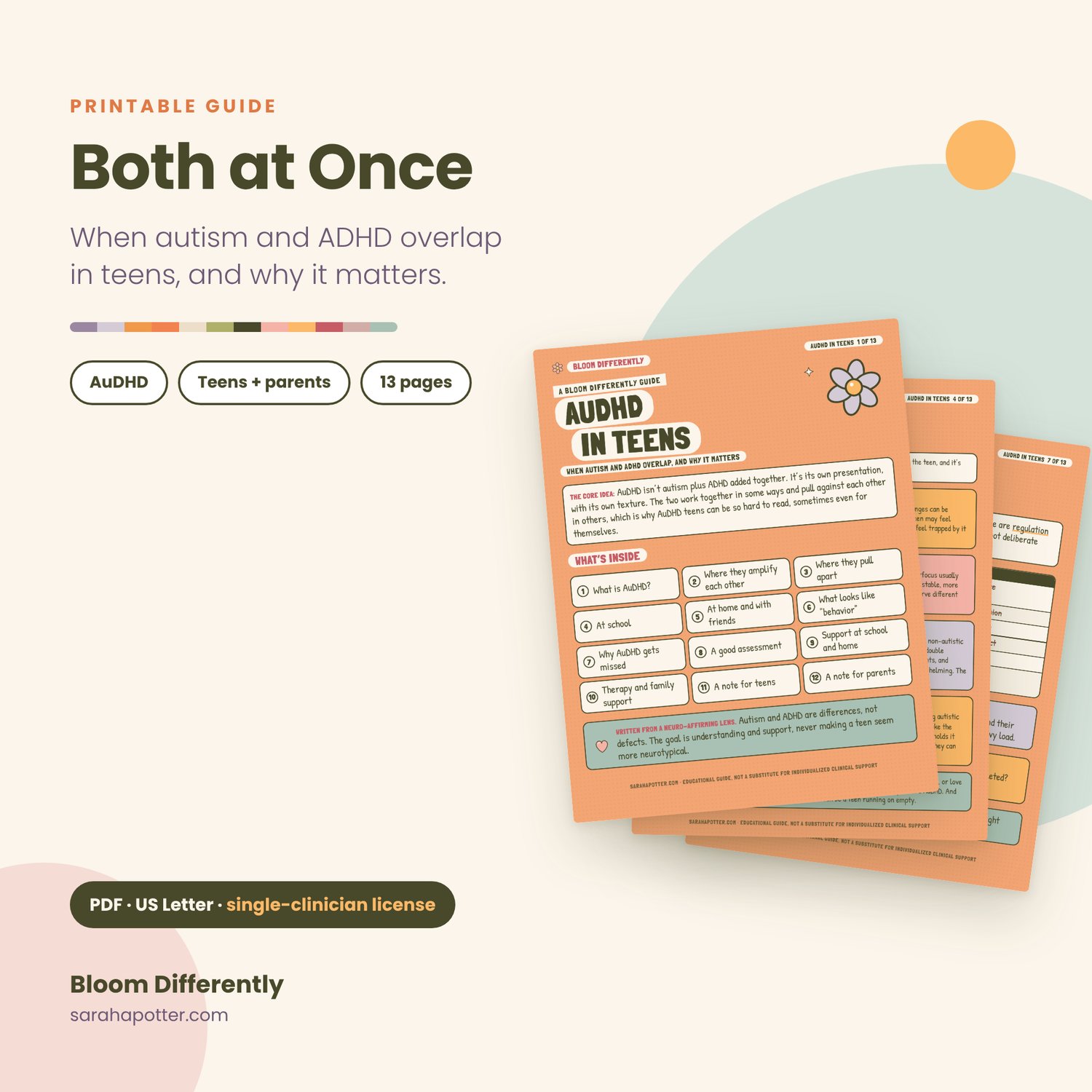
AuDHD isn’t autism plus ADHD added together. It’s its own presentation, with its own texture. The two work together in some ways and pull against each other in others. That’s why AuDHD teens can be so hard to read, sometimes even for themselves. This 13-page guide is written from a neuro-affirming lens. It helps teens, parents and professionals understand what’s happening underneath, and how to support it without asking a teen to seem more neurotypical.
What’s inside
- What is AuDHD? How common it is, why dual diagnosis wasn’t allowed until 2013, why it’s especially hard to see in teens, and the strengths that often come with it.
- Where they amplify each other: sensory processing, emotional intensity and other areas where having both makes things bigger.
- Where they pull in different directions: routine vs. novelty and the other internal tug-of-wars that make AuDHD so exhausting.
- At school: why AuDHD teens get called inconsistent or contradictory, and what’s really going on.
- At home and with friends: after-school collapse, the cost of masking, and friendship challenges.
- What can look like a “behavior problem”: a table translating refusal, shutdown and outbursts into the regulation needs underneath.
- Why AuDHD gets missed: six reasons, including masking, the traits hiding each other, and bias in assessment tools.
- What a good assessment includes: a checklist for families.
- Support at home and at school: strategies that fit both autism and ADHD, and where common advice backfires.
- Therapy and family support: what AuDHD-informed therapy looks like, and why some standard approaches don’t fit.
- A note for teens: “You are not broken. You are not lazy. You are not too much.”
- A note for parents and caregivers: reframes for the hard days, including treating home behavior as information.
Who it’s for
- Teens who are autistic, have ADHD, or both, and are trying to make sense of themselves.
- Parents whose teen “holds it together at school and falls apart at home.”
- Families seeking, or newly navigating, an AuDHD diagnosis.
- Therapists, school counselors and educators supporting AuDHD teens.
Ways to use it
- As psychoeducation after a diagnosis or during evaluation.
- For a parent and teen to read side by side, then talk about what fits.
- As a parent handout alongside individual teen work.
- As a professional development resource for school teams.
Why it’s different
Most resources treat autism and ADHD separately. This guide focuses on how they interact, where they amplify each other and where they pull apart, which is exactly what makes AuDHD teens hard to understand. It’s neuro-affirming from start to finish, it speaks directly to teens, and it treats behavior as communication rather than defiance.
What you get
- 1 printable PDF, 13 pages, US Letter.
- 12 sections of psychoeducation, a behavior translation table, an assessment checklist, and notes for teens and parents.
- Single-clinician license included.
Pairs well with
- Effort Isn’t the Issue: ADHD in Teens
- Autistic Teens: Here and NEVER Out of Place
- When the Cup Overflows (Sensory Meltdowns)
- Respect Goes Both Ways: Wise Mind Parenting for Teens