
Confidence and Self-Talk: Speaking to Yourself More Kindly (PDF Guide)
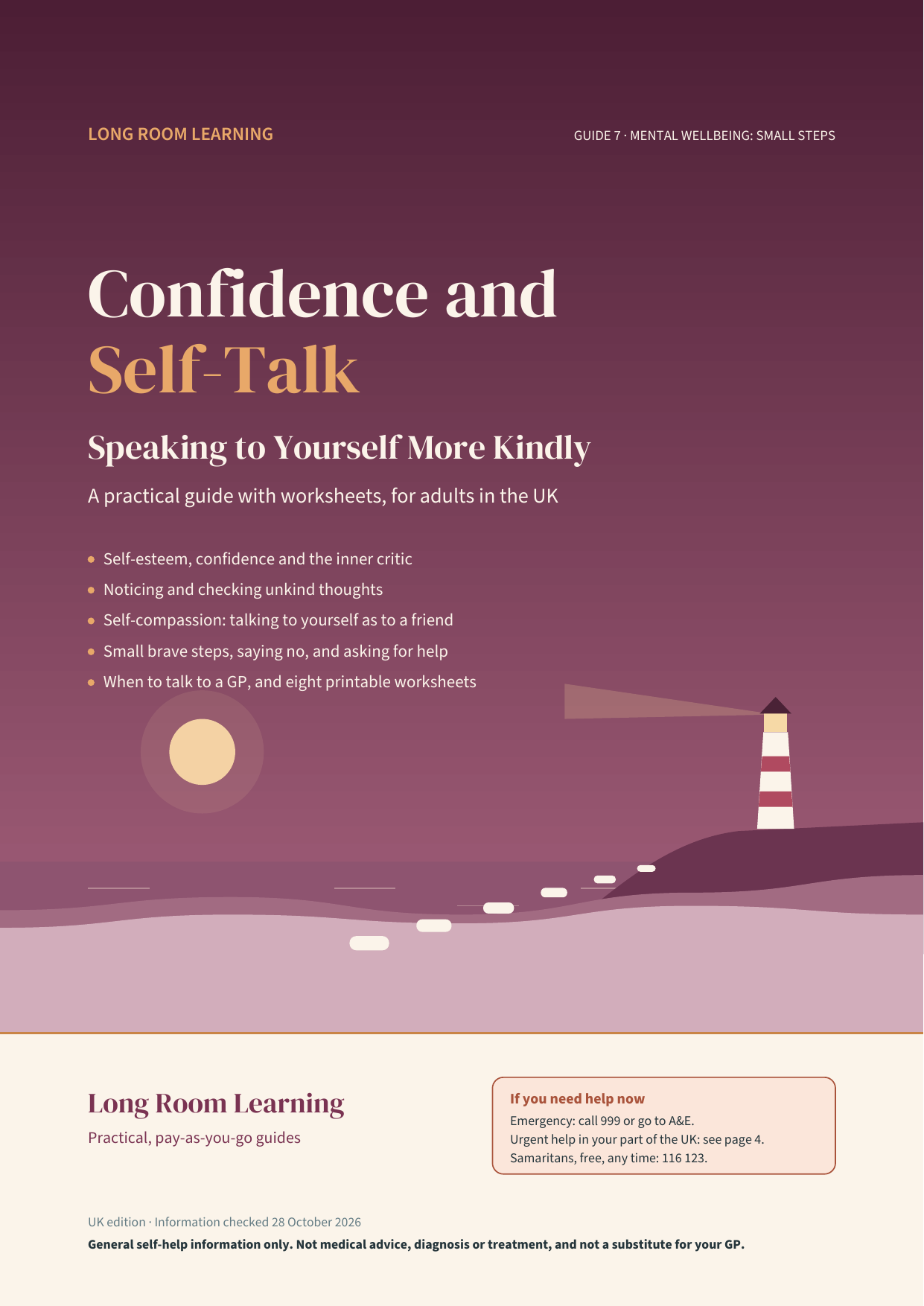
Is your inner voice harder on you than you would ever be on a friend? A calm, practical UK guide to noticing self-talk, checking unhelpful thoughts and taking small, brave steps, with eight printable worksheets.
Most of us have a critical inner voice at times. When it is loud or constant, it can make it harder to try new things, say no, or feel OK about yourself. This guide brings together official UK health information and what Mind and the Mental Health Foundation say about self-esteem and self-talk, and turns it into small, manageable steps.
It explains, in plain words, what self-esteem, confidence and self-talk mean, how low self-esteem can show up, and why avoiding things can keep it going. Then it walks you through noticing your self-talk, spotting common thinking patterns, the "catch it, check it, change it" approach, speaking to yourself as you would to a friend, keeping a list of good things, taking small brave steps, saying no and asking for what you need, and comparison and social media.
It is honest about what it does not do: it makes no promises to transform your confidence quickly. It explains that low self-esteem is not a medical condition on its own, and when it may be more than low self-esteem.
A clear chapter explains when to see a GP and how to get NHS talking therapies in England, Scotland, Wales and Northern Ireland. Urgent help contacts for each part of the UK are at the front and again at the back.
The eight A4 worksheets are spaced for handwriting: a self-talk log, spotting the patterns, catch it, check it, change it (a thought record), "me, forever, everything?", the friend test, a good-things list, small brave steps and saying no, and a kindness toolkit with space to prepare for a GP appointment.
What you get: one 32-page A4 PDF. Print the worksheets as often as you like for your own use. Information checked against official UK health and charity pages on 28 October 2026, with every source listed.
Please note: This guide is general self-help information only. It is not medical advice, therapy, counselling, diagnosis or treatment, and it is not a substitute for your GP. It cannot tell you whether you have depression, anxiety or any other condition. No particular result is promised. It does not give medicine or supplement advice: please ask your GP or a pharmacist. If low self-esteem or low mood is affecting your daily life, speak to a GP. If you feel unsafe or someone's life is at risk, call 999 or go to A&E. Samaritans are free to call on 116 123, day or night.
Guide 7 in the Mental Wellbeing: Small Steps series from Long Room Learning. Guide 1, Coping with Seasonal Low Mood, and Guide 2, Better Sleep, are also available.