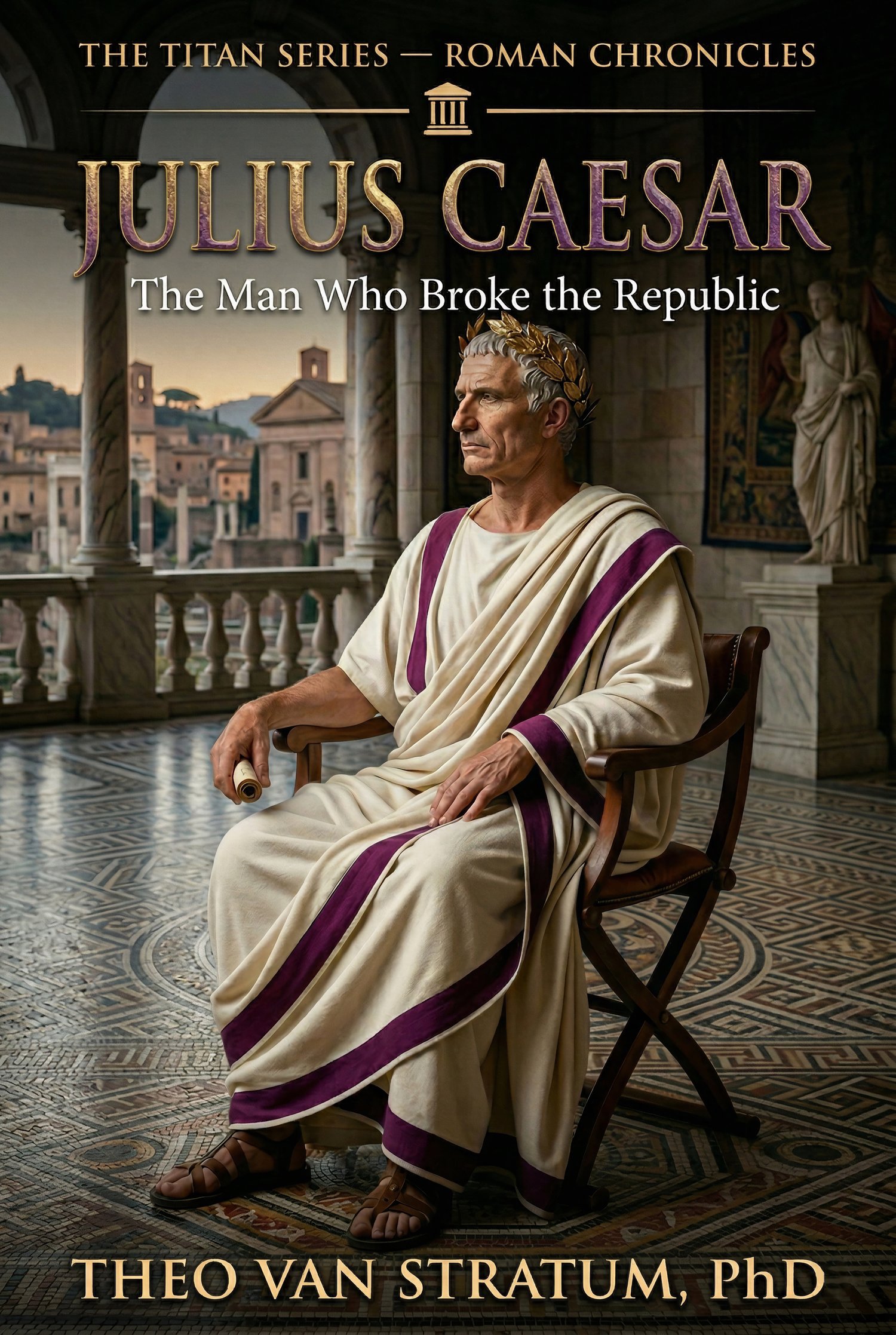
The Roman Chronicles - Titans - Julius Caesar
He crossed a river with one understrength cohort and started a war that ended a republic.
Julius Caesar is one of the most written-about figures in human history — and one of the most misunderstood. He is the salad. He is the Shakespeare quote. He is the statue with his arm raised. But behind the monument is a man of bewildering complexity: a patrician who championed the poor, a general who enslaved a million people, a politician who broke every rule he had ever sworn to uphold, and an administrator whose calendar reform we still live inside two thousand years later.
Julius Caesar: The Man Who Broke the Republic tells the full story — where he came from, what Rome actually was, what he built and what he destroyed, and why it still matters.
This is narrative nonfiction in the tradition of popular history: rigorously researched, written for the general reader, and unsparing in its honesty. It does not ask you to admire Caesar. It asks you to understand him — which turns out to be more unsettling.
What you will find inside:
- The Rome Caesar grew up in: a city of half a million people, extreme inequality, and a political system already beginning to crack under its own contradictions
- The making of a politician: the pirate kidnapping, the military campaigns that built his reputation, the audacious elections, the debts that were never really about money
- Ten years in Gaul: the engineering, the strategy, the casualties — a million dead and another million enslaved, told without evasion
- The civil war: the Rubicon crossing, the clemency policy that was also a weapon, Pharsalus, and the pursuit of Pompey to a boat off the Egyptian coast
- Egypt, Cleopatra, and the question Caesar could not answer: what does a man do when he has won everything?
- The reforms: the calendar, the census, the colonisation programmes, the law reform, the Corinthian canal that would not be built for another nineteen centuries
- The conspiracy: who they were, why they acted, what they got wrong — and the unread note he was still carrying when he died
- The aftermath: how the Republic the conspirators tried to restore became the Empire nobody had officially declared
No jargon. No footnotes. Just the story, told straight.