
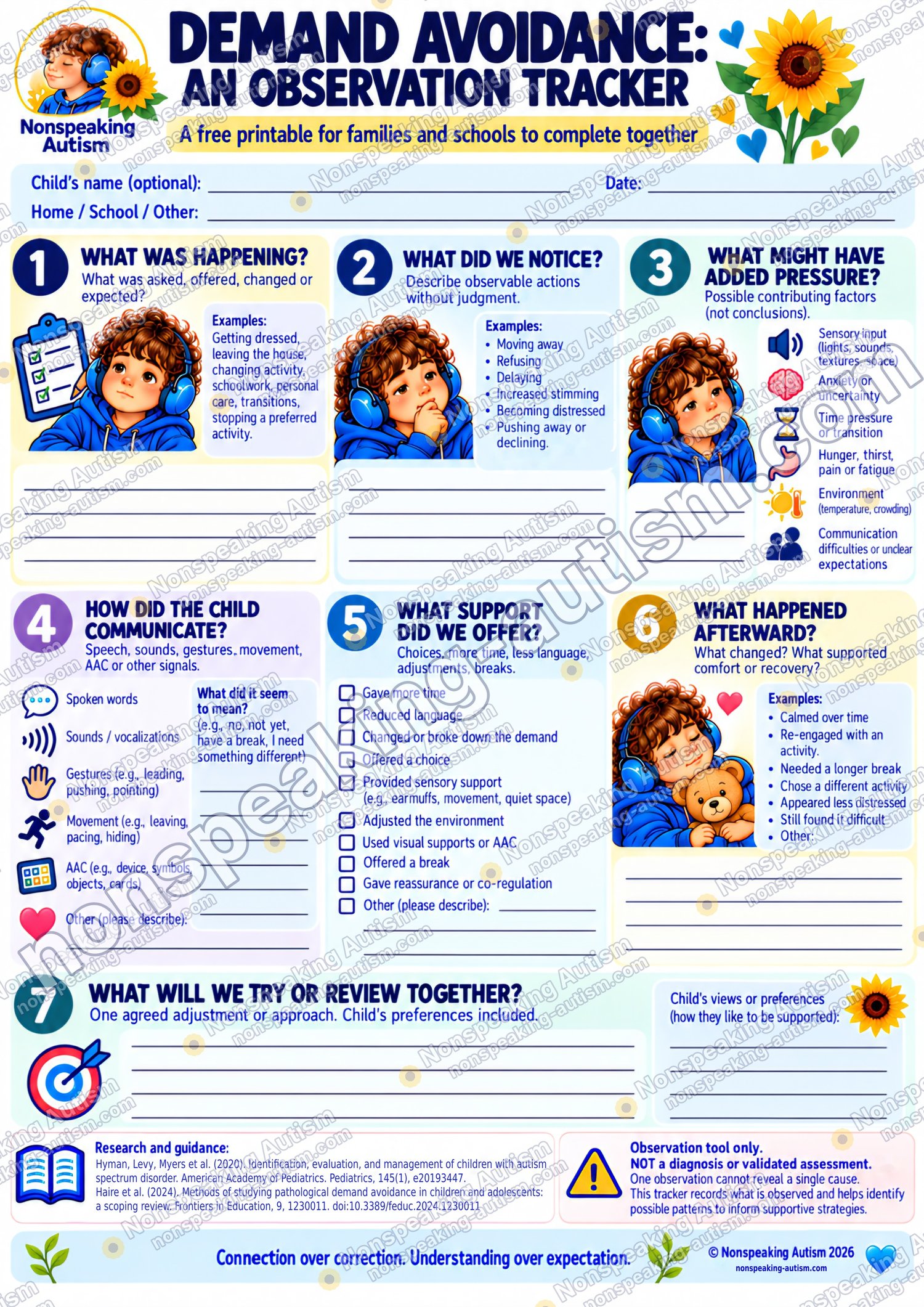
💙 DEMAND AVOIDANCE: AN OBSERVATION TRACKER
💙 DEMAND AVOIDANCE: AN OBSERVATION TRACKER
A Free Printable Worksheet for Families and Schools to Complete Together
🌻 FREE DIGITAL DOWNLOAD | U.S. EDITION
Created by Nonspeaking Autism
Connection over correction. Understanding over expectation.
💛 ABOUT THIS FREE RESOURCE
When an autistic child avoids, delays, refuses, or becomes distressed by a demand, there may be more happening than adults can immediately see.
Everyday expectations such as getting dressed, leaving the house, starting schoolwork, attending appointments, changing activities, or completing personal care tasks can involve multiple challenges.
For some children, these situations may bring together sensory discomfort, anxiety, uncertainty, fatigue, communication barriers, motor demands, or a need for greater predictability and control.
What looks like refusal from the outside may sometimes reflect genuine difficulty, distress, or an attempt to communicate a need.
Demand avoidance is something to understand, not automatically something to punish.
Demand Avoidance: An Observation Tracker is a free, printable resource designed to help families, caregivers, and school staff observe patterns, identify possible contributing factors, record what support was offered, and review what happened afterward.
Instead of asking only:
"Why won't this child do what they're told?"
This worksheet encourages a different set of questions:
"What was happening? What might have made it difficult? What was the child communicating? What helped, and what could we change next time?"
The goal is not to make assumptions about the child's intentions or identify one fixed cause.
It is to support curiosity, communication, practical adjustments, and collaborative planning.
🧠 WHAT THIS WORKSHEET EXPLORES
The printable contains seven structured sections, guiding adults from the original situation through to a shared plan for future support.
1️⃣ WHAT WAS HAPPENING?
This section helps adults describe the situation before the child showed signs of difficulty.
The worksheet asks:
What was asked, offered, changed, or expected?
Examples include:
- Getting dressed.
- Leaving the house.
- Changing activities.
- Starting schoolwork.
- Completing personal care.
- Managing transitions.
- Stopping a preferred activity.
Recording the context helps adults identify whether difficulties occur around particular activities, times of day, environments, or types of expectation.
A child may find one demand manageable in a familiar, calm environment but struggle with the same demand when tired, overwhelmed, or uncertain.
Context matters.
2️⃣ WHAT DID WE NOTICE?
This section focuses on observable actions rather than assumptions or judgment.
Possible observations include:
- Moving away.
- Refusing.
- Delaying.
- Increased stimming.
- Becoming distressed.
- Pushing away or declining.
The aim is to describe what actually happened.
For example, rather than writing:
"The child was being difficult."
An adult might record:
"The child moved away when asked to stop playing and begin getting dressed."
This creates a more useful starting point for understanding what may have contributed to the situation.
Importantly, stimming is not automatically a sign of distress. Its meaning depends on the child, their usual patterns, and the surrounding context.
3️⃣ WHAT MIGHT HAVE ADDED PRESSURE?
The third section encourages adults to consider possible contributing factors without treating them as proven explanations.
🔊 Sensory input
Bright lights, loud sounds, uncomfortable textures, busy spaces, or unexpected sensory experiences may increase discomfort.
🧠 Anxiety or uncertainty
Not knowing what will happen next, how long an activity will last, or whether something difficult might occur can make some situations harder.
⏰ Time pressure or transitions
Being rushed, interrupted, or expected to change activities without preparation may add pressure.
❤️ Physical needs
Hunger, thirst, pain, illness, fatigue, or other discomfort may affect a child's capacity to participate.
🌡️ Environmental conditions
Temperature, crowding, unfamiliar surroundings, or other changes in the environment may contribute.
💬 Communication difficulties or unclear expectations
A child may not fully understand what is being requested, may need additional processing time, or may not have an accessible way to express concerns.
These factors can overlap.
The worksheet encourages adults to consider possibilities, check with the child where possible, and avoid assuming that every instance of demand avoidance has the same cause.
4️⃣ HOW DID THE CHILD COMMUNICATE?
Communication is central to understanding distress and demand-related difficulties.
This section encourages adults to record how the child communicated and what the communication appeared to mean.
Possible methods include:
- Spoken words.
- Sounds or vocalizations.
- Gestures.
- Movement, including leaving, pacing, or hiding.
- Augmentative and alternative communication (AAC).
- Other individual communication signals.
Examples might include:
- "No."
- "Not yet."
- "I need a break."
- "I need something different."
A child may communicate through speech, gestures, body movement, symbols, a communication device, or several methods together.
A child does not need to communicate through spoken words for their needs, preferences, or boundaries to matter.
Adults should consider the child's individual communication methods and avoid assigning one definite meaning to a movement or behavior without further context.
5️⃣ WHAT SUPPORT DID WE OFFER?
This practical checklist helps adults record the adjustments they tried.
The worksheet includes:
- Giving more time.
- Reducing language.
- Changing or breaking down the demand.
- Offering a choice.
- Providing sensory support.
- Adjusting the environment.
- Using visual supports or AAC.
- Offering a break.
- Providing reassurance or co-regulation.
- Recording another support strategy.
This section is particularly useful because the support offered matters as much as the behavior observed.
A child who struggles with a task in one situation may participate more comfortably when the environment changes, communication becomes clearer, or expectations become more manageable.
No support works for everyone.
Choice, flexibility, sensory accommodations, and communication access should be based on the child's needs and preferences.
6️⃣ WHAT HAPPENED AFTERWARD?
The sixth section helps adults record what changed following the support.
Examples include:
- The child calmed over time.
- The child re-engaged with an activity.
- The child needed a longer break.
- The child chose a different activity.
- The child appeared less distressed.
- The situation remained difficult.
This helps families and educators look beyond whether a task was completed.
For example, a child may not complete the original activity but may become more comfortable, communicate a preference, or recover from distress.
These observations can still provide valuable information for future planning.
Successful support is not measured only by compliance.
Comfort, communication, safety, autonomy, and meaningful participation matter too.
7️⃣ WHAT WILL WE TRY OR REVIEW TOGETHER?
The final section encourages adults to agree on one practical adjustment or approach to try next.
It also provides space to include:
The child's views or preferences about how they like to be supported.
This is an important feature of the worksheet.
Children should be included in decisions affecting them wherever possible, using their preferred communication methods.
A shared plan might involve:
- Giving advance notice before transitions.
- Offering a quieter space.
- Adjusting the time allowed for a task.
- Making AAC available.
- Reducing unnecessary verbal instructions.
- Providing an alternative way to participate.
- Offering a meaningful choice.
- Building a more predictable routine.
- Reviewing whether the activity itself needs changing.
The aim is to agree on an adjustment, observe what happens, and review it together.
Observe. Support. Review. Adapt.
🌿 UNDERSTANDING DEMAND AVOIDANCE IN AUTISM
Demand avoidance can describe a range of responses to expectations or requests.
These responses may include delaying, withdrawing, declining, moving away, becoming distressed, or finding it difficult to begin or continue an activity.
It is important to distinguish the observable response from any assumptions about why it occurred.
A child might avoid a demand because:
- The task is confusing or inaccessible.
- The environment is overwhelming.
- The child is experiencing pain or fatigue.
- A transition feels unpredictable.
- The task involves difficult motor coordination.
- The child is anxious about making a mistake.
- The child needs more processing time.
- The child is communicating a preference or boundary.
- Several pressures are occurring together.
Demand avoidance does not automatically indicate a specific diagnosis or profile.
Terms such as pathological demand avoidance or persistent drive for autonomy are used in some clinical, educational, and community discussions, but their definitions and diagnostic status are debated.
This worksheet does not attempt to identify a particular demand-avoidance profile.
Instead, it focuses on practical observations and individualized support.
The same outward response can have different meanings for different children.
💬 RESPECTING COMMUNICATION AND AUTONOMY
A central principle of this resource is that children's communication deserves to be recognized and respected.
For nonspeaking and minimally speaking children, communication may involve:
- AAC devices.
- Picture symbols.
- Gestures.
- Body movements.
- Facial expressions.
- Vocalizations.
- Written language.
- Other individualized methods.
Some children may need support to understand a request, consider options, or communicate what feels difficult.
Adults can help by allowing processing time, offering accessible information, and ensuring communication systems remain available.
Refusal or avoidance should not automatically be treated as proof that a child lacks understanding or is deliberately challenging adults.
Likewise, adults should not assume that every movement or expression communicates refusal.
Observe carefully, listen to the child, and seek clarification through accessible communication whenever possible.
🏫 HOW SCHOOLS CAN USE THIS RESOURCE
This observation tracker may support collaborative conversations between families and educational teams.
It can help identify patterns around:
- Classroom tasks.
- Morning arrival.
- Transitions between activities.
- Personal care routines.
- Group participation.
- Sensory environments.
- Communication demands.
- Homework.
- Unexpected changes.
- Recovery after distress.
📘 SUPPORTING IEP DISCUSSIONS
For students with an Individualized Education Program (IEP), observations may help families and educators discuss individualized supports and accommodations.
These might include:
- AAC access.
- Visual information.
- Sensory adjustments.
- Flexible transitions.
- Additional processing time.
- Adapted task presentation.
- Communication supports.
- Break opportunities.
- Collaborative problem-solving.
📗 SUPPORTING SECTION 504 DISCUSSIONS
Where appropriate, observations may also inform discussions about accommodations under Section 504.
The worksheet may help teams consider whether changes to routines, environments, communication access, or task demands could reduce barriers.
This resource is not a substitute for an IEP, Section 504 plan, Functional Behavioral Assessment (FBA), or formal educational evaluation.
It is a supplementary observation and discussion tool.
🔬 RESEARCH & GUIDANCE-INFORMED
This worksheet draws on broader principles from autism assessment, individualized support, and research into demand-related difficulties.
Research highlights the importance of considering context, communication, anxiety, sensory needs, and other potential influences rather than assuming one explanation for an observable response.
However, demand avoidance remains a complex area of study.
Different researchers may define and measure it in different ways, and findings should not be applied as though every autistic child has the same experience.
📚 SELECTED REFERENCES
1. Hyman, S. L., Levy, S. E., & Myers, S. M. (2020).
Identification, Evaluation, and Management of Children With Autism Spectrum Disorder.
Pediatrics, 145(1), e20193447.
https://doi.org/10.1542/peds.2019-3447
This American Academy of Pediatrics clinical report supports individualized evaluation and coordinated care that considers communication, development, medical needs, behavior, and environmental context.
2. Haire, N., et al. (2024).
Methods of studying pathological demand avoidance in children and adolescents: A scoping review.
Frontiers in Education, 9, 1230011.
https://doi.org/10.3389/feduc.2024.1230011
This review examines approaches to studying demand avoidance and helps illustrate the importance of careful definitions, measurement, and interpretation.
Evidence Note
The research and guidance above inform the educational approach used in this worksheet.
They do not establish that the worksheet is a validated assessment or that any individual behavior proves a particular cause.
Observations should be interpreted alongside the child's communication, preferences, circumstances, and any relevant professional assessments.
👨👩👧 WHO IS THIS FREE RESOURCE FOR?
This worksheet may be useful for:
- Parents and caregivers.
- Families of nonspeaking autistic children.
- Families of minimally speaking autistic children.
- Families of speaking autistic children.
- General education teachers.
- Special education teachers.
- Classroom aides and paraprofessionals.
- School psychologists.
- School counselors.
- Speech-language pathologists.
- Occupational therapists.
- Autism support professionals.
- IEP and Section 504 teams.
- Home–school support teams.
It is designed for shared reflection and practical planning rather than scoring, labeling, or comparing children.
📦 WHAT YOU RECEIVE
🌻 1 FREE PRINTABLE OBSERVATION TRACKER
Demand Avoidance: An Observation Tracker — U.S. Edition
The worksheet includes:
✅ Child's name (optional), date, and setting fields.
✅ Seven structured observation and planning sections.
✅ Examples of everyday demands.
✅ Space to describe observable responses without judgment.
✅ Prompts for possible contributing pressures.
✅ Communication methods, including AAC.
✅ A checklist of support strategies.
✅ Space to record what happened afterward.
✅ A collaborative review and next-steps section.
✅ Dedicated space for the child's views and preferences.
✅ Research and educational disclaimer notes.
💙 DOWNLOAD DETAILS
Price: FREE.
- Edition: U.S. English.
- Resource type: Printable observation worksheet.
- Intended use: Home, school, and individual educational support.
- Delivery: Digital download through Payhip.
- Physical product: None.
The promotional preview contains watermarks. The downloadable version should be provided as a clean, readable file without promotional watermarks.
⚠️ IMPORTANT DISCLAIMER
This resource is provided for educational and observational purposes only.
It is not a diagnostic tool, validated assessment, behavioral evaluation, medical assessment, or substitute for individualized professional advice.
No single observation can establish why a child avoided, delayed, or declined a demand.
Possible contributing factors include communication barriers, sensory discomfort, anxiety, pain, illness, fatigue, environmental conditions, and other individual needs.
Sudden, unusual, persistent, or severe changes in a child's behavior or functioning may require professional assessment.
Adults should prioritize safety, respect communication, and avoid coercive or punitive responses to distress.
The worksheet should be used collaboratively and adapted to the child's individual circumstances.
©️ COPYRIGHT & PERMITTED USE
Copyright © 2026 Nonspeaking Autism. All rights reserved.
This worksheet is offered as a free educational resource.
Permitted use:
- Personal and family use.
- Printing copies for individual home use.
- Individual classroom and school use.
- Individual professional educational use.
- Collaborative support planning with families and school teams.
Not permitted:
- Reselling the worksheet.
- Redistributing the downloadable digital file.
- Uploading it to other websites or resource platforms.
- Removing the copyright or Nonspeaking Autism branding.
- Claiming the content or artwork as your own.
- Including it in commercial bundles or products.
Please share the original Payhip listing with others who may benefit, so they can obtain their own free copy.
💛 THE MESSAGE BEHIND THIS RESOURCE
When a child struggles with a demand, the response we see is only one part of the story.
There may be uncertainty we have not recognized.
A sensory experience we have not noticed.
A communication barrier we have not understood.
A physical need we have not checked.
Or a task that requires more effort than we realize.
We cannot always know the cause immediately.
But we can listen.
We can observe without judgment.
We can make meaningful adjustments.
And we can include the child in decisions about their support.
The purpose of this tracker is not to prove that a child is avoiding demands. It is to help adults understand what may be making everyday situations difficult and respond more effectively.
🌻 Look for patterns. Respect communication. Plan support together.
💙 Connection over correction. Understanding over expectation.
Nonspeaking Autism © 2026
Different needs. Equal belonging.