
Cognitive Restructuring
Accurate, kind, and complete thinking.
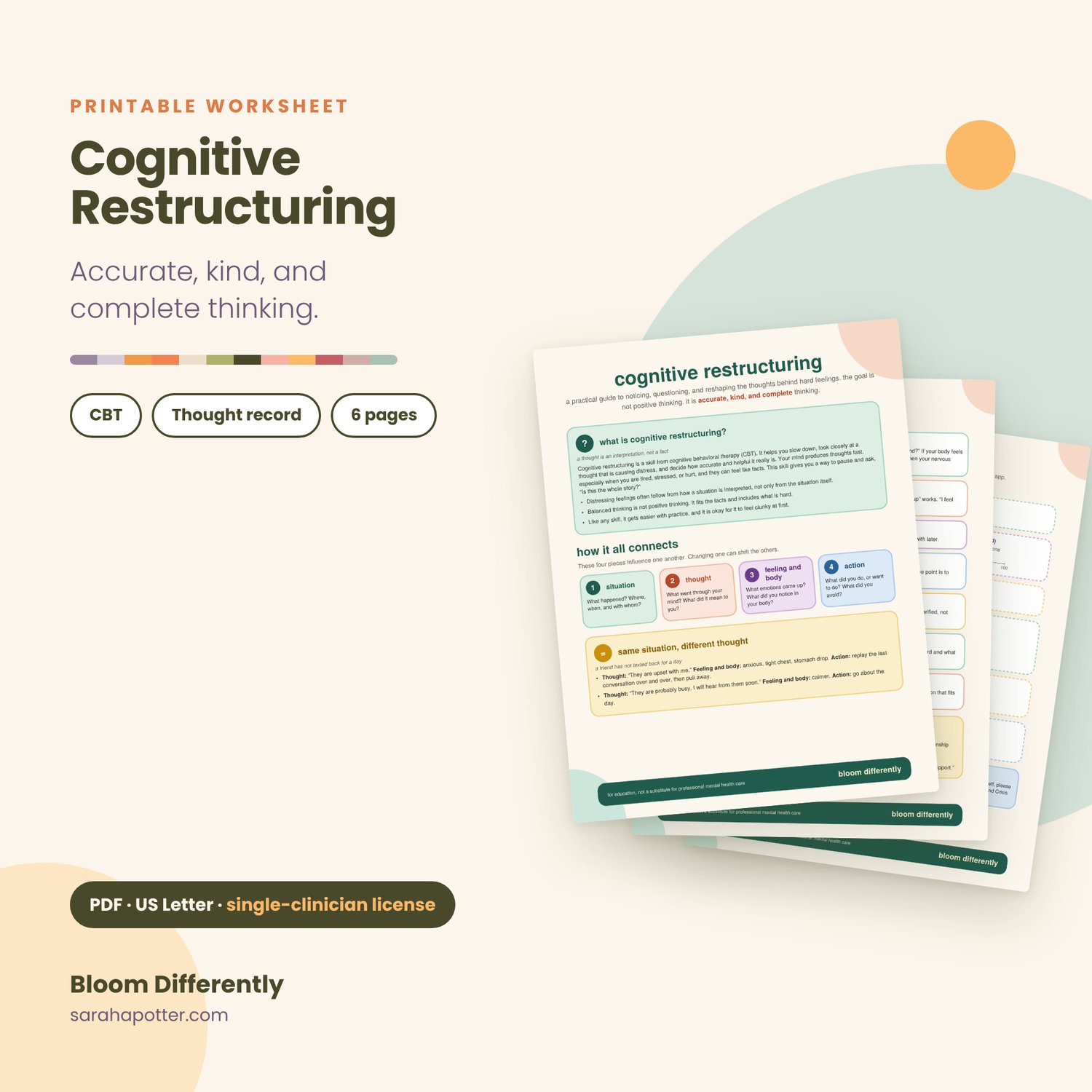
Cognitive restructuring isn’t positive thinking. It’s learning to slow down, look closely at a thought that’s causing distress, and ask, “Is this the whole story?” This six-page CBT guide walks clients through the skill step by step, from noticing a thought to writing a balanced one.
What’s inside
- Page 1, what it is and how it connects: the situation, thought, feeling and action cycle, and a “same situation, different thought” example.
- Page 2, twelve common thinking traps, sorted into four groups (all-or-nothing patterns, predicting and guessing, filtering what counts, and rules and responsibility), each with a question to ask.
- Page 3, the seven steps: pause and notice the shift, capture the thought, rate the feeling, look for a trap, weigh the evidence, write a balanced thought, and re-rate and choose a next step.
- “When the thought is partly (or fully) true”: restructuring is never arguing yourself out of what’s real, like an unsafe relationship or a non-accommodating workplace.
- Page 4, questions that loosen a stuck thought, tips for making it stick, and a three-question quick version for low-energy days.
- Page 5, a worked example plus stuck-to-balanced thought pairs.
- Page 6, a blank thought record with support information, including 988.
Who it’s for
Teens and adults in CBT or CBT-informed therapy, especially those dealing with anxiety, low mood, perfectionism, self-criticism or people-pleasing. It’s useful for therapists, school counselors and groups.
Ways to use it
- Teach the full skill over one or two sessions, using the worked example together.
- Print extra copies of the thought record for homework.
- Use the quick version when a client is too tired or overwhelmed for all seven steps.
- Pair it with ANTs as the next step after a client learns to spot thinking traps.
Why it’s different
It’s validating rather than dismissive. It says outright that some painful thoughts are true, puts “regulate first, reframe second” for flooded nervous systems, and allows drawing, voice notes or talking it through instead of writing.
What you get
A six-page printable PDF, US Letter, available as an instant download. Single-clinician license included.
Pairs well with: ANTs: Automatic Negative Thoughts, Thoughts vs. Feelings, Building Confidence