
🌻 Safety Communication Board
🌻 Safety Communication Board
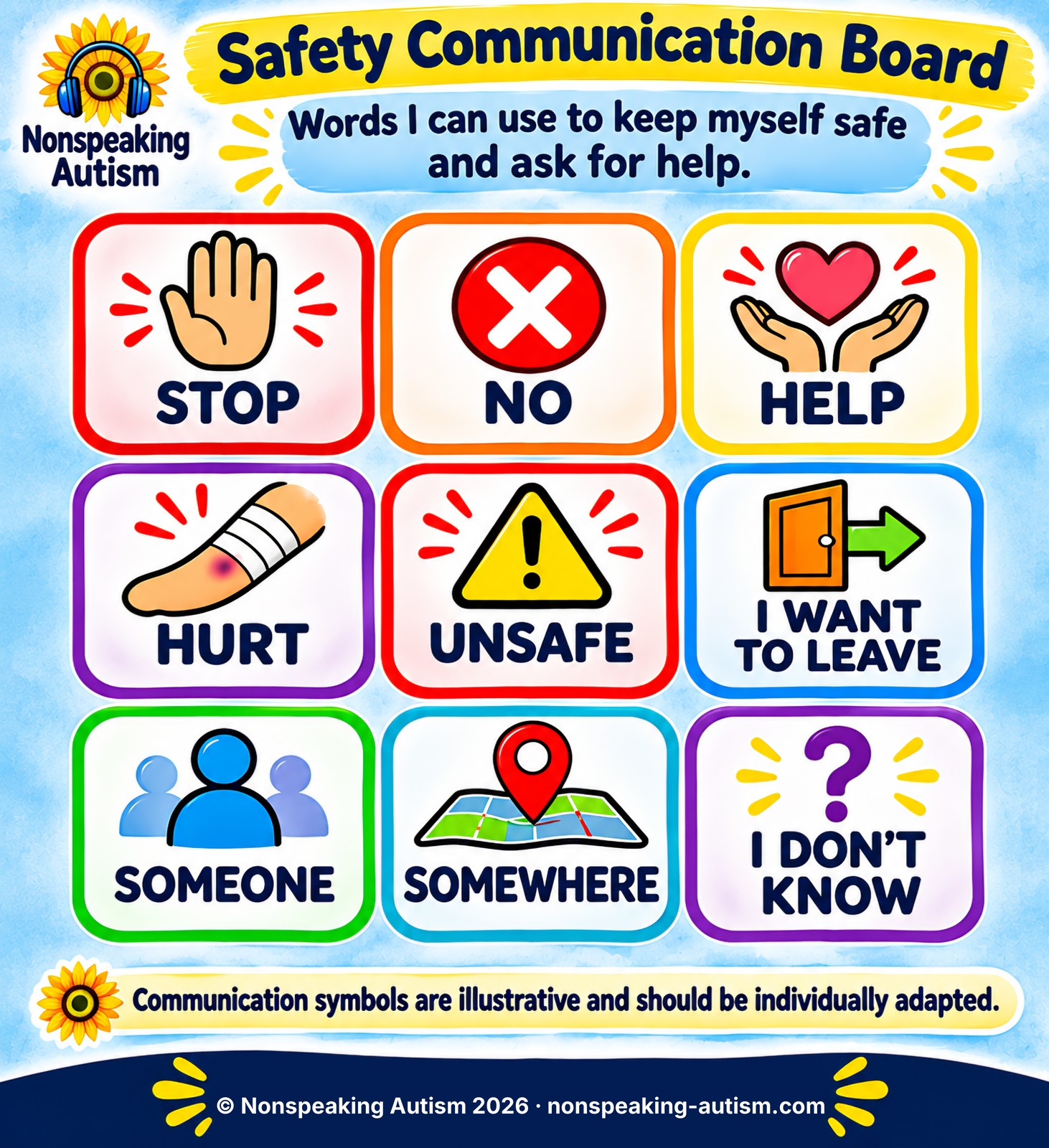
Words I can use to keep myself safe and ask for help
Printable Communication Board | A4, A3 and A2 | UK Edition
Many communication boards are designed for requesting snacks, toys and activities, but not for saying "stop", "I'm hurt" or "I want to leave".
The Safety Communication Board gives nonspeaking children and AAC users nine clear, high-contrast symbols for keeping themselves safe and asking for help:
STOP • NO • HELP
HURT • UNSAFE • I WANT TO LEAVE
SOMEONE • SOMEWHERE • I DON'T KNOW
SOMEONE and SOMEWHERE let a child begin to say who or where, and I DON'T KNOW gives them an honest answer that is always allowed.
A child should never have to learn to speak before being given a way to ask for protection.
💛 HOW TO USE IT
- Introduce the board when your child is calm, and model the symbols yourself during everyday activities, for example "STOP" when a game ends, or "HURT" when you bump your knee.
- Keep it within reach at home, at school, in the car and at appointments, alongside your child's usual AAC.
- Always respect "STOP" and "NO" when it is safe to do so, so your child learns their communication is listened to.
- Take every "HURT", "UNSAFE" or "HELP" seriously. Stay calm, avoid leading questions and follow safeguarding procedures if you are worried.
- Work with your child's speech and language therapist to add these words to their own AAC system, using symbols they already know.
👨👩👧 WHO IS THIS BOARD FOR?
- Nonspeaking children and AAC users
- Parents, carers and families
- Teachers, teaching assistants and SENCOs
- Speech and language therapists
- Designated safeguarding leads
- Health, social care, respite and residential staff
📦 WHAT YOU RECEIVE
- A4 print-ready PDF (210 x 297 mm)
- A3 print-ready PDF (297 x 420 mm)
- A2 print-ready PDF (420 x 594 mm)
- A2 high-resolution image (300 DPI)
Tip: print and laminate several A4 copies, so there is always one in the school bag, car and hospital bag.
Instant digital download. No physical product will be posted.
The downloadable files are provided without a watermark.
🔗 FURTHER RESOURCES
NSPCC Learning – Safeguarding d/Deaf and disabled children and young people
https://learning.nspcc.org.uk/safeguarding-child-protection/deaf-and-disabled-children
NSPCC Learning – Why language matters: why we talk about 'safe' rather than 'trusted' adults
https://learning.nspcc.org.uk/news/why-language-matters/safe-adults
ASHA – Augmentative and Alternative Communication (AAC)
https://www.asha.org/practice-portal/professional-issues/augmentative-and-alternative-communication/
📚 RESEARCH & REFERENCES
- Safety vocabulary and accessible ways to report harm: NSPCC (2025), Safeguarding d/Deaf and disabled children and young people (personal safety education is not always accessible; using each child's preferred communication method; making it easier for disabled children to report abuse).
- Adults who respond to safety communication: NSPCC (2026), Why language matters: why we talk about 'safe' rather than 'trusted' adults.
- Using symbols alongside a child's AAC system: ASHA, Augmentative and Alternative Communication (AAC), Practice Portal.
⚠️ IMPORTANT DISCLAIMER
This resource is for communication support and awareness only. It is not a substitute for professional safeguarding advice, a full AAC system or advice from a speech and language therapist.
Communication symbols are illustrative and should be individually adapted.
Teaching a child to ask for help does not transfer the responsibility for keeping them safe. That responsibility always lies with adults.
If a child is in immediate danger, call 999.
If you are worried about a child, contact your local authority children's services or the NSPCC Helpline on 0808 800 5000.
Children and young people can contact Childline on 0800 1111.
©️ COPYRIGHT & PERMITTED USE
© 2026 Nonspeaking Autism. All rights reserved.
For personal use in one home, classroom or setting only.
Please keep the original branding and copyright notice intact. The digital file must not be resold, modified, redistributed, uploaded to other websites or included in commercial products without permission.
💛 PLEASE LEAVE US FEEDBACK
If you find this board helpful, please consider leaving a review on Payhip. We would love to hear how you used it and what you would like us to create next.
Thank you for supporting Nonspeaking Autism! 🌻
Beyond awareness. Beyond behaviour. Towards understanding.
Nonspeaking Autism © 2026
nonspeaking-autism.com