
Co-Regulation
🌻 Co-Regulation — Why the Adult Nervous System Matters
A Research-Informed Visual Guide to Supporting Regulation, Safety & Communication
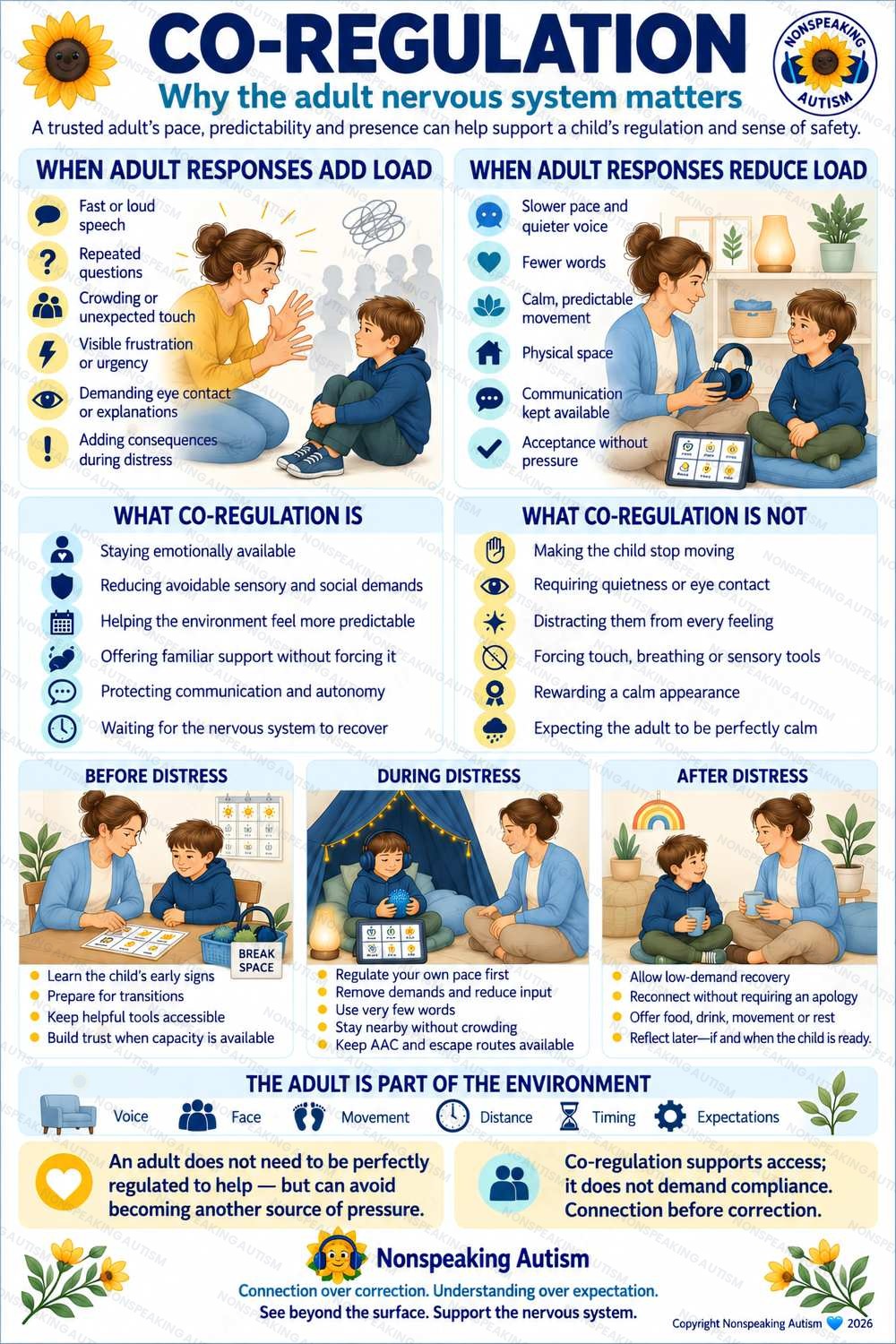
When a child is overwhelmed, the nervous system does not exist in isolation. The pace, voice, movement, expectations and emotional presence of the adults around them can become part of the environment they are trying to process.
Co-Regulation: Why the Adult Nervous System Matters is an educational visual guide exploring how a trusted adult can help reduce additional load during distress and support a child's nervous system as it moves towards safety and recovery.
Rather than focusing on stopping behaviour or achieving immediate compliance, this poster encourages adults to consider an important question:
“Is my response reducing the load — or unintentionally adding to it?”
💙 What This Poster Explores
The poster contrasts adult responses that may add nervous-system load with responses that may help reduce unnecessary pressure.
Responses that can add load may include:
- Fast or loud speech
- Repeated questions
- Crowding or unexpected touch
- Visible frustration or urgency
- Demanding eye contact or explanations
- Adding consequences during distress
Supportive alternatives may include:
- A slower pace and quieter voice
- Using fewer words
- Calm, predictable movement
- Providing physical space
- Keeping communication available
- Acceptance without pressure
The aim is not to create a perfectly calm adult. It is to recognise that adult behaviour can influence the sensory, social and emotional environment surrounding a distressed child.
🌱 What Co-Regulation Is
The guide presents co-regulation as supportive connection rather than behavioural control.
This can include:
- Staying emotionally available
- Reducing avoidable sensory and social demands
- Making the environment more predictable
- Offering familiar support without forcing it
- Protecting communication and autonomy
- Giving the nervous system time to recover
Co-regulation does not mean taking control of another person's body or forcing them to appear calm.
🚫 What Co-Regulation Is NOT
The poster also challenges some common misconceptions.
Co-regulation is not:
- Making a child stop moving
- Requiring quietness or eye contact
- Distracting them from every feeling
- Forcing touch, breathing exercises or sensory tools
- Rewarding a calm appearance
- Expecting the supporting adult to remain perfectly calm at all times
The goal is support and access — not compliance.
🧠 Before, During & After Distress
The poster provides practical examples across three stages.
Before Distress
Adults can learn a child's early signs, prepare for transitions, keep useful communication and sensory tools accessible, and build trust when the child has capacity.
During Distress
The emphasis shifts towards reducing demands and sensory input, regulating the adult's own pace, using fewer words, providing space and keeping AAC or other communication and escape routes available.
After Distress
Recovery may require low-demand time.
Rather than immediately requiring explanations or apologies, adults can reconnect gently, offer food, drink, movement or rest where appropriate, and reflect on what happened later — if and when the child is ready.
🌻 The Adult Is Part of the Environment
One of the central messages of this resource is that the adult's:
Voice • Face • Movement • Distance • Timing • Expectations
can all become part of the child's sensory and social environment.
An adult does not have to be perfectly regulated to provide meaningful support.
Sometimes the most helpful change is simply avoiding becoming another source of pressure.
Co-regulation supports access; it does not demand compliance.
Connection before correction.
📦 What You Receive
Your purchase includes:
1 × Co-Regulation — Why the Adult Nervous System Matters
This is a digital educational poster from Nonspeaking Autism.
The purchased version is supplied as a high-quality A2 PDF — exact 420 × 594 mm page size, suitable for digital viewing or printing.
The purchased version is supplied clear and without the promotional preview watermark. Watermarks visible on Payhip listing images are used for preview and copyright-protection purposes.
Digital download only — no physical product will be shipped.
🏫 Who Is This Poster For?
This resource may be useful for parents, caregivers, teachers, SEN/SEND staff, teaching assistants, support workers, therapists, healthcare professionals, autism organisations and anyone supporting autistic or otherwise neurodivergent children.
It may be particularly useful as a visual discussion resource in homes, classrooms, staff rooms, clinics, therapy environments, support settings and professional training.
⚠️ Educational Disclaimer
This resource is provided for educational and informational purposes only. It is not a diagnostic or therapeutic tool and is not a substitute for individualised medical, psychological, occupational therapy, speech and language, behavioural or other professional advice.
Every child's sensory, communication and regulation needs are different. Strategies that support one person may not support another. Support should always be individualised, respectful of autonomy and adapted to the person's communication, sensory and safety needs.
Sudden, severe or concerning changes in behaviour, communication, consciousness, breathing, pain or physical wellbeing should be appropriately assessed rather than automatically attributed to sensory overload, distress or nervous-system regulation.
© Copyright & Use
Copyright © Nonspeaking Autism 2026. All rights reserved.
Purchase is for the purchaser's personal or professional educational use. The digital file may not be resold, redistributed, uploaded, shared publicly, reproduced as another commercial product or claimed as another person's work without permission.
Connection over correction. Understanding over expectation.
See beyond the surface. Support the nervous system. 💙
Next, this poster is ready to be prepared as the exact 420 × 594 mm A2 PDF for your Payhip download.