
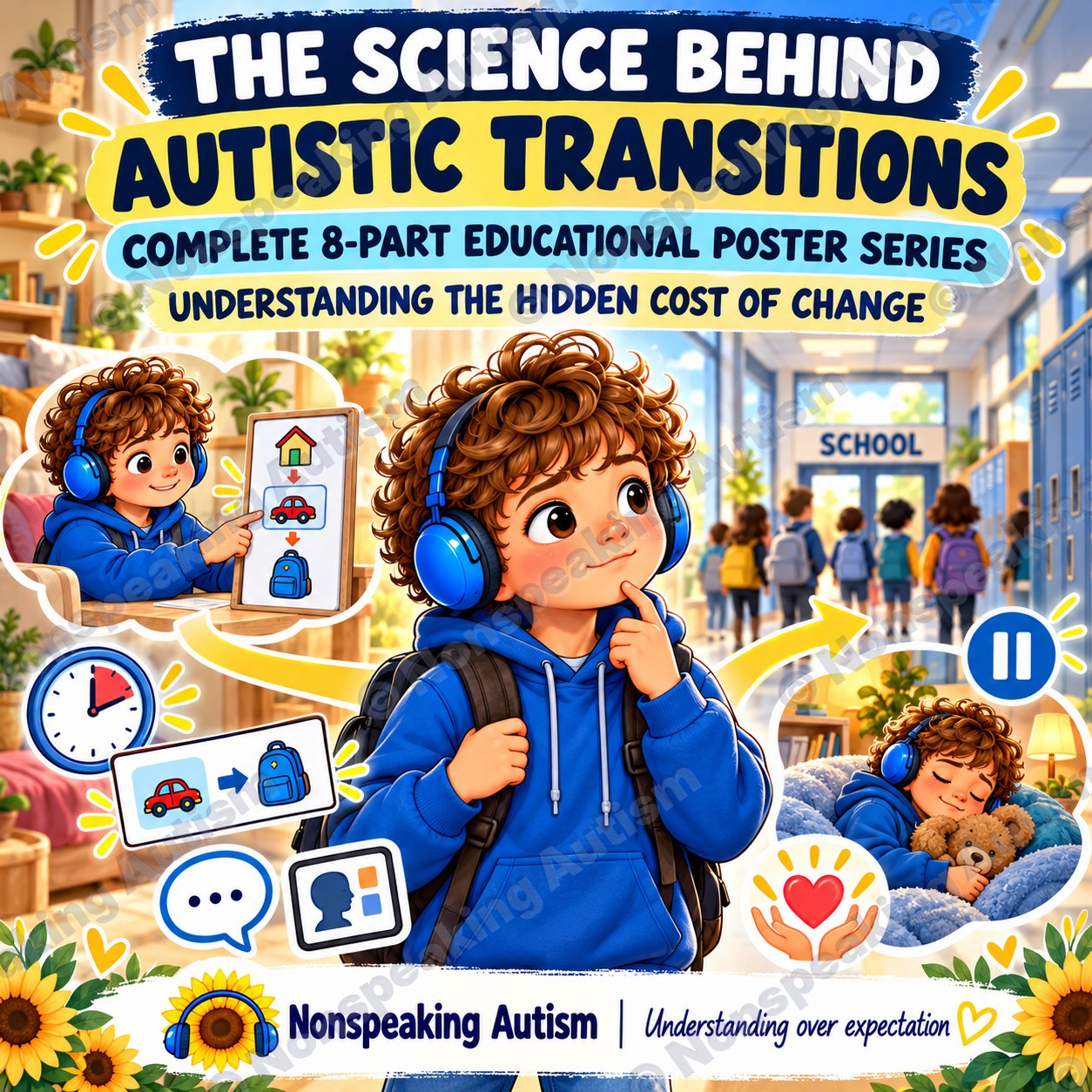
🌻 THE SCIENCE BEHIND AUTISTIC TRANSITIONS
🌻 THE SCIENCE BEHIND AUTISTIC TRANSITIONS
Complete 8-Part Educational Poster Collection | UK Edition
Understanding the Hidden Cost of Change
💙 An educational poster collection exploring sensory demands, communication access, uncertainty, task switching and recovery during autistic transitions.
A transition is not always as simple as moving from one place to another.
For some autistic children, changing activities, stopping something enjoyable, moving between environments or preparing for what comes next can involve several demands happening at once.
A child may need to process new sensory information, shift attention, stop an ongoing activity, understand changing expectations, access communication and manage uncertainty — sometimes within a very short period.
What appears to be one straightforward change to an adult may involve several separate transitions for the child.
The Science Behind Autistic Transitions is an eight-part, research-informed educational poster collection created to help parents, carers, teachers and professionals look beyond outward behaviour and better understand what may make transitions difficult.
The collection encourages adults to move away from automatically interpreting transition difficulties as refusal, defiance or unwillingness.
Instead, it explores possible contributing factors and offers practical, compassionate ways to reduce unnecessary demands.
The central message:
Do not simply help the child transition faster. Help the transition cost less.
🧠 WHAT THIS 8-PART COLLECTION EXPLORES
🌻 PART 1 — The Science Behind the Transitions Nobody Notices
A transition does not have to involve changing places to feel difficult.
This poster explores the smaller, often overlooked transitions that can occur throughout an ordinary day.
These include:
- Stopping a favourite activity.
- Switching between tasks.
- Coping with interruptions.
- Changing physical position.
- Ending a familiar routine.
- Beginning the next step of an activity.
For example, a child may find it difficult to stop building with blocks, switch from drawing to writing or move from sitting comfortably to standing.
These changes may involve attention shifting, motor planning, uncertainty or the effort of disengaging from something meaningful.
What this poster helps adults understand:
A familiar routine may contain several separate transitions, each requiring its own adjustment.
Practical support includes: allowing processing time, using visual supports where helpful, breaking routines into smaller steps and remaining flexible.
🌻 PART 2 — The Transition Isn't Over When the Child Arrives
Moving from A to B may be only the first part. Recovery may still be needed afterwards.
A child may successfully arrive at school, return home or enter a new environment while still managing the effects of the transition.
The poster explores possible signs of continuing adjustment, including:
- Reduced communication.
- Increased movement needs.
- Withdrawal or seeking quiet.
- Irritability or tears.
- Distress that becomes more visible later.
It highlights why adults may overlook this: arrival is easy to observe, but the child's internal experience is not.
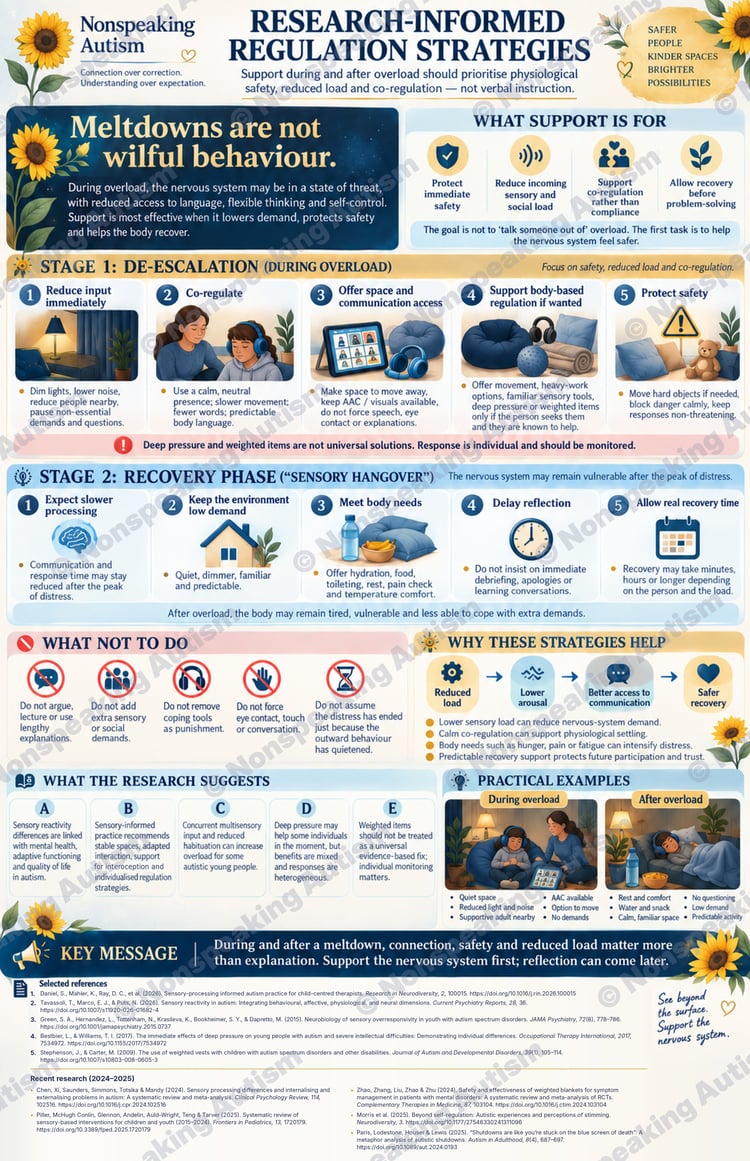
Practical support includes: decompression time, reduced language demands, quieter environments, preferred movement and access to food, drink or familiar comforts when needed.
Key message: A successful arrival does not always mean the transition cost has ended.
🌻 PART 3 — The Sensory Cost of Transitions
Changing rooms, people, activities, clothing, movement and expectations can introduce multiple demands at once.
This poster explores six areas that may change during a transition:
- The room: lighting, temperature, noise, smells, acoustics and visual clutter.
- The people: unfamiliar voices, proximity, communication styles and social expectations.
- The activity: stopping one task and beginning another with different materials or instructions.
- Clothing and body sensations: coats, shoes, PE kits, textures and temperature changes.
- Movement: sitting, standing, walking, lining up or navigating busy spaces.
- Expectations: new rules, time pressure, language demands and uncertainty.
The poster explains why several manageable demands may become difficult when they occur together.
Possible responses include slowing down, freezing, increased stimming, covering ears, moving away, reduced communication or distress.
Practical support includes: reducing unnecessary sensory input, giving processing time, maintaining familiar
communication supports and building recovery into demanding routines.
🌻 PART 4 — The Sensory Gap Between Environments
The destination may be familiar, but the sensory experience of getting there can still be difficult.
This poster uses the example of moving from home to school to explore differences in:
- Lighting.
- Sound.
- Temperature and touch.
- Movement.
- Visual surroundings.
- Social expectations.
A quieter, familiar home environment may feel very different from a busy school corridor or classroom.
The child may have to adjust to brighter lights, more voices, different temperatures, crowded spaces and changing expectations within seconds.
What this poster helps adults understand:
The difficulty may involve the contrast between environments rather than simply the destination itself.
Practical support includes: preparing with photographs or visuals, allowing adjustment time, reducing sensory input where possible and considering gradual transitions.
🌻 PART 5 — The Child's Starting State Matters
Why the same transition can feel different on different days.
A transition that feels manageable one morning may feel overwhelming the next.
This poster explores factors that may affect a child's capacity before a transition begins:
- Hunger or thirst.
- Pain, illness or physical discomfort.
- Tiredness or poor sleep.
- Accumulated sensory demands.
- Earlier tasks and expectations.
- Previous transitions.
Rather than assuming a child should manage a transition because they managed it yesterday, this poster encourages adults to consider what the child may already be coping with.
Practical support includes: checking basic needs, adjusting expectations, reducing sensory demands, using familiar supports and allowing recovery after difficult transitions.
Key message: The transition may not have changed. The child's needs at that moment may have.
🌻 PART 6 — Advance Warning Can Sometimes Add Pressure
Countdowns and reminders may help some children but increase anticipation or distress for others.
Advance notice is often recommended as a transition support. However, one approach does not work for every child.
This poster explores both possibilities.
For some children, a clear warning may:
- Reduce uncertainty.
- Make a change more predictable.
- Provide time to prepare.
For others, repeated reminders may:
- Increase anticipation.
- Draw attention repeatedly to an unwanted change.
- Add pressure while they are still engaged in an activity.
The poster also explains that there is no universally effective countdown interval.
Practical support includes: choosing the type of warning that suits the individual child, keeping reminders brief where helpful, trying visual timers or first–then supports and reducing repeated countdowns if they increase distress.
Key message: A warning can help someone prepare for change. It cannot always remove the difficulty of making that change.
🌻 PART 7 — Communication Access Can Change During a Transition
Understanding what is happening and being able to respond are not always the same thing.
A child may understand the next activity while finding it harder to process spoken language, express uncertainty or access their usual communication method during distress.
This poster explores possible changes in:
- Processing new spoken information.
- Expressing refusal or uncertainty.
- Using gestures, pointing, cards or AAC.
- Accessing words.
- Responding while stopping one action and beginning another.
A child may become quieter, freeze, move away, need repeated support or use fewer signals than usual.
These responses should not automatically be interpreted as deliberate refusal or lack of understanding.
Practical support includes: using fewer words, allowing extra processing time, keeping AAC and familiar communication supports available, reducing pressure and accepting all forms of communication.
Key message: Communication has not necessarily disappeared. The support needed to access it may have changed.
🌻 PART 8 — Knowing What's Next Doesn't Always Mean Being Able to Stop
Understanding, stopping, shifting attention and starting are different demands.
A child may know exactly what comes next and still struggle to move on from their current activity.
This poster explores four important distinctions:
Knowing is not the same as doing: understanding a plan does not guarantee that changing activities will be easy.
Stopping can be hard: ending a movement, routine or preferred activity may itself require considerable effort.
Shifting attention takes effort: disengaging from one focus and engaging with another may be difficult.
Starting the next step may be hard: beginning something new can involve initiation, organisation and motor demands.
The poster highlights why warnings, instructions or visual schedules may help with predictability without removing every difficulty.
Practical support includes: reducing competing input, giving extra time, using predictable language, showing what is ending and what happens next, and offering supportive movement or regulation options.
Key message: Do not just help the child know what comes next. Help them move on from what is happening now.
💛 PRACTICAL SUPPORT: WHAT ADULTS CAN DO
Across the collection, the emphasis is on understanding the individual child and adapting support to their needs.
Helpful approaches may include:
- Prepare thoughtfully: use photographs, visual schedules, first–then boards or advance notice when these genuinely help.
- Reduce unnecessary demands: consider lighting, noise, crowds, clothing, communication load and time pressure.
- Allow processing time: avoid assuming that a delayed response means the child has not understood.
- Protect communication access: keep AAC, gestures, visual supports and other preferred communication methods available.
- Recognise body needs: consider hunger, thirst, pain, fatigue and physical discomfort.
- Make routines flexible: predictability can help, but rigidity may introduce additional pressure.
- Support stopping and starting: recognise that ending one activity and beginning another can be separate challenges.
- Build in recovery: allow quiet time, preferred movement, rest or other personally helpful supports after demanding changes.
- Observe patterns together: involve the child wherever possible, including through their preferred communication methods.
Not every strategy will help every child. Support should be based on the person's preferences, communication, wellbeing and observed responses.
🔬 THE RESEARCH AND GUIDANCE BEHIND THE COLLECTION
This collection is research-informed, drawing on autism research, clinical guidance and educational understanding of sensory differences, activity transitions, communication, predictability and individual support needs.
Research and guidance recognise that autistic people can experience differences in sensory processing, communication, attention and responses to change.
However, transition difficulties are not explained by one universal mechanism.
A particular response may involve several contributing factors, and the same outward behaviour may have different meanings in different situations.
The posters use simplified illustrations and practical examples to make these ideas easier to understand. They should not be interpreted as direct measurements of an individual child's nervous system.
📚 Selected Research and Guidance
National Institute for Health and Care Excellence (NICE). (2013; updated 2021). Autism spectrum disorder in under 19s: support and management. Clinical guideline CG170.
This guideline addresses individualised support and the importance of considering communication needs, sensory sensitivities, environmental factors and coexisting difficulties.
National Autistic Society. Understanding autism, change and predictability.
The National Autistic Society provides practical information about changes in routine, predictability and supporting autistic people through transitions.
Buckle, K. L., et al. (2021). No Way Out Except From External Intervention: First-hand accounts of autistic inertia. Frontiers in Psychology.
This qualitative research explores autistic experiences of difficulties with starting, stopping and changing activities.
Birkett, L., McGrath, L., & Tucker, I. (2022). Muting, filtering and transforming space: Autistic children's sensory ‘tactics’ for navigating mainstream school space following transition to secondary school. Emotion, Space and Society, 42, 100872.
This study explores autistic children's sensory experiences and strategies in mainstream school environments.
Transitions Series – Research & References
• Birkett, L., McGrath, L., & Tucker, I. (2022). Muting, filtering and transforming space: Autistic children's sensory 'tactics' for navigating mainstream school space following transition to secondary school. Emotion, Space and Society, 42, 100872. https://doi.org/10.1016/j.emospa.2022.100872
• Brewer, A. T., Strickland-Cohen, K., Dotson, W., & Williams, D. C. (2014). Advance notice for transition-related problem behavior: Practice guidelines. Behavior Analysis in Practice, 7(2), 117–125. https://doi.org/10.1007/s40617-014-0014-5
• Buckle, K. L., Leadbitter, K., Poliakoff, E., & Gowen, E. (2021). "No way out except from external intervention": First-hand accounts of autistic inertia. Frontiers in Psychology, 12, 631596. https://doi.org/10.3389/fpsyg.2021.631596
• National Institute for Health and Care Excellence (2013, updated 2021). Autism spectrum disorder in under 19s: support and management (CG170). https://www.nice.org.uk/guidance/cg170
• Oldenburg et al. (2026). Describing the communication of autistic people during experiences of distress: A scoping review. Autism, 30(4), 884–900. https://doi.org/10.1177/13623613261417933
• Piller, A., McHugh Conlin, L., Glennon, T., Andelin, L., Auld-Wright, K., Teng, J., & Tarver, T. (2025). Systematic review of sensory-based interventions for children and youth (2015–2024). Frontiers in Pediatrics, 13, 1720179. https://doi.org/10.3389/fped.2025.1720179
• National Autistic Society. Advice and guidance on change, predictability and transitions. https://www.autism.org.uk
• Leicestershire Partnership NHS Trust. Autism Space.
Transitions Series – Research & References
• Birkett, L., McGrath, L., & Tucker, I. (2022). Muting, filtering and transforming space: Autistic children's sensory 'tactics' for navigating mainstream school space following transition to secondary school. Emotion, Space and Society, 42, 100872. https://doi.org/10.1016/j.emospa.2022.100872
• Brewer, A. T., Strickland-Cohen, K., Dotson, W., & Williams, D. C. (2014). Advance notice for transition-related problem behavior: Practice guidelines. Behavior Analysis in Practice, 7(2), 117–125. https://doi.org/10.1007/s40617-014-0014-3
• Buckle, K. L., Leadbitter, K., Poliakoff, E., & Gowen, E. (2021). "No way out except from external intervention": First-hand accounts of autistic inertia. Frontiers in Psychology, 12, 631596. https://doi.org/10.3389/fpsyg.2021.631596
• National Institute for Health and Care Excellence (2013, updated 2021). Autism spectrum disorder in under 19s: support and management (CG170). https://www.nice.org.uk/guidance/cg170
• Oldenburg, K., Gibbons, T., Welch, C., Tint, A., & Albin, M. (2026). Describing the communication of autistic people during experiences of distress: A scoping review. Autism, 30(4), 884–900. https://doi.org/10.1177/13623613261417933
• Piller, A., McHugh Conlin, L., Glennon, T., Andelin, L., Auld-Wright, K., Teng, J., & Tarver, T. (2025). Systematic review of sensory-based interventions for children and youth (2015–2024). Frontiers in Pediatrics, 13, 1720179. https://doi.org/10.3389/fped.2025.1720179
• National Autistic Society. Preference for order, predictability or routine. https://www.autism.org.uk/advice-and-guidance/topics/behaviour/dealing-with-change
• Leicestershire Partnership NHS Trust. Autism Space – information, advice and resources for autistic people in Leicester, Leicestershire and Rutland. https://www.leicspart.nhs.uk/autism-space/
Sources:
- Brewer et al. 2014 (PubMed Central)
- Oldenburg et al. 2026 (publisher listing via DOI)
- NAS – Preference for order, predictability or routine
- NHS England – ChatAutism and Autism Space
Important Evidence Note
The collection combines research findings, guidance and illustrative examples. The sources do not establish that every autistic child experiences transitions in the same way, or that a particular behaviour proves a specific underlying cause.
The suggestion that repeated advance warnings may increase distress for some children is an individualised practical consideration; direct research on the precise effect of countdown frequency and timing is limited.
The posters are educational resources, not validated clinical assessment tools.
👨👩👧 WHO IS THIS RESOURCE FOR?
This collection may be useful for:
- Parents, carers and families of autistic children.
- Autistic people and self-advocates exploring their own experiences.
- Mainstream and specialist school staff.
- SENCOs and SEND support teams.
- Teaching assistants and learning support staff.
- Occupational therapists.
- Speech and language therapists.
- Educational psychologists.
- Paediatric and community professionals.
- Autism support services.
- Home–school communication and collaborative planning.
- Staff training, SEND awareness and continuing professional development.
The posters may support discussions about reasonable adjustments, individual support plans and, where relevant, Education, Health and Care Plans (EHCPs) in England.
They can also be used to encourage conversations about transition-related distress without relying solely on behaviour-based explanations.
📦 WHAT YOU RECEIVE
Complete 8-Part Educational Poster Collection — UK Edition
Your digital collection includes:
- The Science Behind the Transitions Nobody Notices
- The Transition Isn't Over When the Child Arrives
- The Sensory Cost of Transitions
- The Sensory Gap Between Environments
- The Child's Starting State Matters
- Advance Warning Can Sometimes Add Pressure
- Communication Access Can Change During a Transition
- Knowing What's Next Doesn't Always Mean Being Able to Stop
Plus: 1 × matching collection cover.
Total: 8 educational posters + 1 collection cover.
The collection is designed for educational reference, family learning, school awareness and professional discussion.
File information: Digital printable resources. Please refer to the uploaded product files for the exact PDF format, page dimensions and resolution.
Preview watermarks: The product images displayed in the listing contain watermarks for copyright protection. The final customer files should be supplied without preview watermarks.
Digital download only — no physical product will be shipped.
⚠️ IMPORTANT EDUCATIONAL DISCLAIMER
This collection is provided for general education and awareness.
It is not intended to diagnose autism, identify a particular cause of distress, provide a clinical assessment or replace individualised professional advice.
Every autistic person is different. Sensory experiences, communication, attention, motor abilities, emotional responses and support preferences vary considerably.
Difficulty with a transition should not automatically be attributed to autism, sensory overload or anxiety. Pain, illness, fatigue, medication effects, environmental barriers and other factors may also contribute.
If a child experiences sudden, persistent, severe or unexplained changes in behaviour, distress or functioning, seek appropriate professional advice.
All support should respect the child's dignity, communication, preferences, consent and safety.
©️ COPYRIGHT & PERMITTED USE
Copyright © 2026 Nonspeaking Autism. All rights reserved.
Permitted Use
Purchasers may:
- Download and print the resources for personal or family use.
- Display printed posters in classrooms, schools, therapy rooms, clinics, workplaces, community spaces or educational settings.
- Use printed copies as visual references during educational discussions, training and staff development.
Not Permitted
- Reselling the posters or collection.
- Redistributing or sharing the digital files with third parties.
- Uploading the files to public websites, social media, shared drives or other download platforms.
- Editing, rebranding or removing copyright information.
- Including the digital resources in another product, resource pack or commercial download.
- Reproducing the artwork for resale or unauthorised commercial distribution.
Purchase grants permission to use the resources within the stated licence. Copyright and ownership remain with Nonspeaking Autism.
💛 THE MESSAGE BEHIND THIS COLLECTION
A child may know where they are going and still struggle to get there.
They may understand the next instruction and still need help stopping what they are doing.
They may arrive successfully and still need time to recover.
They may manage a transition one day and find the same transition overwhelming the next.
These experiences deserve curiosity, understanding and support — not automatic assumptions about refusal or behaviour.
Transitions are not only about reaching the next place or activity. They are also about the demands of leaving, adjusting, communicating, arriving and recovering.
When adults recognise those demands, they can begin to reduce unnecessary pressure and create more accessible, supportive environments.
Connection over correction.
Understanding over expectation.
🌻 Nonspeaking Autism
Different needs. Equal belonging.
© 2026 Nonspeaking Autism — All rights reserved.