
From Observation to Useful SEN Evidence
🌻 Part 2 — From Observation to Useful SEN Evidence
How to Record What You Are Actually Seeing
Everyday observations can contain valuable information about a child’s support needs — but phrases such as “they struggle after school” or “they find transitions difficult” may not provide enough detail to show what is happening, when it happens, what may contribute to it, or what actually helps.
Part 2 — From Observation to Useful SEN Evidence is an educational poster designed to help parents, caregivers and professionals turn everyday experiences into clearer, more structured observations that can support conversations with schools, SENCOs and other professionals.
The aim is not to prove a diagnosis or label a child’s behaviour. It is to help adults:
Look. Notice. Record. Join the dots.
📝 Turning Observations Into Useful Information
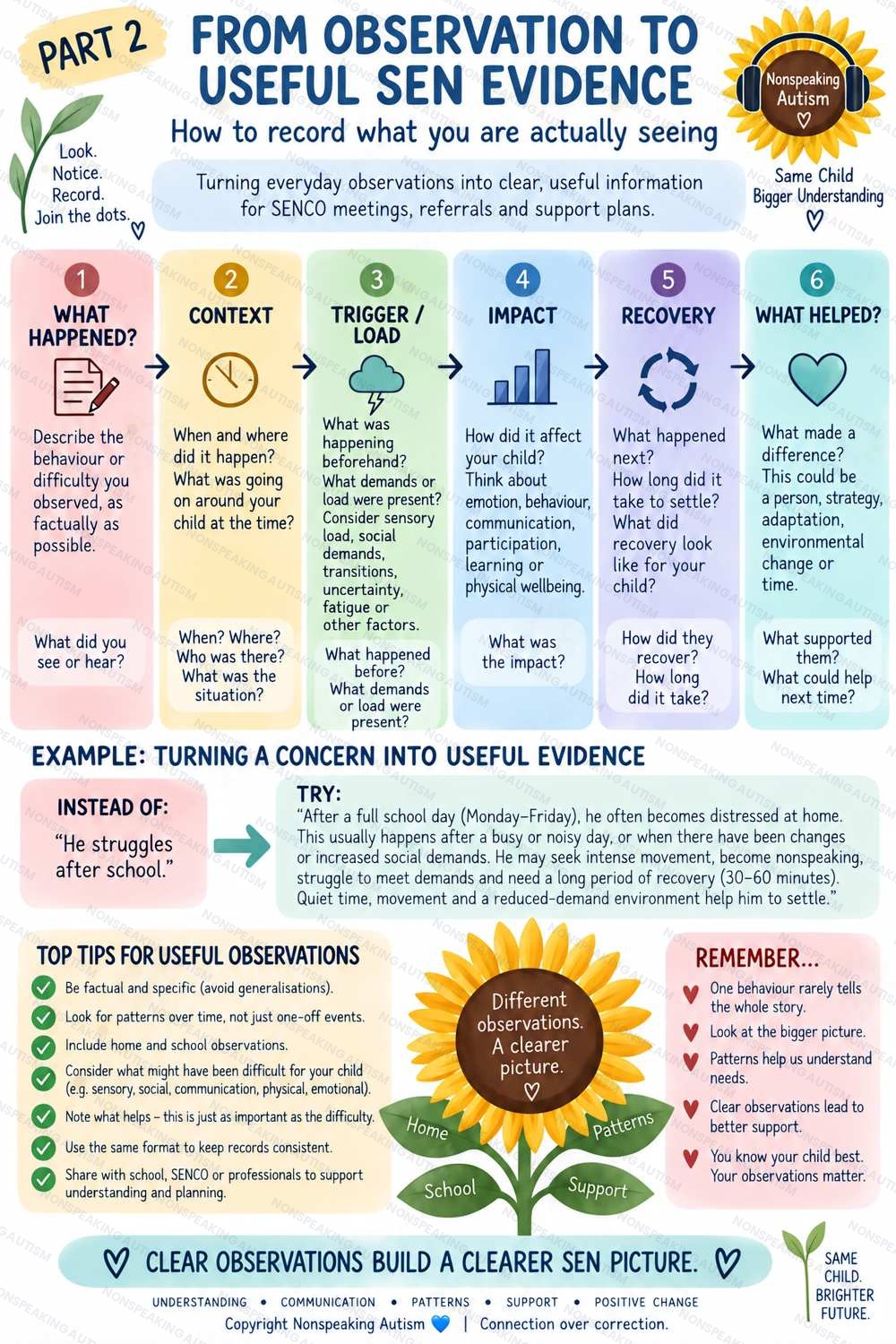
The poster introduces a simple six-part observation framework:
1. What happened?
Describe what you actually saw or heard as factually as possible.
2. Context
Record when and where it happened, who was present and what was happening around the child.
3. Trigger / Load
Consider what happened beforehand and what demands or pressures may have been present — including sensory load, social demands, transitions, uncertainty, fatigue or other factors.
4. Impact
Record how the experience affected the child. This may include changes in emotion, behaviour, communication, participation, learning or physical wellbeing.
5. Recovery
Notice what happened afterwards, how the child recovered and approximately how long it took them to settle.
6. What Helped?
Record anything that appeared to make a positive difference, such as another person, a strategy, adaptation, environmental change or simply additional time.
Together, these details can provide a much more informative picture than a general statement about a child “struggling”.
🔎 From a Concern to Clearer Evidence
Instead of recording only:
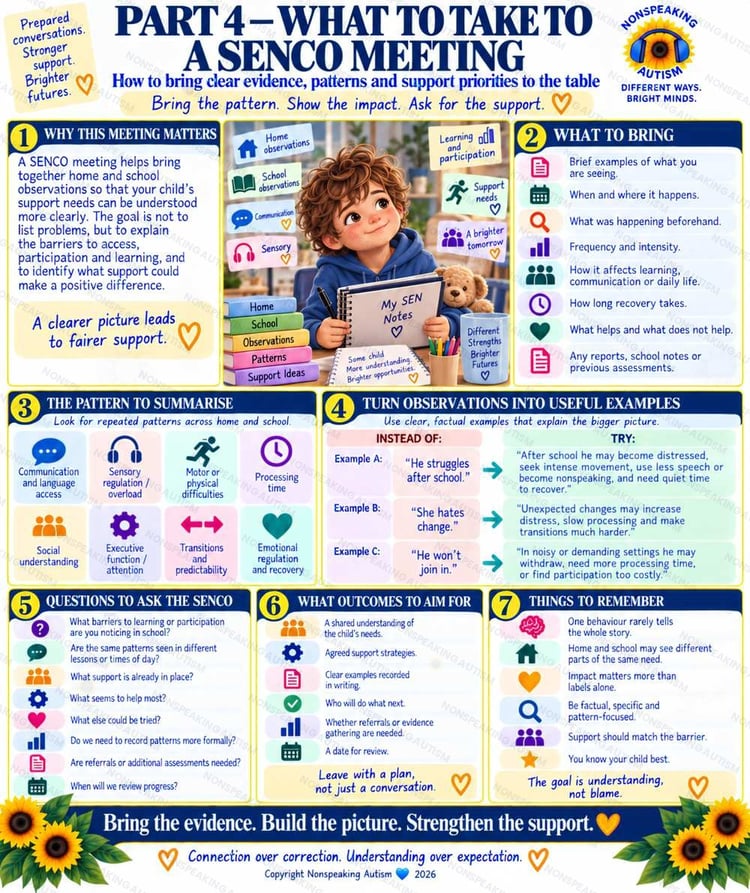
“He struggles after school.”
a more useful observation might describe:
- How often it happens
- What the school day was like
- Whether the environment had been busy or noisy
- Whether there had been changes or increased social demands
- What the child did afterwards
- Whether communication changed
- How long recovery took
- What helped the child settle
This creates context around the experience and makes it easier to identify recurring patterns over time.
💙 Why Patterns Matter
One observation rarely tells the whole story.
A difficulty noticed at home may be connected to demands experienced earlier at school. Something that appears behavioural may have sensory, communication, physical, emotional or social factors underneath it.
Recording observations consistently can help adults look beyond a single event and ask:
When does this happen? What tends to come before it? What is the impact? How long does recovery take? What makes things easier?
Over time, repeated observations can help build a clearer picture of the child’s individual needs.
🌻 Tips for More Useful Observations
Helpful records are generally factual, specific and consistent.
Look for patterns over time rather than relying on one-off events. Include observations from different environments where possible, consider what may have been difficult for the child, and record what helped as carefully as you record the difficulty itself.
Information from home and school can then be brought together to support a more complete discussion.
🏫 Supporting SEN Conversations
This poster can be particularly useful when preparing information for:
- SENCO discussions
- School support meetings
- Referrals
- SEN support planning and reviews
- Parent–school communication
- Professional appointments
- Personal observation records
It can also be used alongside Part 1 — Putting the Whole SEN Picture Together, helping move from recognising a possible pattern to documenting that pattern clearly and consistently.
💛 Remember
One behaviour rarely tells the whole story.
Look at the bigger picture.
Patterns can help us understand needs, and clear observations can support better-informed conversations about appropriate support.
Different observations. A clearer picture.
📦 What You Receive
Your purchase includes:
1 × From Observation to Useful SEN Evidence — Part 2
This is a digital educational poster from Nonspeaking Autism.
The purchased version is supplied as a high-quality A2 PDF — exact 420 × 594 mm page size, suitable for professional or home printing.
The purchased PDF is supplied clear and without the promotional preview watermark. Watermarks visible on Payhip listing images are used only for preview and copyright-protection purposes.
Digital PDF download only — no physical product will be shipped.
👨👩👧 Ideal For
This resource may be useful for parents and caregivers, teachers, SENCOs, SEN/SEND staff, teaching assistants, support workers and other professionals involved in understanding and supporting a child's individual needs.
It is particularly useful for families who want a straightforward framework for turning everyday experiences into clearer observations for SEN discussions.
⚠️ Educational Disclaimer
This resource is provided for educational and informational purposes only.
It is not a diagnostic or assessment tool and does not diagnose autism, ADHD, sensory processing differences, learning difficulties or any other developmental, medical or psychological condition.
The poster does not replace professional assessment, medical advice, educational assessment or the formal processes used to determine a child's special educational needs or provision.
Every child is different. Observations should be considered alongside information from the child, family, educational setting and relevant professionals where appropriate.
© Copyright & Permitted Use
Copyright © Nonspeaking Autism. All rights reserved.
Purchase permits use by the purchaser for personal or individual professional educational purposes.
The digital file may not be resold, redistributed, shared publicly, uploaded to file-sharing platforms, reproduced as another commercial product or claimed as another person's work without permission.
Clear observations build a clearer SEN picture. 💙
Understanding • Communication • Patterns • Support • Positive Change
Connection over correction. Understanding over expectation.