
🌻 UNDERSTANDING FACIAL TICS
🌻 UNDERSTANDING FACIAL TICS
A Simple Guide to Help Families Respond with Understanding and Support
Research-Informed Educational Poster | Nonspeaking Autism | UK Edition
💛 Different faces. Same worth. Always.
A child blinks repeatedly.
Their nose wrinkles unexpectedly.
Their mouth moves or their face briefly grimaces.
Someone assumes they are making faces, being rude, mocking another person or deliberately trying to get attention.
But what if the movement is not intentional?
Facial tics are involuntary movements that can look deliberate, even when they are not being done on purpose.
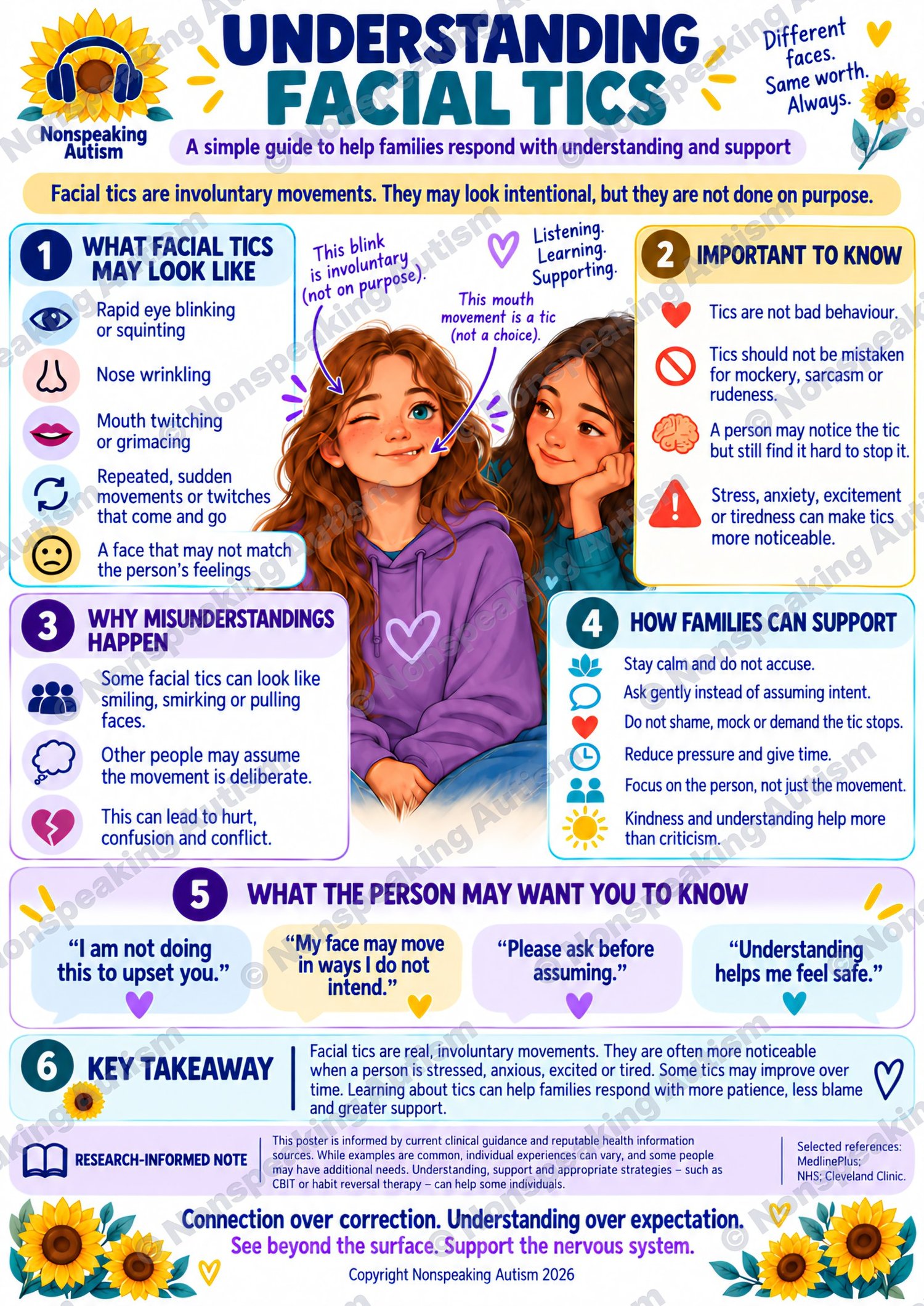
Understanding Facial Tics is an illustrated educational poster designed to help families, carers, teachers and professionals recognise possible facial tics, reduce misunderstandings and respond with kindness rather than blame.
It explores what facial tics may look like, why they are sometimes misinterpreted, what can make them more noticeable and how adults can provide compassionate, practical support.
The central message is simple:
See the person, not just the movement.
🧠 WHAT ARE FACIAL TICS?
Facial tics are sudden, repeated movements involving muscles of the face.
They are a type of motor tic and may include blinking, squinting, nose movements, mouth movements or facial grimacing.
Tics can vary in frequency, intensity and appearance. They may come and go, change over time or become more noticeable in particular situations.
Although facial tics are generally considered involuntary, some people experience a sensation or urge before a tic and may be able to suppress it temporarily. Suppression can require effort and does not mean the tic is simply a choice.
Facial tics can occur in people with or without autism. They are not automatically a sign of autism or Tourette syndrome.
A facial movement should not be assumed to be a tic without appropriate assessment.
🌈 WHAT THIS POSTER EXPLORES
1. 👁️ WHAT FACIAL TICS MAY LOOK LIKE
Facial tics can appear in several ways.
Rapid Eye Blinking or Squinting
A child may blink repeatedly or briefly tighten the muscles around their eyes.
Nose Wrinkling
The nose or surrounding facial muscles may move repeatedly.
Mouth Twitching or Grimacing
The mouth may pull to one side, twitch or briefly form an expression that others misunderstand.
Repeated Facial Movements
Movements may occur suddenly, repeatedly or in changing patterns.
Expressions That Do Not Match the Person's Feelings
A facial tic may resemble smiling, smirking, frowning or another emotional expression, even when it does not reflect what the person feels.
These examples are possibilities, not a diagnostic checklist.
Other conditions, habits, sensory responses and medical concerns can also cause facial movements.
2. ❤️ IMPORTANT THINGS TO KNOW ABOUT FACIAL TICS
The poster highlights several important messages.
Tics are not bad behaviour.
A child should not be punished, criticised or shamed for an involuntary movement.
A tic is not necessarily an emotional expression.
A mouth movement that resembles a smirk does not automatically indicate sarcasm, disrespect or amusement.
Awareness does not equal control.
A person may notice a tic but still find it difficult to prevent.
Stress, anxiety, excitement or tiredness may influence tics.
These factors can make tics more noticeable for some people, but patterns vary.
Tics are not always constant.
They may fluctuate over days, weeks or longer periods.
A child should not have to prove that a tic is involuntary in order to be treated respectfully.
3. 💜 WHY MISUNDERSTANDINGS HAPPEN
Facial expressions are often used to interpret another person's feelings or intentions.
However, a facial tic may resemble an intentional expression.
For example:
- A mouth movement may be mistaken for smirking.
- Repeated blinking may be interpreted as an exaggerated reaction.
- Facial grimacing may be mistaken for disapproval.
- A sudden expression may be misunderstood as mocking someone.
- Repeated movements may be viewed as deliberate attention-seeking.
These assumptions can lead to embarrassment, conflict, unfair discipline or distress.
For autistic children who also experience communication differences, explaining what happened may be particularly difficult.
The movement alone cannot tell us the person's intention.
A supportive response begins by avoiding assumptions.
4. 🤝 HOW FAMILIES CAN SUPPORT
The poster offers practical ways to respond with understanding.
Stay Calm and Avoid Accusations
Do not automatically assume a child is making a face deliberately.
Ask Gently Rather Than Assuming Intent
If clarification is needed, use respectful language and avoid repeatedly questioning the child about their movements.
Do Not Shame, Mock or Demand That Tics Stop
Drawing unwanted attention to a tic can increase embarrassment or distress.
Reduce Unnecessary Pressure
Consider whether fatigue, stress or environmental demands may be affecting the person.
Focus on the Whole Person
Notice their communication, preferences, strengths, comfort and wellbeing — not only the movement.
Respond With Kindness
Understanding and reassurance can help create a safer environment.
Some children may prefer adults not to comment on their tics at all. Follow the individual's preferences wherever possible.
💬 WHAT THE PERSON MAY WANT YOU TO KNOW
The poster includes four compassionate statements that encourage perspective-taking:
💜 “I am not doing this to upset you.”
💛 “My face may move in ways I do not intend.”
💜 “Please ask before assuming.”
💙 “Understanding helps me feel safe.”
These statements are illustrative examples, not words that should automatically be attributed to every person who experiences tics.
The aim is to encourage adults to listen, learn and avoid assigning negative intentions to involuntary movements.
🏫 SUPPORTING CHILDREN AT SCHOOL
Facial tics may be misunderstood in classrooms, playgrounds and other social environments.
A child may be wrongly accused of:
- Making faces at a teacher
- Laughing at another student
- Being disrespectful
- Deliberately distracting others
- Refusing to stop a behaviour
A supportive school approach may include:
- Helping staff understand what tics are
- Avoiding unnecessary public attention
- Responding to bullying or teasing
- Allowing appropriate breaks
- Considering the impact of fatigue and stress
- Supporting communication access
- Making reasonable adjustments when needed
- Working collaboratively with the child and family
For some pupils, support may be discussed with the SENCO and incorporated into relevant school support arrangements.
A child should not be disciplined for a movement simply because it has been mistaken for intentional behaviour.
FACIAL TICS, AUTISM AND OTHER MOVEMENTS
Autistic people may experience facial tics, but not every repeated facial movement is a tic.
It is important to distinguish between possibilities such as:
Motor Tics
Sudden, recurring movements that may fluctuate over time.
Stimming or Self-Regulatory Movements
Movements that may provide sensory feedback, enjoyment, comfort or regulation.
Habitual Movements
Movements that may have developed through other patterns of repetition.
Other Medical or Movement-Related Causes
Eye irritation, vision difficulties, medication effects and other neurological or physical conditions may contribute to unusual facial movements.
These categories can sometimes be difficult to distinguish without a clinical assessment.
A professional should consider the person's history, the movement pattern and any associated symptoms.
One visible movement does not establish a diagnosis.
🔬 RESEARCH AND CLINICAL GUIDANCE
This resource is informed by established clinical information about tics and supportive approaches.
Current guidance recognises that:
- Tics are involuntary or only partly suppressible movements or sounds.
- Symptoms can fluctuate over time.
- Stress, excitement and fatigue may affect tic frequency for some individuals.
- Many childhood tics improve over time, although experiences vary.
- Treatment is not always necessary.
- When tics cause significant distress or interfere with everyday activities, specialist assessment and evidence-based treatment may be helpful.
Approaches such as Comprehensive Behavioral Intervention for Tics (CBIT), which includes habit reversal training, may help some individuals manage troublesome tics.
Such treatment should be delivered appropriately by trained professionals. It is not the same as telling a child to stop making a movement.
📚 SELECTED CLINICAL INFORMATION SOURCES
NHS — Tics
Information about common tic symptoms, possible influences, when to seek medical advice and available treatments.
https://www.nhs.uk/conditions/tics/
MedlinePlus — Tic Disorders
U.S. National Library of Medicine health information covering tic disorders and related conditions.
https://medlineplus.gov/tics.html
Cleveland Clinic — Tic Disorders
Clinical educational information about tics, possible symptoms and management.
https://my.clevelandclinic.org/health/diseases/tic-disorders
Further Resources
- NHS – Tics: https://www.nhs.uk/conditions/tics/
- MedlinePlus – Facial tics: https://medlineplus.gov/ency/article/001410.htm
- Cleveland Clinic – Tics and Tic Disorders: https://my.clevelandclinic.org/health/diseases/tics-and-tic-disorders
Research & References
Recent research (2024–2026), by section:
- Sections 2 & 6 (stress, anxiety and how noticeable tics are): Ludlow, A., Anderson, S. M., Hedderly, T. J., & Gutierrez, R. G. (2024). The relationship between anxiety and tic severity in children and adolescents with tic disorders: a scoping review. Current Psychology, 43(25), 21808–21829. https://doi.org/10.1007/s12144-024-05975-w
- Section 4 and the Research-Informed Note (support, CBIT and co-occurring autism): Sanderson, C., Verdellen, C., Debes, N., Tárnok, Z., van de Griendt, J., Zimmerman-Brenner, S., & Murphy, T. (2024). Addressing co-occurring conditions in behavioural therapy for tic disorders: a review and guideline. European Child & Adolescent Psychiatry, 33(7), 2111–2127. https://doi.org/10.1007/s00787-022-02097-1
Foundational references (printed on the poster):
- MedlinePlus (2026). Facial tics. U.S. National Library of Medicine. Reviewed 27 January 2026.
- NHS (2023). Tics. NHS website. Last reviewed 5 April 2023.
- Cleveland Clinic (2024). Tics and Tic Disorders. Last updated 19 August 2024.
The NHS page was due for review in April 2026 and still shows its 2023 review date, so the link works but the date may change.
Sources:
- NHS – Tics
- MedlinePlus – Facial tics
- Cleveland Clinic – Tics and Tic Disorders
- Ludlow et al. 2024 (University of Hertfordshire)
- Sanderson et al. 2024 (Region H)
EVIDENCE NOTE
This poster is a general educational guide, not a systematic review or a validated diagnostic tool.
Tic presentations differ between individuals, and not every movement shown or described is necessarily a tic.
Clinical assessment may be needed to distinguish tics from other movements or medical concerns.
👨👩👧 WHO IS THIS RESOURCE FOR?
This poster may be helpful for:
- Parents and carers
- Families of children who experience facial tics
- Autistic children and young people
- Teachers and teaching assistants
- SENCOs and SEND professionals
- School pastoral and inclusion teams
- Speech and language therapists
- Occupational therapists
- Educational psychologists
- Healthcare professionals
- Autism advocates
- Professionals supporting children with communication differences
It may be displayed in homes, classrooms, school support rooms, therapy settings and professional learning spaces.
📦 WHAT YOU RECEIVE
💙 PAID DIGITAL DOWNLOAD
1 × Understanding Facial Tics — Educational Poster
The poster includes:
- Examples of facial tics
- Important facts about involuntary movements
- Explanations of common misunderstandings
- Practical family support strategies
- Compassionate perspective-taking statements
- A key takeaway about patience and understanding
- Research-informed clinical guidance
- Original Nonspeaking Autism illustrations and branding
Digital product only. No physical poster will be shipped.
The preview may contain promotional watermarks. The final purchased file should be supplied without preview watermarks.
The final print size, file format and resolution should match the files included with the Payhip product.
⚠️ IMPORTANT DISCLAIMER
This poster is provided for educational and informational purposes only.
It is not intended to diagnose facial tics, Tourette syndrome, autism, or another neurological or medical condition.
Not all repeated facial movements are tics.
Seek advice from a GP or an appropriate healthcare professional if movements are new, persistent, painful, distressing, interfere with daily life or raise concerns.
Sudden unusual movements accompanied by other concerning neurological symptoms require prompt medical assessment.
Professional guidance should be individualised to the person's needs and circumstances.
©️ COPYRIGHT & PERMITTED USE
Copyright © 2026 Nonspeaking Autism. All rights reserved.
Your purchase permits personal, family, classroom, school and individual professional educational use.
You may print the poster for these purposes.
You may not:
- Resell or redistribute the digital file
- Upload it to other websites or file-sharing platforms
- Share the purchased file publicly
- Remove copyright or branding
- Claim the design as your own
- Include it in another commercial product without permission
Please share the original Payhip product listing rather than the purchased digital file.
💛 THE MESSAGE BEHIND THE RESOURCE
Not every facial expression is intentional.
Not every movement communicates an emotion.
Not every repeated action is a choice.
A child who blinks, grimaces or moves their face unexpectedly deserves the same dignity and understanding as anyone else.
Instead of asking:
“Why are you making that face?”
We can begin with:
“Could there be something happening that I don't understand yet?”
Understanding reduces blame.
Patience creates safety.
And kindness makes room for difference.
🌻 DIFFERENT FACES. SAME WORTH. ALWAYS.
Connection over correction. Understanding over expectation.
See beyond the surface. Support the nervous system.
💙 Nonspeaking Autism © 2026