Racovian Catechism – Audiobook
Racovian Catechism
The doctrinal main document of the Polish Brethren
Audiobook · unabridged · 9 hrs 38 min · 10 chapters · English
Valentin Schmalz, Johannes Völkel, Hieronymus Moskorzowski · translated from the Latin by Marcin Poholski
Can Christianity be conceived as a scriptural religion without the doctrine of the Trinity?
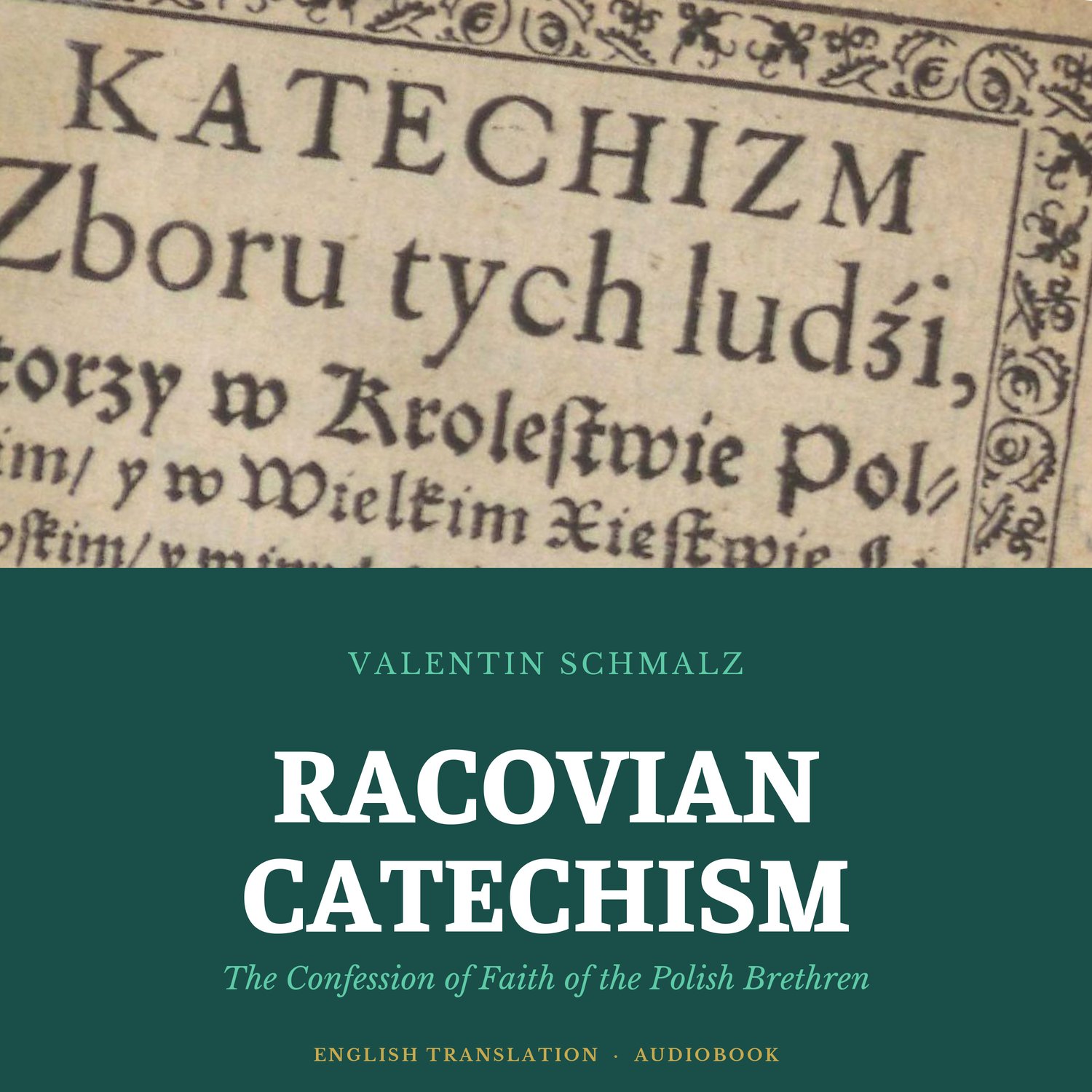
In 1605 a catechism appeared in Raków in Lesser Poland, the “Sarmatian Athens” of the Polish Brethren, that measured the central dogmas of Western Christianity by Holy Scripture and reason alone. The disciples of Faustus Socinus (1539–1604) summarised in it the teaching of their churches. The Racovian Catechism became the foundational document of Socinianism; carried through the Netherlands to England, its ideas lived on in the toleration debates of the Enlightenment.
In question and answer it leads from Holy Scripture and the way of salvation to the knowledge of the one God and of Christ, to the commandments of Christ and the Decalogue, to baptism and the breaking of bread, to the death of Christ and the critique of the doctrine of satisfaction, to faith, free will and justification, to the priestly and kingly offices of Christ, and finally to the Church and its order. The authors did not wish to “declare war on anyone”, but to set out their convictions for examination – true to the apostle’s watchword: “Prove all things; hold fast that which is good.”
This audiobook contains the complete English translation with preface, the Preface to the Pious Reader and afterword; Bible references are spoken out.
What you get – instant download after purchase
- Complete audiobook as M4B (one file, 430 MB, with chapter marks and cover) – for Apple Books, BookPlayer, Smart AudioBook Player, VLC and others
- MP3 version (256 kbps, 98 tracks) in two ZIP archives, one per part – plays on any device and player
- Companion PDF with the glossary of terms from the print edition
You only need one of the two versions: M4B for audiobook apps with chapter navigation, MP3 for everything else.
Note: This audiobook is read by an AI voice (synthetic voice, generated with Fish Audio – Built with Fish Audio).
The book is also available in print.