ECMO Emergency Response & Troubleshooting Toolkit 2026
Most ECMO programs are built around equipment. This toolkit is built around decisions.
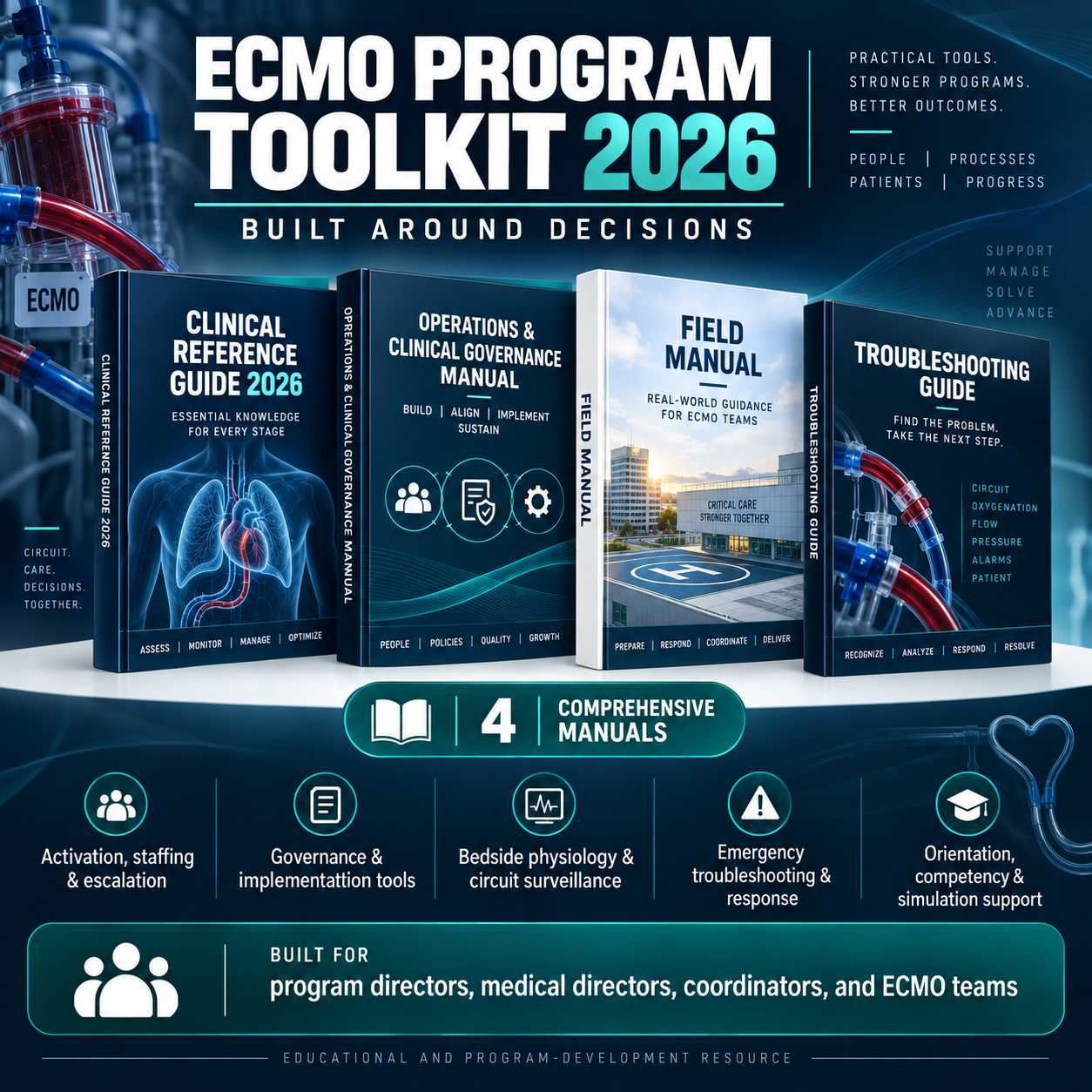
The ECMO Program Toolkit 2026 is a four-manual operational system for clinicians and program leaders responsible for ECMO readiness, bedside surveillance, escalation, troubleshooting, governance, and emergency response.
It brings together the clinical and operational work that determines whether a program recognizes deterioration early, assigns responsibility clearly, and responds without improvising critical steps.
What’s included
ECMO Clinical Reference Guide 2026 — Unified Edition
A structured operational reference covering patient selection frameworks, activation, pre-cannulation documentation, staffing, escalation, safety huddles, stop-the-line authority, shift standards, and institutional decision points. Includes 15 reference tables.
ECMO Operations & Clinical Governance Manual
Program structure, chain of command, credentialing, safety-pause processes, ECPR readiness, quality review, documentation, communication, and implementation tools.
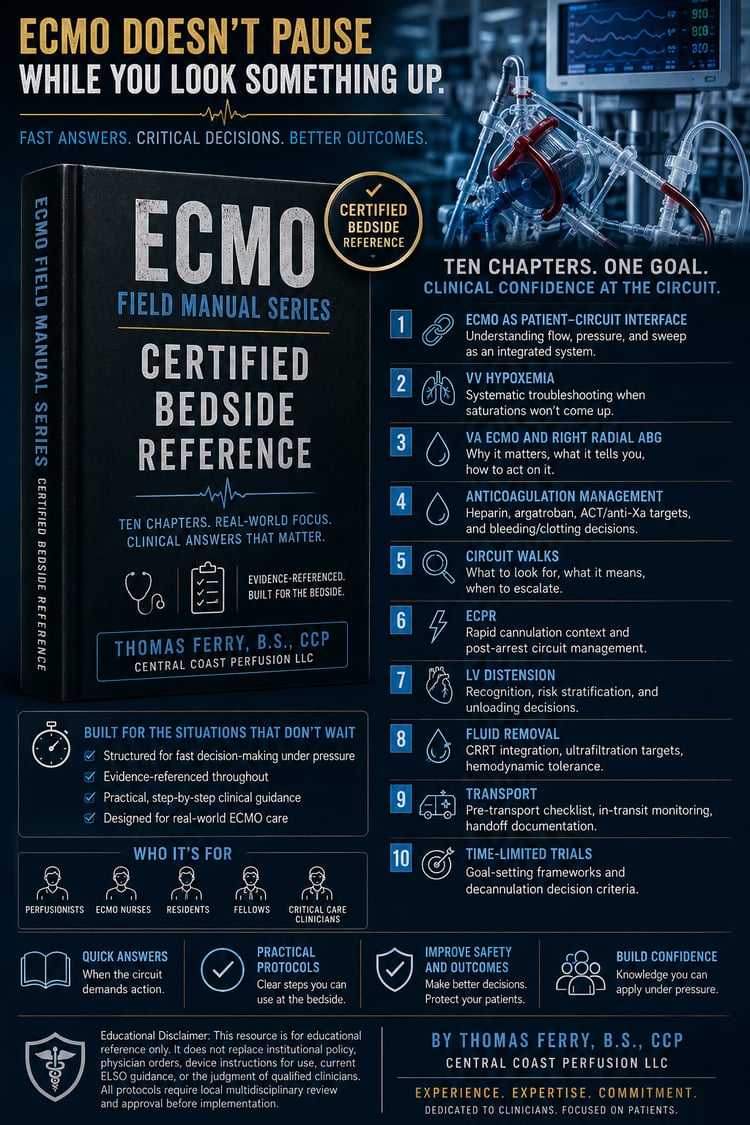
ECMO Field Manual: Certified Bedside Reference
Ten clinical chapters covering patient–circuit physiology, VV and VA surveillance, anticoagulation, circuit walks, transport, ECPR, LV loading, fluid management, complications, and ethical de-escalation.
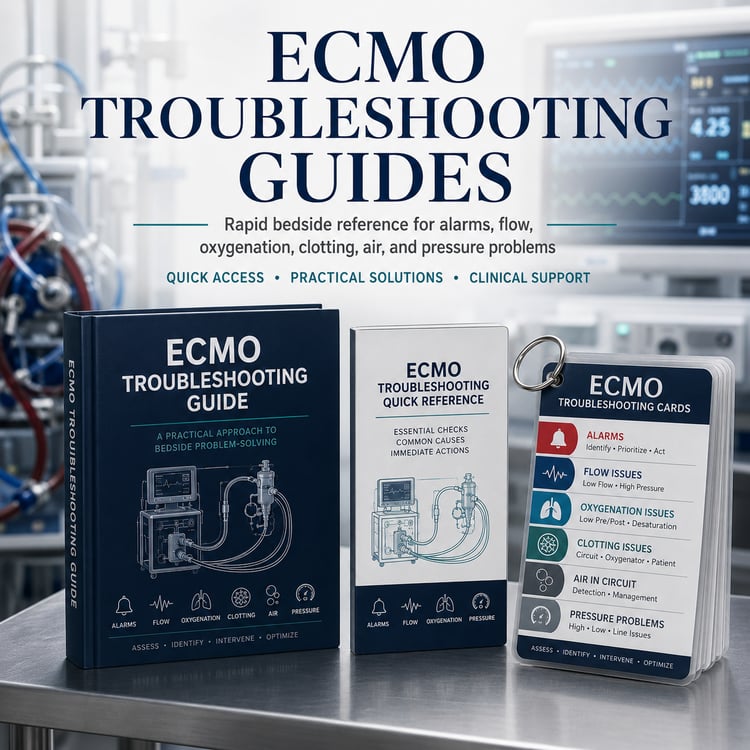
ECMO Troubleshooting: Expanded Clinical Guide
Structured response pathways for oxygenator dysfunction, component exchange, air and clot events, low flow and chatter, hemodynamic instability, differential hypoxemia, bleeding and anticoagulation crises, and decannulation planning.
Use this toolkit to
- Build or audit ECMO emergency-response pathways
- Standardize chain of command and escalation language
- Develop circuit-walk, handoff, and shift-start standards
- Improve recognition of low flow, oxygenator failure, air, clot, hemolysis, and differential hypoxemia
- Support orientation, simulation, and competency discussions
- Strengthen ECPR readiness and first-hour response
- Reduce reliance on improvised bedside decision-making
- Create a more consistent operational framework across shifts and disciplines
Built for
ECMO program directors
Medical directors
ECMO coordinators
Chief perfusionists
ECMO specialists
Clinical educators
Hospitals building or auditing ECMO operations
What makes this different
This is not a generic ECMO overview.
The material is organized around real operational decision points:
What changed?
What does it mean?
Who owns the response?
What should happen next?
That framework is carried across bedside physiology, circuit surveillance, escalation, troubleshooting, governance, and emergency response.
Educational disclaimer: These materials are for program development and professional education. They do not replace institutional policy, physician orders, device instructions for use, current professional guidance, scope-of-practice requirements, or the judgment of qualified clinicians. All protocols and workflows require local multidisciplinary review and approval before implementation.