ECMO Troubleshooting Toolkit 2026 | Clinical Guide + Emergency Cognitive Aids
When ECMO deteriorates, the problem is rarely solved by memorizing one threshold.
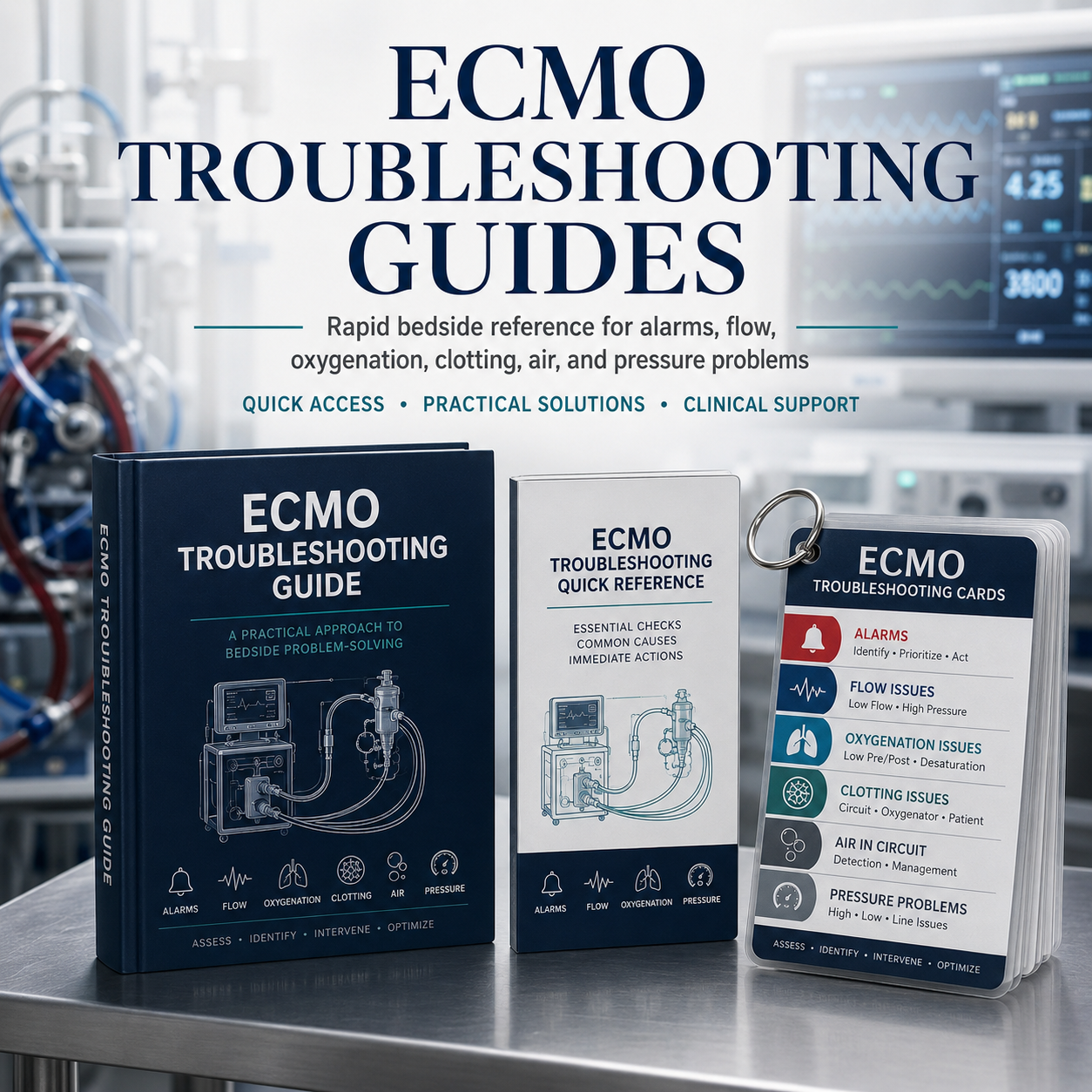
The ECMO Troubleshooting Toolkit 2026 is a rapid clinical and operational reference for perfusionists, ECMO specialists, coordinators, educators, and critical-care teams who need a structured way to recognize what changed, identify the likely mechanism, and respond without improvising critical steps.
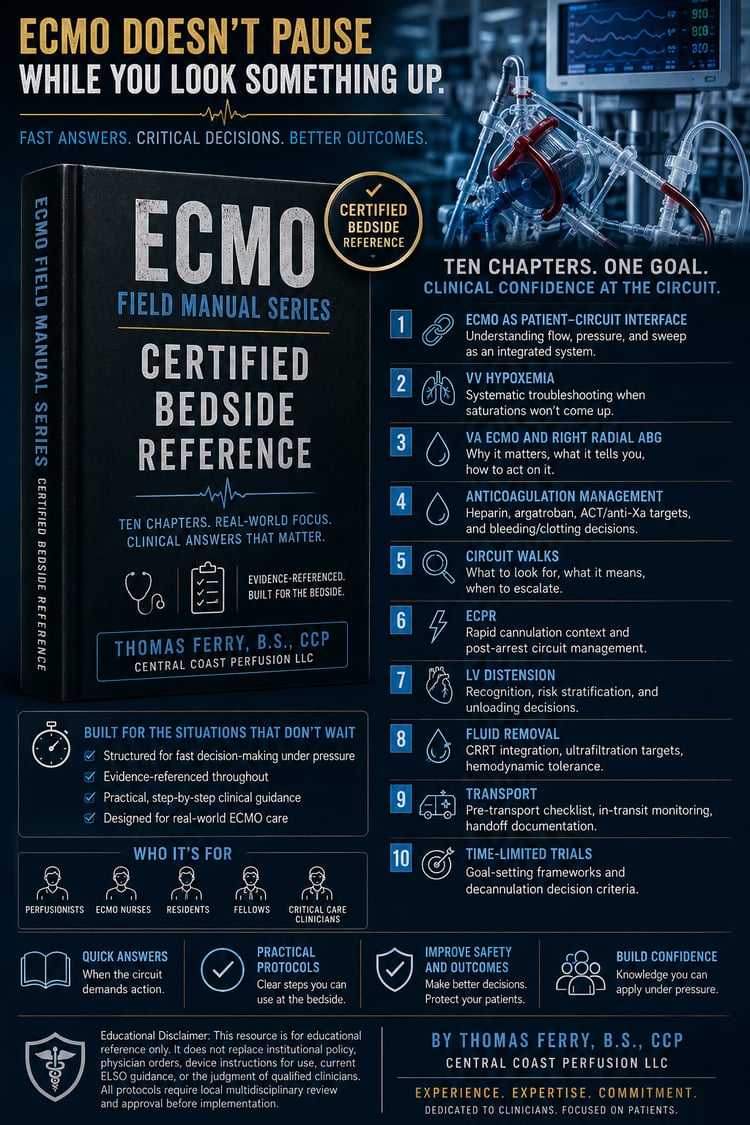
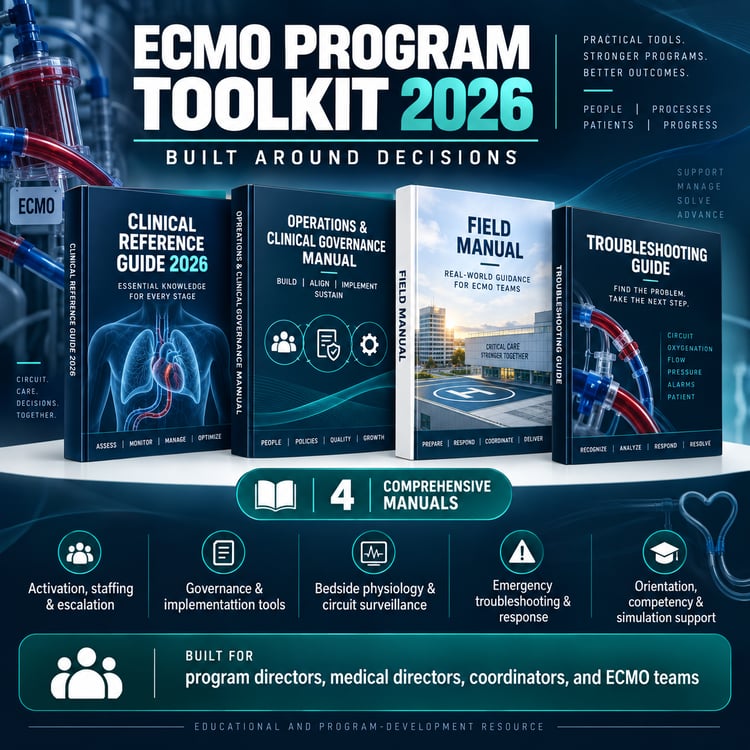
This expanded edition now goes beyond a single troubleshooting guide and includes a complete set of rapid-response tools for bedside review, simulation, orientation, and post-event learning.
Included in the toolkit
- ECMO Troubleshooting Guide 2026 — Evidence-Aligned Revision
- Expanded problem-oriented reference covering:
- low flow, chatter, and drainage instability
- oxygenator dysfunction and exchange decision-making
- air, pump, and power emergencies
- hemolysis and circuit thrombosis
- VV-ECMO hypoxemia and recirculation
- VA-ECMO hemodynamic deterioration
- LV loading and differential hypoxemia
- bleeding, anticoagulation crisis, and HIT
- limb ischemia and cannula complications
- liberation failure and decannulation readiness
- transport and movement-related deterioration
- master troubleshooting matrix
- simulation and post-event debrief structure
- 8 Printable Emergency Cognitive AidsLow Flow / Chatter
- Oxygenator Dysfunction
- Air / Pump / Power
- VV Hypoxemia
- VA Hemodynamic Deterioration
- Bleeding / Anticoagulation
- Limb Ischemia / Cannula
- Liberation / Decannulation
- 4 Printable Operational ChecklistsOxygenator / Component Exchange Preparation
- ECMO Transport Readiness
- Shift Circuit Walk & Deterioration Scan
- Post-Event Debrief & Corrective Action
- Individual one-page PDFs for the emergency cards
- Editable source files for local education and program adaptation
Built for
Perfusionists
ECMO specialists
ECMO coordinators
Critical-care clinicians
Clinical educators
Simulation teams
Programs standardizing emergency response
Use this toolkit to
- standardize troubleshooting language across shifts and disciplines
- teach physiology-driven problem solving
- reduce reflexive responses to isolated numbers
- improve emergency recognition and escalation
- build simulation scenarios
- support orientation and annual review
- strengthen circuit-walk and transport readiness
- improve post-event debriefing and corrective action
Why this toolkit is different
This is not a list of alarms and fixed thresholds.
Each section is built around the same practical questions:
What changed?
What mechanism could explain it?
What should be checked next?
When does the problem become an emergency?
The 2026 revision also removes unsupported universal thresholds and emphasizes trend interpretation, device-specific behavior, patient–circuit interaction, and local protocol.
Educational disclaimer: These materials are for professional education and program development. They do not replace physician orders, device instructions for use, institutional policy, current professional guidance, scope-of-practice requirements, or patient-specific clinical judgment. Device-specific emergency actions and procedures must follow the approved process for the specific ECMO platform and institution.