
What to Take to a SENCO Meeting
🌻 Part 4 — What to Take to a SENCO Meeting
How to Bring Clear Evidence, Patterns and Support Priorities to the Table
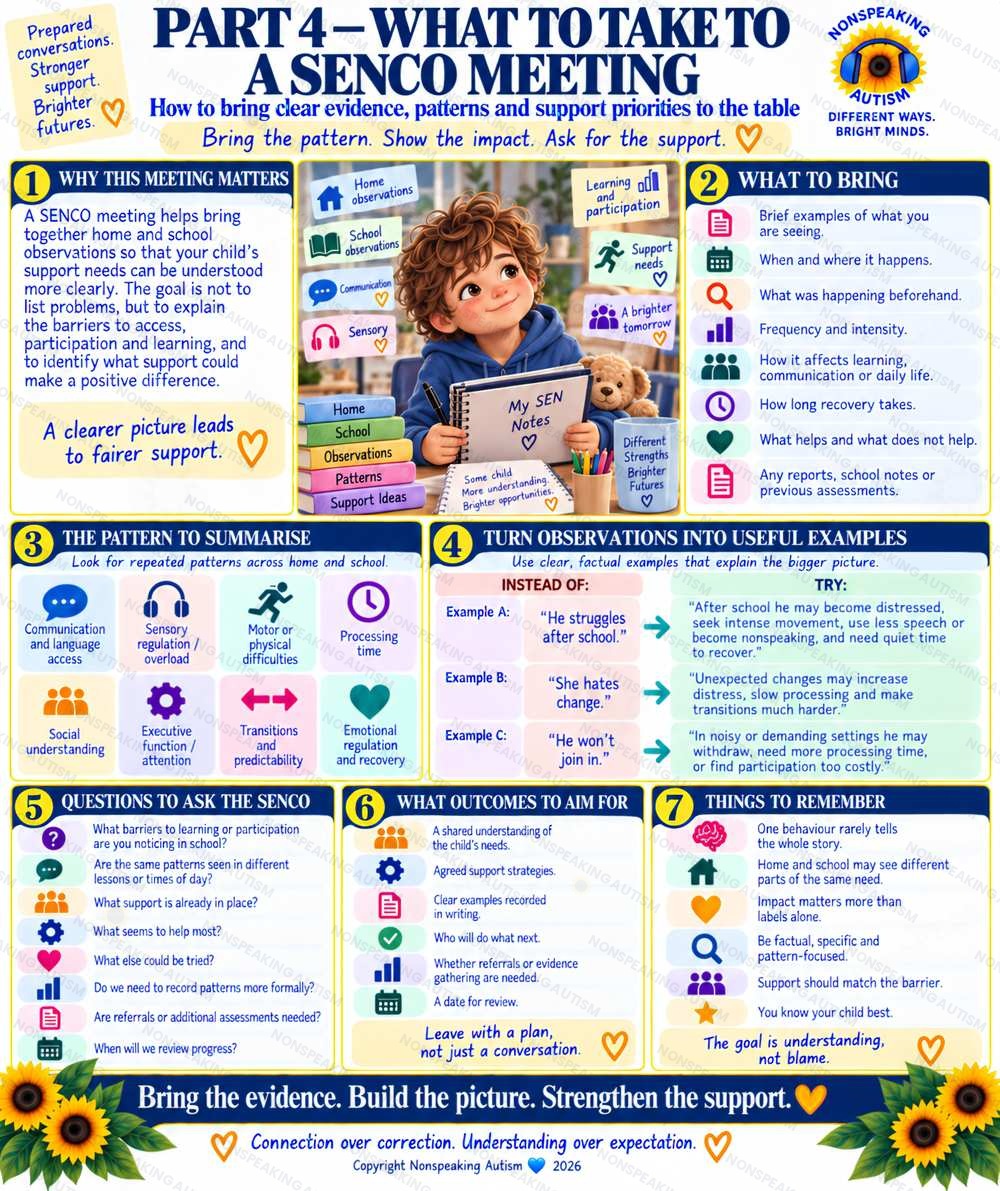
A SENCO meeting can be an important opportunity to bring together what is being seen at home and at school, identify recurring patterns and discuss what may help a child access learning, communication and everyday school life more successfully.
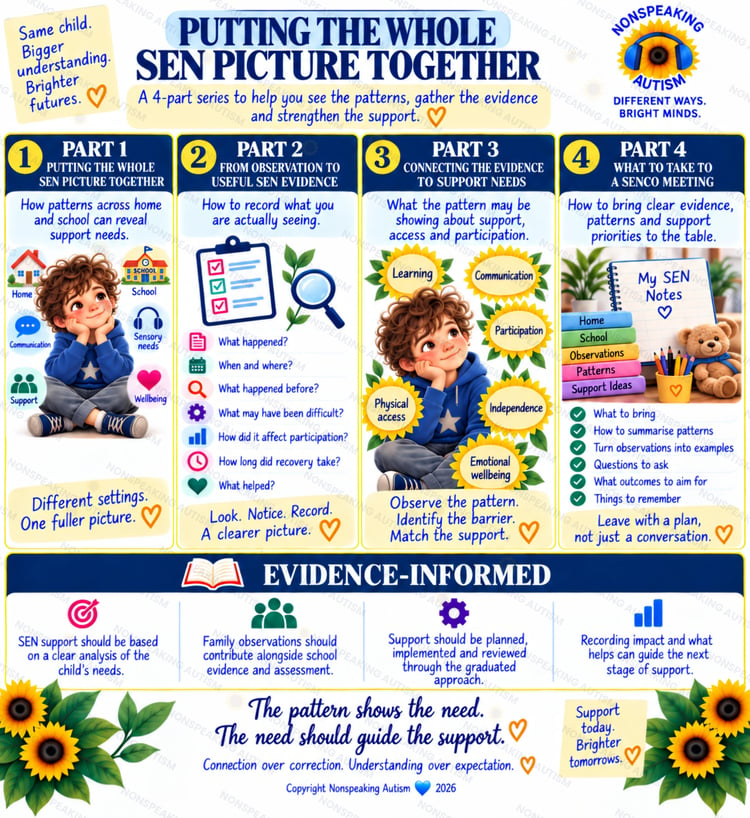
Part 4 — What to Take to a SENCO Meeting is the final poster in the Putting the Whole SEN Picture Together series.
It is designed to help parents and caregivers prepare for SENCO and school support conversations with clear observations, practical examples and useful questions rather than trying to remember everything during the meeting.
The goal is not to list problems or place blame.
It is to:
Bring the pattern. Show the impact. Ask for the support. 💛
📋 What to Bring
The poster provides a practical guide to the information that may be useful to take into a SENCO meeting, including:
- Brief examples of what you are seeing
- When and where difficulties happen
- What was happening beforehand
- Frequency and intensity
- How it affects learning, communication or everyday life
- How long recovery takes
- What appears to help — and what does not
- Relevant reports, school notes or previous assessments
Bringing this information together can make it easier to move from general concerns towards a clearer discussion about the child's needs.
🔎 Summarising the Pattern
Rather than focusing on one isolated behaviour, the poster encourages families to look for repeated patterns across areas such as:
Communication & language access • Sensory regulation/overload • Motor or physical difficulties • Processing time • Social understanding • Executive function/attention • Transitions & predictability • Emotional regulation & recovery
The same need may present differently at home and school, which is why sharing information across settings can be so valuable.
📝 Turn Observations Into Useful Examples
Clear, factual examples can help explain the bigger picture.
Instead of simply saying:
“He struggles after school.”
you might explain that after school the child may become distressed, seek intense movement, use less speech or become nonspeaking, and need quiet time to recover.
Instead of:
“She hates change.”
you can describe how unexpected changes appear to increase distress, slow processing and make transitions more difficult.
The aim is to describe what actually happens and its impact, rather than relying only on broad descriptions.
💬 Questions to Ask the SENCO
The poster includes useful prompts for the meeting, helping families ask about barriers to learning or participation, patterns across lessons and different times of day, existing support, what appears to help, other strategies that could be tried, whether patterns should be recorded more formally, whether referrals or additional assessments may be appropriate, and when progress will be reviewed.
These questions can help make the meeting a two-way conversation focused on understanding and practical next steps.
🎯 What Outcomes to Aim For
A useful SENCO conversation should ideally move towards greater clarity about what happens next.
Possible outcomes may include:
A shared understanding of the child's needs • Agreed support strategies • Clear examples recorded in writing • Responsibilities for next steps • Decisions about referrals or further evidence gathering • A date for review
The aim is to:
Leave with a plan, not just a conversation.
💙 Things to Remember
One behaviour rarely tells the whole story.
Home and school may see different parts of the same need.
Impact can matter more than labels alone.
Observations are most useful when they are factual, specific and recorded over time.
Support should be matched to the barrier being experienced rather than simply trying to change the visible behaviour.
And importantly:
The goal is understanding, not blame.
📚 Part of the Putting the Whole SEN Picture Together Series
This is Part 4 and the final poster in the four-part educational series:
Part 1 — Putting the Whole SEN Picture Together
Part 2 — From Observation to Useful SEN Evidence
Part 3 — Connecting the Evidence to Support Needs
Part 4 — What to Take to a SENCO Meeting
Together, the series follows a practical progression:
Notice → Record → Identify Patterns → Consider Barriers → Match Support → Prepare for the Meeting
📦 What You Receive
Your purchase includes:
1 × What to Take to a SENCO Meeting — Part 4
This is a digital educational poster from Nonspeaking Autism.
The purchased version is supplied as a high-quality A2 PDF — exact 420 × 594 mm page size, suitable for professional or home printing.
The purchased PDF is supplied clear and without the promotional preview watermark. Watermarks visible on Payhip listing images are used only for preview and copyright-protection purposes.
Digital PDF download only — no physical product will be shipped.
👨👩👧 Ideal For
This resource may be useful for parents and caregivers preparing for SENCO meetings, teachers, SENCOs, SEN/SEND staff, teaching assistants, support workers and other professionals involved in supporting children with additional needs.
It may also be useful when preparing for school support reviews, SEN support discussions, referrals or conversations about further assessment.
⚠️ Educational Disclaimer
This resource is provided for educational and informational purposes only.
It is not a diagnostic, legal or formal assessment tool and does not diagnose autism, ADHD, sensory processing differences, learning difficulties or any other developmental, medical or psychological condition.
It does not replace professional educational, medical, psychological or legal advice, nor does it guarantee a particular SEN provision, assessment, referral or outcome.
Every child and educational setting is different. Decisions about assessment and support should be based on the individual child's needs and the appropriate professional and educational processes.
© Copyright & Permitted Use
Copyright © Nonspeaking Autism. All rights reserved.
Purchase permits use by the purchaser for personal or individual professional educational purposes.
The digital file may not be resold, redistributed, shared publicly, uploaded to file-sharing platforms, reproduced as another commercial product or claimed as another person's work without permission.
💛 Bring the evidence. Build the picture. Strengthen the support.
Connection over correction. Understanding over expectation.