
The Rhythm of the Room™: Action Guide
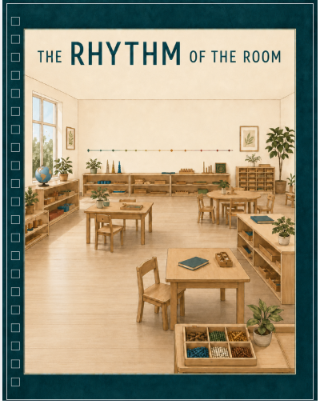
The Rhythm of the Room
Before you decide the problem, study the room.
There are moments in every classroom when something starts to feel off.
Children are waiting. Someone is always asking for help. Work keeps getting abandoned. The same area becomes crowded. Concentration is repeatedly interrupted. By the end of the morning, you know something is happening—but you may not know what is producing it.
The Rhythm of the Room gives you a way to find out.
This 18-page observation and environmental practice guide helps you step out of reaction and look closely at what the classroom itself may be asking of children.
You will learn to notice the rhythm of the day, identify recurring friction, gather observable evidence, trace a routine from beginning to end, make one small environmental change, and return to see what actually changed.
No behavior charts. No diagnosing children. No complete classroom overhaul.
Just a disciplined way to ask:
What is this room making possible—and what is getting in the way?
Start by finding the pulse of your day.
The included Daily Rhythm Scan lets you track the room hour by hour and see where activation rises, falls, or repeatedly peaks.
That gives you somewhere specific to look.
Maybe the difficult part of your morning is not “lack of focus.”
Maybe everyone needs the same material at 10:30.
Maybe a routine quietly requires adult permission.
Maybe children have to cross concentrated work to reach something they use constantly.
Maybe the adults are stepping in before the room has had a chance to work.
A rise tells you where to look. It does not tell you why.
That is where the observation begins.
The guide walks you through a complete cycle:
See it. Observe one ordinary period without explaining it.
Count it. Measure the recurring event so irritation does not become evidence.
Follow it. Trace the routine and locate the places where children must wait, search, guess, remember, interrupt, compete for space, or depend on an adult.
Listen. Compare what the adults notice and ask a child to show you how the routine actually works from their side.
Change one thing. Move, group, clarify, remove, protect, or teach one physical condition.
Watch again. Repeat the observation and see what became more—or less—possible.
You are not trying to create a perfectly controlled classroom.
You are trying to build a room that can carry more of the work.
Inside you’ll find:
- The Daily Rhythm Scan and Pulse of the Day graph
- A focused observation record
- A simple tally tool
- A routine-friction tracker
- Adult-view and child-view observation pages
- Environmental change prompts
- An adult-practice check
- Before-and-after comparison
- A reusable full classroom change-cycle page
- A seven-day practice for testing one grounded change
Use it whenever the same classroom difficulty keeps returning and you are tired of guessing why.
Because sometimes the child does not need another correction.
Sometimes the room needs to change.
Digital Download — $15
Print it. Write in it. Copy the reusable field tool. Return to it whenever the room begins telling you that something needs a closer look.