
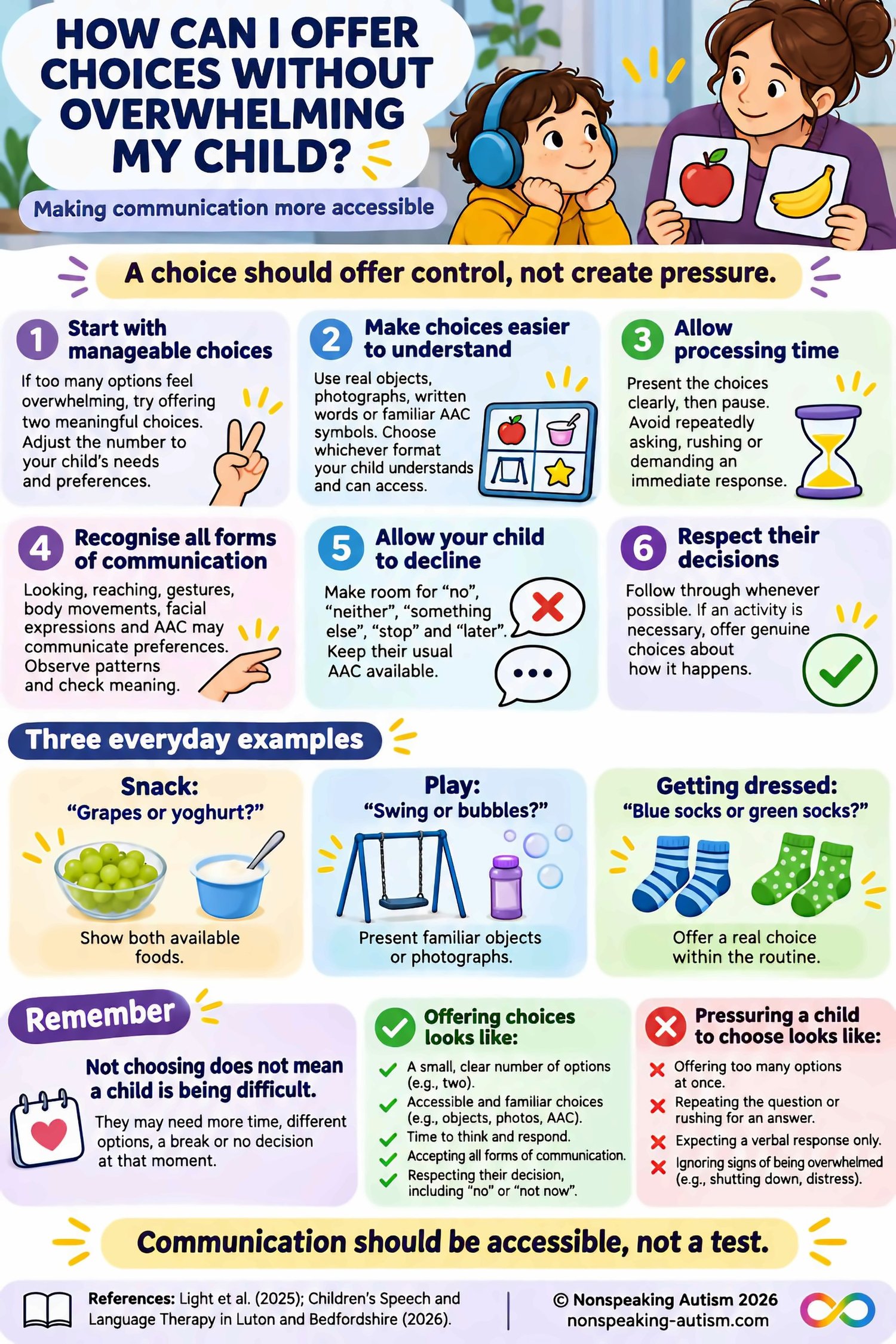
🌻 How Can I Offer Choices Without Overwhelming My Child? Making communication more accessible
🌻 How Can I Offer Choices Without Overwhelming My Child?
Making communication more accessible
Autism Poster | A2 Printable | UK Edition
A choice should offer control, not create pressure.
Offering choices is one of the simplest ways to give a child more control over their day. But too many options, unfamiliar formats or pressure to answer quickly can turn a choice into a source of stress, especially for nonspeaking autistic children and AAC users.
How Can I Offer Choices Without Overwhelming My Child? is a bright, friendly A2 poster with six practical steps, three everyday examples and a clear guide to what helpful choice-making looks like, and what pressure looks like.
Communication should be accessible, not a test.
🧠 THE SIX STEPS
1. Start with manageable choices
If too many options feel overwhelming, try offering two meaningful choices. Adjust the number to your child's needs and preferences.
2. Make choices easier to understand
Use real objects, photographs, written words or familiar AAC symbols. Choose whichever format your child understands and can access.
3. Allow processing time
Present the choices clearly, then pause. Avoid repeatedly asking, rushing or demanding an immediate response.
4. Recognise all forms of communication
Looking, reaching, gestures, body movements, facial expressions and AAC may communicate preferences. Observe patterns and check meaning.
5. Allow your child to decline
Make room for "no", "neither", "something else", "stop" and "later". Keep their usual AAC available.
6. Respect their decisions
Follow through whenever possible. If an activity is necessary, offer genuine choices about how it happens.
🍇 THREE EVERYDAY EXAMPLES
- Snack: "Grapes or yoghurt?" – show both available foods.
- Play: "Swing or bubbles?" – present familiar objects or photographs.
- Getting dressed: "Blue socks or green socks?" – offer a real choice within the routine.
✅ OFFERING CHOICES LOOKS LIKE
- A small, clear number of options (e.g. two)
- Accessible and familiar choices (e.g. objects, photos, AAC)
- Time to think and respond
- Accepting all forms of communication
- Respecting their decision, including "no" or "not now"
❌ PRESSURING A CHILD TO CHOOSE LOOKS LIKE
- Offering too many options at once
- Repeating the question or rushing for an answer
- Expecting a verbal response only
- Ignoring signs of being overwhelmed (e.g. shutting down, distress)
Remember: not choosing does not mean a child is being difficult. They may need more time, different options, a break or no decision at that moment.
👨👩👧 WHO IS THIS POSTER FOR?
- Parents, carers and families
- Early years practitioners and nursery staff
- Teachers, teaching assistants and SENCOs
- Speech and language therapists
- Occupational therapists and play workers
- Anyone supporting autistic children, including nonspeaking children and AAC users
Ideal for homes, classrooms, nurseries, therapy rooms and parent workshops.
📦 WHAT YOU RECEIVE
- A2 print-ready PDF (420 x 594 mm)
- A2 high-resolution image (300 DPI)
Instant digital download. No physical product will be posted.
The downloadable files are provided without a watermark.
🔗 FURTHER RESOURCES
Children's Speech and Language Therapy Service in Luton and Bedfordshire – Speech, Language and Communication Toolkit for Schools (2026)
https://bedslutonchildrenshealth.nhs.uk/media/0inhwcow/slc-toolkit-2026_digital.pdf
Bedfordshire and Luton Children's Speech and Language Therapy – Supporting early communicators
https://bedslutonchildrenshealth.nhs.uk/services/bedfordshire-and-luton-childrens-speech-and-language-therapy-service/supporting-early-communicators/
Gormley, McNaughton & Light (2023) – Supporting children's communication of choices during inpatient rehabilitation
https://doi.org/10.1044/2022_AJSLP-22-00200
ASHA – Augmentative and Alternative Communication (AAC)
https://www.asha.org/practice-portal/professional-issues/augmentative-and-alternative-communication/
📚 RESEARCH & REFERENCES
Mapped to poster sections:
- 1. Start with manageable choices and 2. Make choices easier to understand: Children's Speech and Language Therapy Service in Luton and Bedfordshire (2026), Speech, Language and Communication Toolkit for Schools (offering limited, structured choices with clear verbal and visual cues; objects and pictures of reference).
- 3. Allow processing time: Children's Speech and Language Therapy Service in Luton and Bedfordshire (2026) (pausing and allowing wait time for a response, including through gesture or AAC).
- 4. Recognise all forms of communication and 5. Allow your child to decline: Gormley, J., McNaughton, D., & Light, J. (2023). Supporting children's communication of choices during inpatient rehabilitation: Effects of a mobile training for health care providers. American Journal of Speech-Language Pathology, 32(2), 545–564; ASHA, Augmentative and Alternative Communication (AAC).
- 6. Respect their decisions and Three everyday examples: Gormley, McNaughton & Light (2023); Children's Speech and Language Therapy Service in Luton and Bedfordshire (2026).
Foundational references (printed on the poster):
1. Gormley, J., McNaughton, D., & Light, J. (2023). American Journal of Speech-Language Pathology, 32(2), 545–564.
2. Children's Speech and Language Therapy Service in Luton and Bedfordshire (2026). Speech, Language and Communication Toolkit for Schools.
Sources:
- Bedfordshire and Luton – Speech, Language and Communication Toolkit for Schools 2026 (PDF)
- Bedfordshire and Luton – Supporting early communicators
- Bedfordshire and Luton Speech and Language Therapy Service
- Penn State AAC – Supporting children’s communication of choices (Gormley, McNaughton & Light, 2023)
- Supporting meaningful participation in society by adults who need and use AAC (2025)
- How to select AAC: further evidence from children with autism (2025)
⚠️ IMPORTANT DISCLAIMER
This resource is for educational and information purposes only. It is not a communication assessment or substitute for advice from a speech and language therapist or other qualified professional.
Every child is different. Some children may need more or fewer choices, different formats or more time. A speech and language therapist can help find the best approach for your child.
All support should respect the child's communication, dignity, preferences, safety and wellbeing, and AAC should never be removed or withheld.
©️ COPYRIGHT & PERMITTED USE
© 2026 Nonspeaking Autism. All rights reserved.
For personal use in one home, classroom or setting only.
Please keep the original branding and copyright notice intact. The digital file must not be resold, modified, redistributed, uploaded to other websites or included in commercial products without permission.
💛 PLEASE LEAVE US FEEDBACK
If you find this poster helpful, please consider leaving a review on Payhip. We would love to hear how you used it and what you would like us to create next.
Thank you for supporting Nonspeaking Autism! 🌻
Connection over correction. Understanding over expectation.
Nonspeaking Autism © 2026
nonspeaking-autism.com