
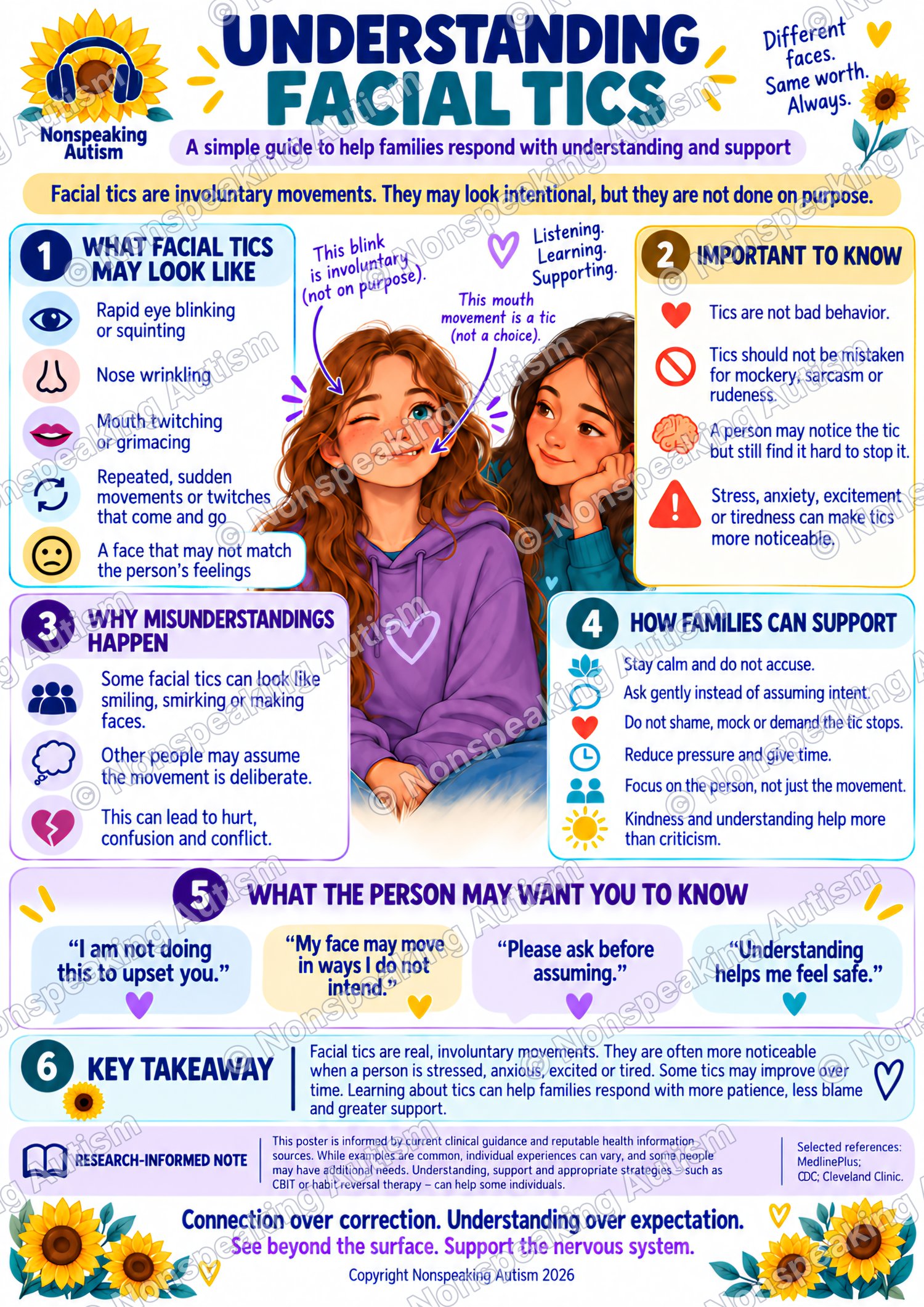
🌻 UNDERSTANDING FACIAL TICS
🌻 UNDERSTANDING FACIAL TICS
A Simple Guide to Help Families Respond With Understanding and Support
U.S. Edition | Research-Informed Educational Poster | Nonspeaking Autism
💙 Different faces. Same worth. Always.
A child blinks repeatedly, wrinkles their nose, or makes an unexpected facial movement.
Someone assumes they are being disrespectful, making faces, mocking another person, or deliberately trying to get attention.
But what if the movement is not intentional?
Facial tics are involuntary movements. They may look intentional, but they are not done on purpose.
Understanding Facial Tics is an illustrated educational resource designed to help parents, caregivers, teachers, and professionals recognize possible facial tics, reduce misunderstandings, and respond with patience rather than blame.
This poster explores what facial tics may look like, why they can be misinterpreted, what may influence them, and how families can offer compassionate support.
The message: See the person, not just the movement.
🧠 1. WHAT FACIAL TICS MAY LOOK LIKE
Facial tics are a type of motor tic involving sudden, recurring facial movements.
Examples may include:
- Rapid eye blinking or squinting: Repeated blinking or tightening around the eyes.
- Nose wrinkling: Sudden or repeated movements of the nose.
- Mouth twitching or grimacing: Brief movements that may resemble smiling, smirking, or pulling a face.
- Repeated movements: Facial movements that come and go or change over time.
- Expressions that do not match feelings: A facial tic may resemble an emotional expression without reflecting what the person is experiencing.
Tics may vary in frequency and intensity. Some individuals experience a physical urge before a tic and may temporarily suppress it, although doing so can require considerable effort.
These examples are not diagnostic criteria. Not every repeated facial movement is a tic.
❤️ 2. IMPORTANT THINGS TO KNOW
Tics are not bad behavior.
A child should not be punished, criticized, or shamed for an involuntary movement.
Facial tics should not automatically be interpreted as mockery, sarcasm, or rudeness.
A movement that resembles a smirk does not necessarily communicate amusement or disrespect.
Awareness does not mean complete control.
Some people can briefly suppress tics, but that does not make the movements voluntary in the usual sense.
Stress, anxiety, excitement, and tiredness may influence tics.
For some individuals, these factors can make movements more noticeable. Experiences vary.
Tics may change over time.
Some childhood tics improve or disappear, while others persist or fluctuate.
Every child deserves understanding, regardless of how noticeable their movements are.
💜 3. WHY MISUNDERSTANDINGS HAPPEN
Facial expressions are an important part of social communication, but an involuntary facial movement may be mistaken for an intentional expression.
For example:
- A mouth movement may resemble smirking.
- Repeated blinking may be mistaken for an exaggerated reaction.
- Facial grimacing may be interpreted as disapproval.
- A sudden movement may be mistaken for making fun of someone.
- Repeated movements may be incorrectly labeled as attention-seeking.
These misunderstandings can lead to embarrassment, conflict, unfair discipline, or emotional distress.
For children who also experience communication differences, explaining an involuntary movement may be difficult.
A facial expression alone cannot reliably tell us what a child intends or feels.
🤝 4. HOW FAMILIES CAN SUPPORT
The poster offers practical, respectful ways to respond.
💙 Stay Calm
Avoid reacting with anger or accusations.
💬 Ask Gently Instead of Assuming Intent
If clarification is necessary, communicate respectfully and without pressure.
❤️ Do Not Shame, Mock, or Demand That Tics Stop
Avoid unwanted attention, criticism, or repeated reminders to suppress movements.
⏰ Reduce Unnecessary Pressure
Consider whether fatigue, stress, or environmental demands may be affecting the child.
🫂 Focus on the Person, Not Just the Movement
Recognize the child's strengths, communication, preferences, and emotional well-being.
☀️ Choose Kindness Over Criticism
Understanding can reduce misunderstandings and support a more accepting environment.
Some children prefer that adults do not comment on their tics. Respect individual preferences whenever possible.
💬 5. WHAT THE PERSON MAY WANT YOU TO KNOW
The poster includes four compassionate statements:
💜 “I am not doing this to upset you.”
💛 “My face may move in ways I do not intend.”
💜 “Please ask before assuming.”
💙 “Understanding helps me feel safe.”
These are illustrative statements intended to encourage empathy, not quotations representing every person who experiences tics.
They remind adults that an unexpected movement should not automatically be interpreted as a negative intention.
🏫 FACIAL TICS IN U.S. SCHOOLS
Children with facial tics may experience misunderstandings in classrooms, hallways, playgrounds, and other school environments.
A student may be incorrectly accused of:
- Making faces at a teacher
- Being disrespectful
- Mocking another student
- Deliberately distracting the class
- Refusing to stop a movement
Supportive educational practices may include:
- Helping teachers and school staff understand tics
- Avoiding unnecessary public attention
- Addressing bullying and teasing
- Allowing appropriate breaks
- Reducing avoidable stressors
- Respecting the student's communication needs
- Collaborating with families and relevant professionals
- Considering accommodations through an IEP or Section 504 plan when appropriate
A student should not be disciplined simply because an involuntary movement has been mistaken for intentional behavior.
FACIAL TICS, AUTISM, AND OTHER MOVEMENTS
Facial tics can occur in autistic and non-autistic individuals.
However, not every repeated facial movement is a tic.
Other possibilities may include:
Motor Tics: Sudden, recurring movements that may fluctuate over time.
Stimming or Self-Regulatory Movements: Repetitive movements that may provide sensory feedback, enjoyment, comfort, or regulation.
Habitual Movements: Movements associated with other patterns of repetition.
Other Medical or Movement-Related Causes: Eye irritation, vision concerns, medication effects, and certain neurological conditions may also contribute to unusual facial movements.
Some movement patterns can be difficult to distinguish without professional evaluation.
One visible movement does not establish a diagnosis of autism, Tourette syndrome, or another condition.
🔬 RESEARCH-INFORMED EDUCATIONAL RESOURCE
This poster draws on established clinical information about tic disorders and supportive approaches.
Clinical guidance recognizes that:
- Tics are involuntary or only partly suppressible movements or sounds.
- Symptoms can fluctuate.
- Stress, excitement, and fatigue may influence tic frequency.
- Many childhood tics improve over time, although experiences differ.
- Not everyone with tics requires treatment.
- Evidence-based interventions may be appropriate when tics cause significant distress or interfere with daily activities.
Comprehensive Behavioral Intervention for Tics (CBIT), which incorporates habit reversal training, can help some individuals manage bothersome tics.
CBIT is a structured therapeutic intervention, not punishment or a demand that a child simply stop their movements.
📚 SELECTED CLINICAL REFERENCES AND RESOURCES
1. MedlinePlus — Tic Disorders
U.S. National Library of Medicine information about tic disorders, symptoms, and related conditions.
https://medlineplus.gov/tics.html
2. Centers for Disease Control and Prevention (CDC) — Tourette Syndrome
Information about tics, Tourette syndrome, diagnosis, treatment, and support.
https://www.cdc.gov/tourette-syndrome/
3. Cleveland Clinic — Tic Disorders
Clinical educational information about tic symptoms, possible causes, and management.
https://my.clevelandclinic.org/health/diseases/tic-disorders
4. National Institute of Neurological Disorders and Stroke (NINDS) — Tourette Syndrome
Information about Tourette syndrome and associated motor and vocal tics.
https://www.ninds.nih.gov/health-information/disorders/tourette-syndrome
Evidence Note
This poster is educational and research-informed. It is not a systematic review, diagnostic assessment, or individualized treatment plan.
Research & References
Centers for Disease Control and Prevention. (2026, August 5). About Tourette syndrome. U.S. Department of Health and Human Services. https://www.cdc.gov/tourette-syndrome/about/index.html
Cleveland Clinic. (2024, August 19). Tics and tic disorders. https://my.clevelandclinic.org/health/diseases/tics-and-tic-disorders
MedlinePlus. (2026, January 27). Chronic motor or vocal tic disorder. U.S. National Library of Medicine. https://medlineplus.gov/ency/article/000745.htm
Pringsheim, T., Okun, M. S., Müller-Vahl, K., Martino, D., Jankovic, J., Cavanna, A. E., Woods, D. W., Robinson, M., Jarvie, E., Roessner, V., Oskoui, M., Holler-Managan, Y., & Piacentini, J. (2019). Practice guideline recommendations summary: Treatment of tics in people with Tourette syndrome and chronic tic disorders. Neurology, 92(19), 896–906. https://doi.org/10.1212/WNL.0000000000007466
Sources:
- CDC – About Tourette Syndrome
- Cleveland Clinic – Tics and Tic Disorders
- MedlinePlus – Chronic motor or vocal tic disorder
- PubMed – Pringsheim et al. (2019)
Not all facial movements are tics, and tic experiences differ between individuals.
👨👩👧 WHO IS THIS RESOURCE FOR?
This educational poster is suitable for:
- Parents and caregivers
- Families supporting children with facial tics
- Autistic children and young people
- Teachers and classroom aides
- Special education teachers
- School counselors and psychologists
- Speech-language pathologists
- Occupational therapists
- Pediatric healthcare professionals
- Autism advocates
- Professionals supporting neurodivergent children
It may be useful in homes, classrooms, counseling offices, school support spaces, therapy environments, and parent education settings.
📦 WHAT YOU RECEIVE
💙 FREE DIGITAL DOWNLOAD
1 × Understanding Facial Tics — U.S. Edition Educational Poster
The poster includes:
- Common examples of facial tics
- Important information about involuntary movements
- Explanations of why misunderstandings happen
- Practical family support strategies
- Compassionate communication statements
- A key takeaway about patience and understanding
- A research-informed note and selected resources
- Original Nonspeaking Autism artwork and branding
Digital product only. No physical item will be shipped.
The listing image contains a promotional watermark. The purchased download should be provided as a clean, watermark-free file.
Print size and resolution should be confirmed against the final download file.
⚠️ IMPORTANT DISCLAIMER
This resource is for educational and informational purposes only.
It does not diagnose facial tics, Tourette syndrome, autism, or any other medical or neurological condition.
Not every repeated facial movement is a tic.
Consult a qualified healthcare professional if movements are new, persistent, painful, distressing, or interfere with daily life.
Seek urgent medical evaluation for sudden unusual movements accompanied by other concerning neurological symptoms.
Any treatment or support should be individualized to the person's needs and circumstances.
©️ COPYRIGHT & PERMITTED USE
Copyright © 2026 Nonspeaking Autism. All rights reserved.
Purchase permits personal, home, classroom, school, and individual professional educational use.
Printing for these permitted purposes is allowed.
The digital file may not be resold, redistributed, publicly shared, uploaded elsewhere, altered for commercial resale, or included in another product without permission.
Please share the Payhip listing link rather than distributing the purchased file.
💛 THE MESSAGE BEHIND THE RESOURCE
A child who blinks repeatedly is not necessarily trying to attract attention.
A child whose mouth moves unexpectedly is not necessarily being disrespectful.
A facial expression does not always reveal an emotion or intention.
Before assuming a child is making faces deliberately, consider whether the movement may be involuntary.
Understanding begins when we stop assigning negative intentions to movements we do not yet understand.
💙 Different faces. Same worth. Always.
🌻 Connection over correction. Understanding over expectation.
See beyond the surface. Support the nervous system.
Nonspeaking Autism © 2026