Running Economy - for coaches and ambitious athletes (EN)
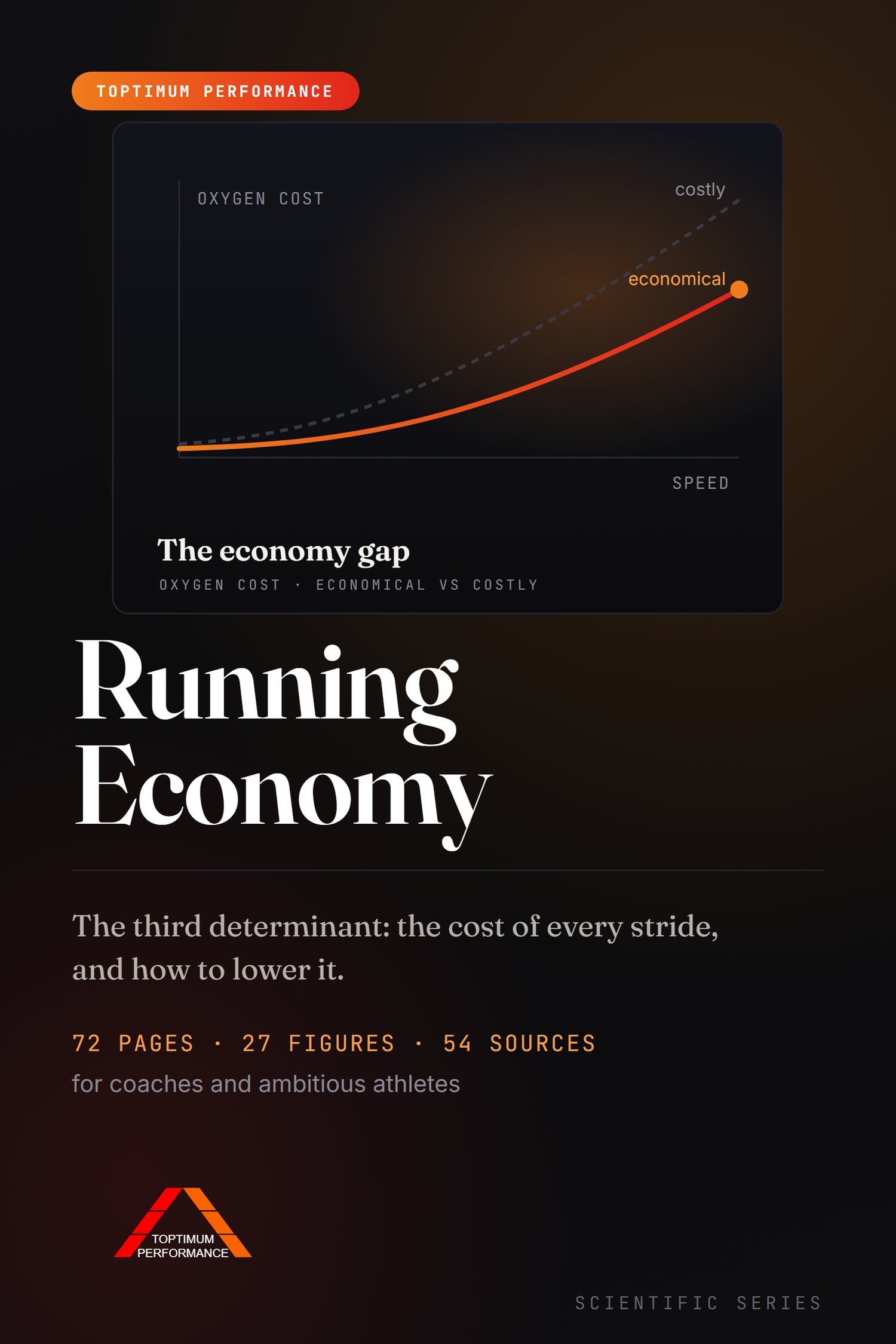
**The third determinant of endurance-running performance alongside VO2max and threshold. The cost of every stride decides how fast you run.**
Two runners with the same VO2max and the same threshold can finish far apart on the road. The difference often lies in running economy: how much energy it takes to move forward at a given speed. It is the determinant that is least well understood and most often measured wrongly and at the same time the one on which an athlete can keep improving for years.
This guide builds the story up from measurement to lever. First, what running economy actually is, and why many published figures are unreliable. Then the biological basis: fibre typology, the tendon as a spring, the mitochondria and the coupling. And finally the levers you can genuinely work with: strength, technique, volume, shoes and nutrition, each with an honest note on how strong the evidence is.
**What's inside**
- What running economy is, and the measurement pitfalls that make figures unreliable
- The biological basis: muscle-fibre typology, the tendon as a spring, the mitochondria and coupling efficiency
- The levers: strength training (the best supported), technique and running drills, volume, intervals and hills
- Shoe technology and nutrition, with the nuance the advertising leaves out
- Economy under fatigue: the decline, and how you train it
- Measuring and programming: field tests, typology and a twelve-week block
- A glossary in which every technical term is briefly explained
**A few things you'll find here and rarely elsewhere**
- Why many economy figures don't hold up and how to set up a usable measurement yourself instead of getting lost in the noise.
- The tendon as a spring: how much of the energy per stride comes free, and what that means for strength training.
- Coupling efficiency: that it is not only more mitochondria that count, but how much usable energy they deliver per molecule of oxygen.
- Economy under fatigue: why a profile that looks good in a rested state can look very different after two hours, and how you train precisely that.
**For whom**
Coaches and ambitious athletes who already know what VO2max and threshold are, and who want to take the third determinant as seriously as the first two.
**Extent**
72 pages
27 figures
54 scientific sources (with DOI where available)
Glossary