AP World History: Modern Unit 3 – Land-Based Empires | Activities, SAQs & LEQ
AP World History: Modern Unit 3 – Land-Based Empires | Activities, SAQs & LEQ
That puts the strongest search terms right up front: AP World History, Unit 3, Land-Based Empires, SAQ, LEQ.
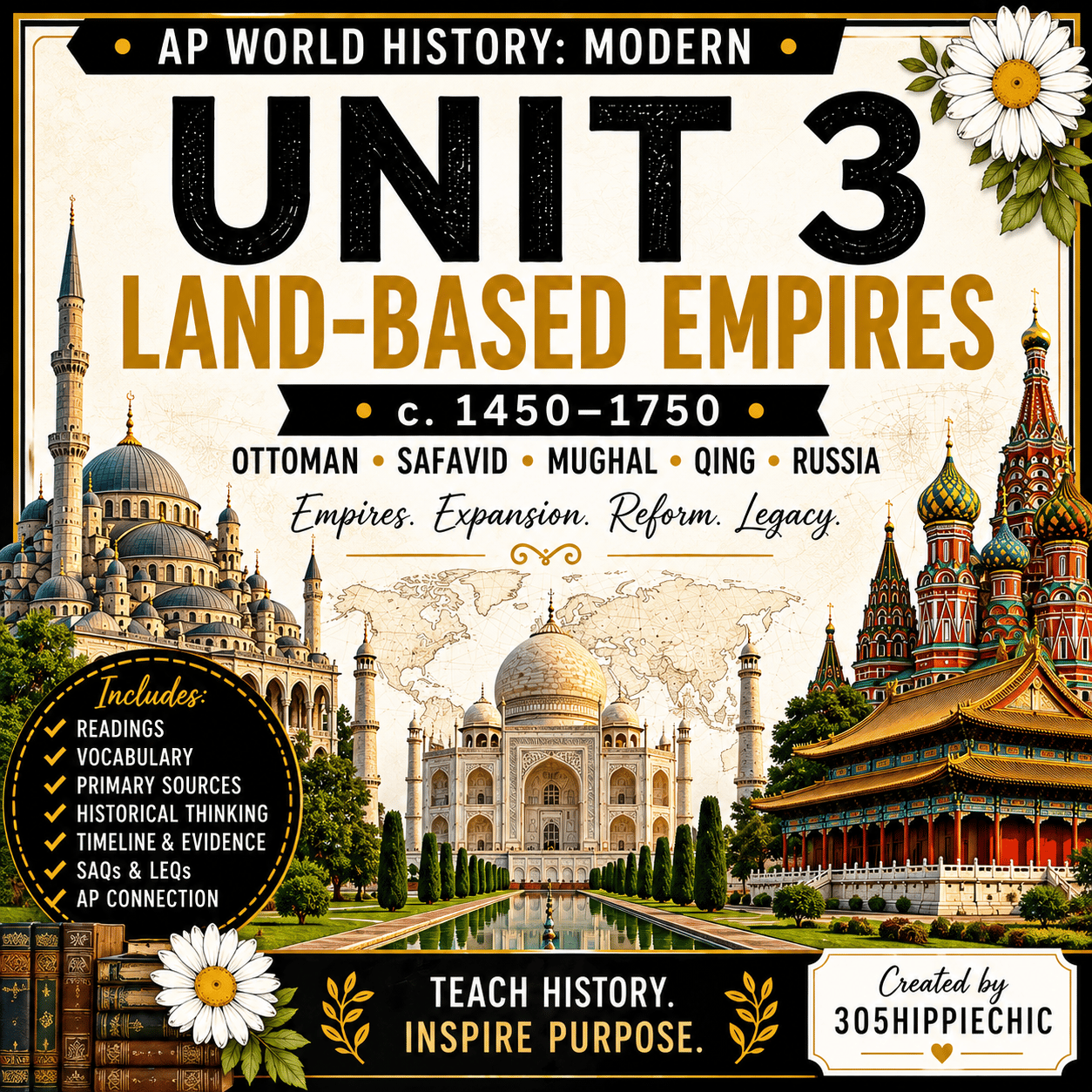
AP World History: Modern Unit 3 – Land-Based Empires (c. 1450–1750)
Teach AP World History: Modern Unit 3: Land-Based Empires with a comprehensive, classroom-ready resource designed to build historical knowledge while strengthening the historical thinking and writing skills students need for the AP World History exam.
Students explore the rise, expansion, governance, and lasting influence of the major land-based empires from c. 1450–1750, including the Ottoman, Safavid, Mughal, Ming, Qing, and Russian Empires. The unit examines how rulers used gunpowder technology, military organization, bureaucracy, religion, cultural achievements, and political institutions to expand their territories and maintain authority over diverse populations.
Rather than relying on content recall alone, students repeatedly apply AP historical reasoning through comparison, causation, continuity and change over time (CCOT), sourcing, contextualization, close reading, and claim-evidence-reasoning (CER).
What’s Included:
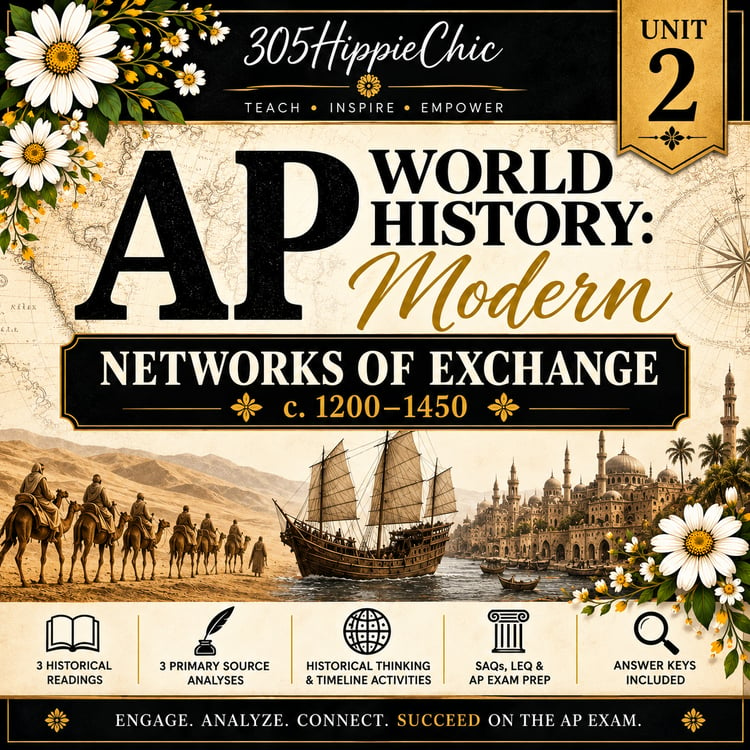
- 3 historical background readings
- Multi-part vocabulary activities
- 3 primary source analyses
- Historical thinking activities
- Timeline activity
- Historical evidence activity
- Short Answer Questions (SAQs)
- Long Essay Question (LEQ)
- AP historical reasoning and exam practice
- Complete answer keys and sample responses
The vocabulary sequence moves students beyond simple definitions by asking them to explain historical significance, apply terminology using evidence, and construct historical explanations. Key concepts include Gunpowder Empires, Janissaries, devshirme, Suleiman the Magnificent, Akbar, Shah Abbas I, Sunni and Shi’a Islam, bureaucracy, religious tolerance, syncretism, and monumental architecture.
Students also analyze primary sources connected to major rulers and political ideas. Activities incorporate sourcing, close reading, historical context, comparison, and CER writing. For example, students examine Suleiman the Magnificent’s ideas about justice and leadership and evaluate the extent to which effective government contributed to the success of land-based empires.
Additional source work explores Akbar’s policies of religious tolerance and asks students to evaluate how religious policies contributed to imperial success, giving students meaningful practice connecting evidence to larger AP World themes.
Perfect for:
AP World History: Modern Unit 3 instruction, whole-class lessons, independent or partner work, review and test preparation, AP exam skill practice, sub plans, homeschool instruction, and supplemental practice.
This resource is designed to help students move beyond memorizing empires and rulers. Students analyze how and why land-based empires expanded, maintained power, governed diverse populations, and established political and cultural legacies while practicing the historical reasoning skills required throughout AP World History.
Digital download. No physical product will be shipped.