
Anxiety & the Body
How worry lives in your mind and your muscles, and what helps.
Anxiety isn’t only thoughts. It shows up in the body too, and those symptoms are real, not “all in your head.” This three-page, research-based guide explains how worry and the body feed each other, then teaches the two skills that calm both: validation and cognitive restructuring.
What’s inside
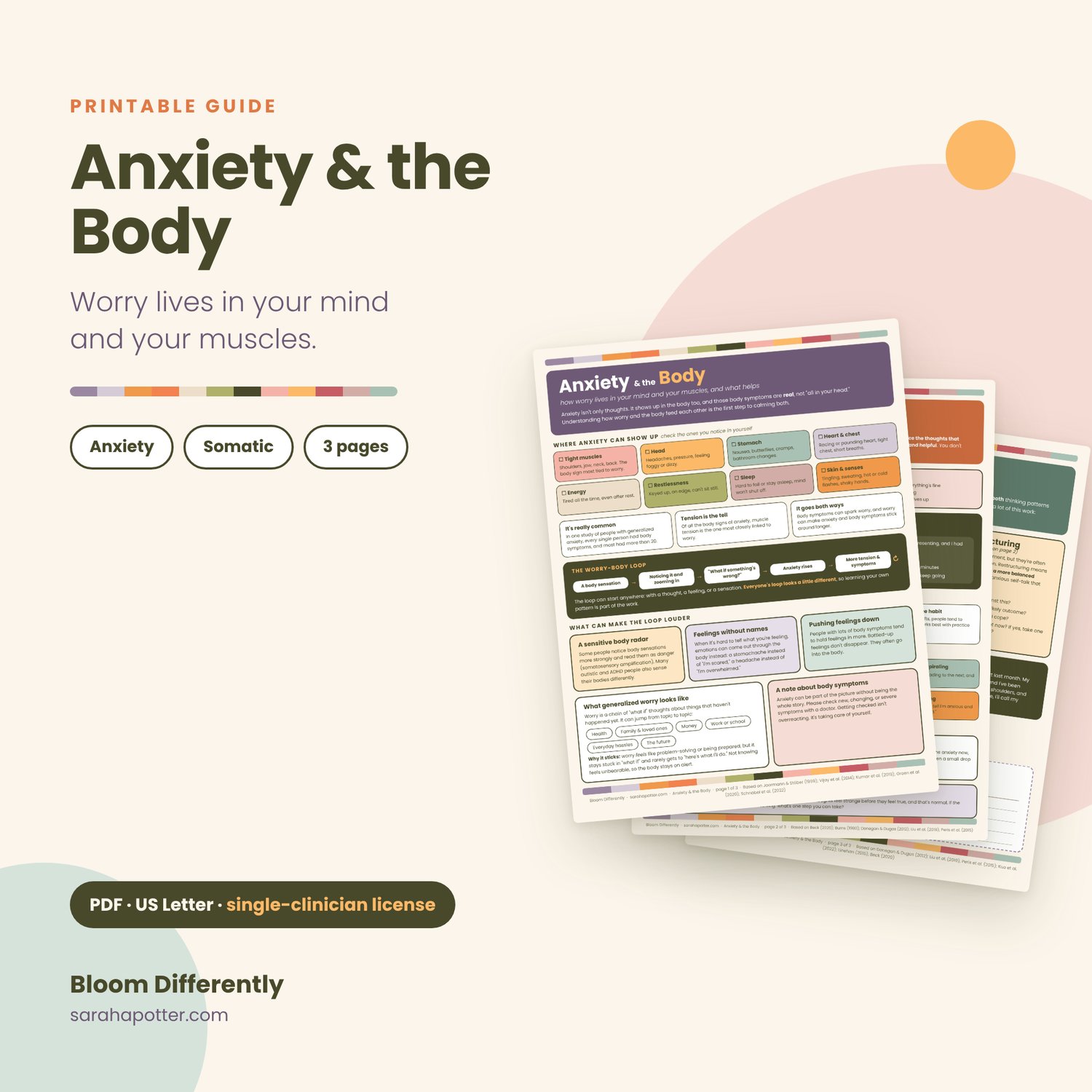
Page 1: Anxiety & the Body
- Where anxiety can show up: a checklist of eight areas, including tight muscles, head, stomach, heart and chest, energy, restlessness, sleep, and skin and senses.
- Three research facts:It’s really common: in one study of people with generalized anxiety, every person had body symptoms.
- Tension is the tell: muscle tension is the body sign most closely linked to worry.
- It goes both ways: body symptoms can spark worry, and worry keeps symptoms going.
- The worry-body loop, and what makes it louder: a sensitive body radar, feelings without names and pushing feelings down. It notes that many autistic and ADHD people sense their bodies differently.
- What generalized worry looks like and why it sticks, plus a reminder to check new or changing symptoms with a doctor.
Page 2: Cognitive Restructuring
- What it is and what it isn’t: not “just think positive.”
- Same moment, different thought: a racing heart in a meeting, two ways.
- Why it matters: in CBT for generalized anxiety, drops in worry were followed by drops in body anxiety.
- Eight anxious thinking traps, including reading the body as danger and underestimating coping.
- Four steps: catch it, check it, change it, notice it.
- “Make it work for your brain”: write it, voice-memo it or draw it.
Page 3: What helps
- Validation: name it, make sense of it and make room for it.
- Questions to check a worry.
- Put them together: validate first, then restructure, with a full worked example.
- Quick body resets: drop your shoulders, unclench your jaw, take a long exhale, and more.
- Your Turn, trace your loop: body, worry, validation, balanced thought, and what your body needs.
Who it’s for
Teens and adults with generalized anxiety, health anxiety or stress that shows up physically. It’s useful for therapists, school counselors and integrated care settings.
Ways to use it
- Use it as psychoeducation for clients who say “it’s not anxiety, it’s my stomach.”
- Teach validation and cognitive restructuring as a pair over two sessions.
- Have clients trace their own loop as homework.
- Keep the quick body resets on hand for in-the-moment tension.
Why it’s different
It honors the feeling and changes the thought, so the body is never dismissed. It’s neurodivergent-aware, with sensory and interoceptive differences named explicitly, and it’s grounded in current research with citations on every page.
What you get
A three-page printable PDF, US Letter, available as an instant download. It’s based on research including Beck (2020), Donegan & Dugas (2012), Liu et al. (2019), Peris et al. (2015) and Linehan (2015). Single-clinician license included.
Pairs well with: Understanding Panic, What’s In Your Control?, A Guided Body Scan