
Home Ed Planner: England Edition
ENGLAND EDITION
The Home Education Planner: England, September 2026 to August 2027
A full year planner and record keeping system for home educating families in England, with the law quoted directly from the current legislation, including the 2024 deregistration rules that most guidance online still gets wrong.
136 pages. Printable and deliberately light on ink. Print what you need.
Most planners are written for people whose weeks go to plan. Home educating weeks rarely do, and that is not a fault in you.
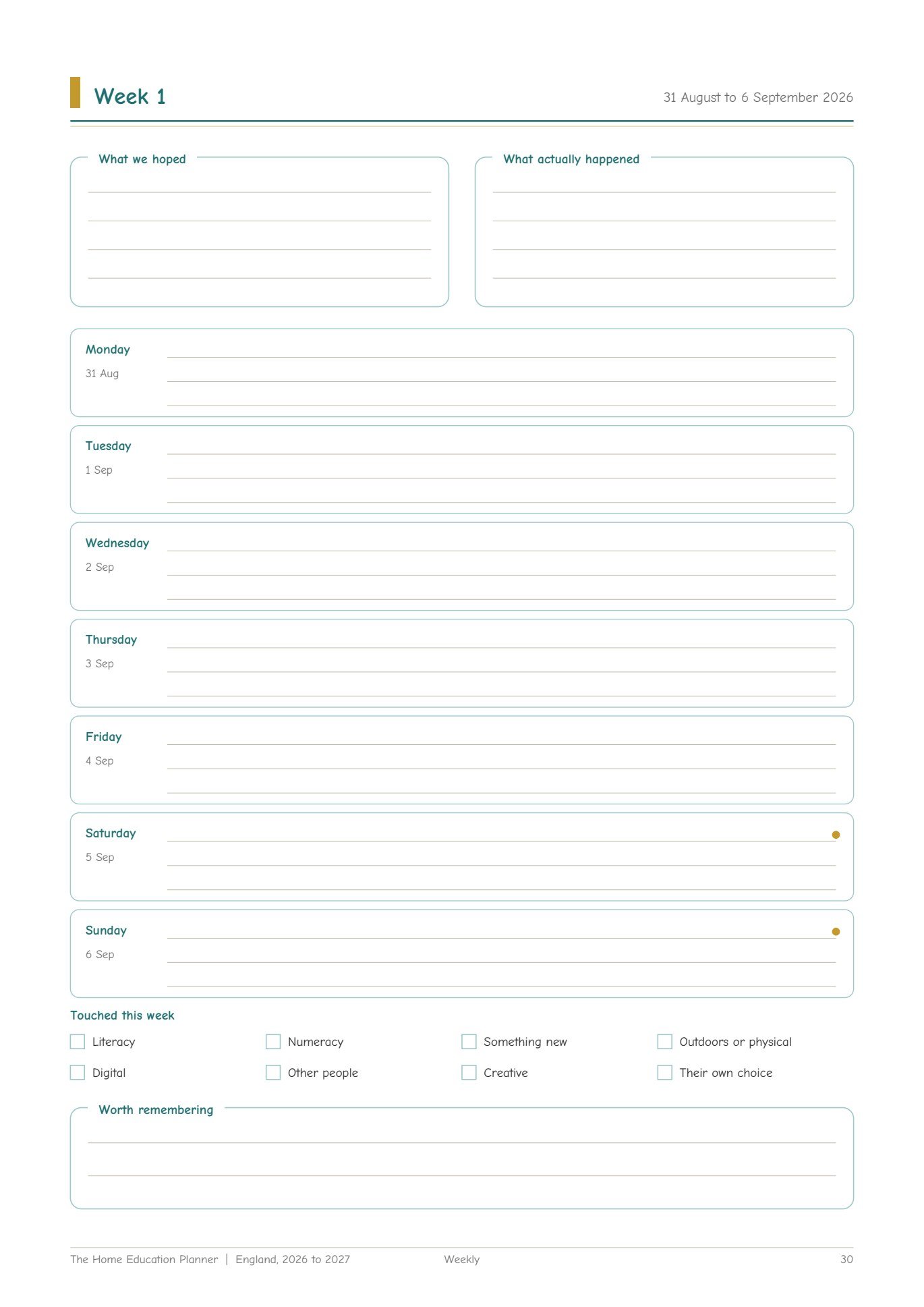
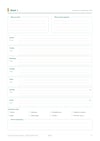
So this one is built the other way round. Every weekly page has two columns; what you hoped, and what actually happened. The second one is usually the more interesting column, and it is also the one that quietly builds your evidence while you are not looking.
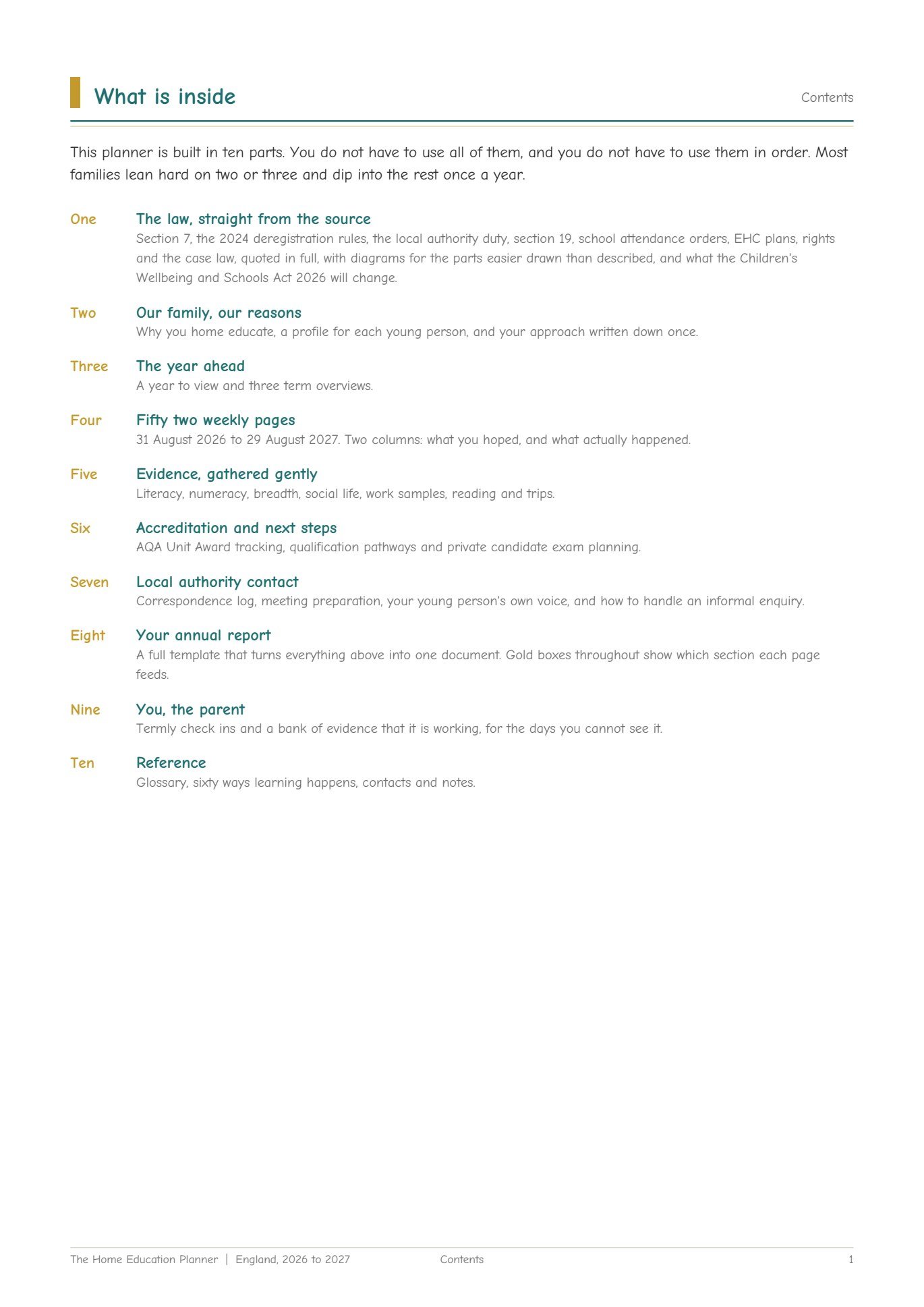
There are 136 pages covering the full year from 31 August 2026 to 29 August 2027, in ten parts.
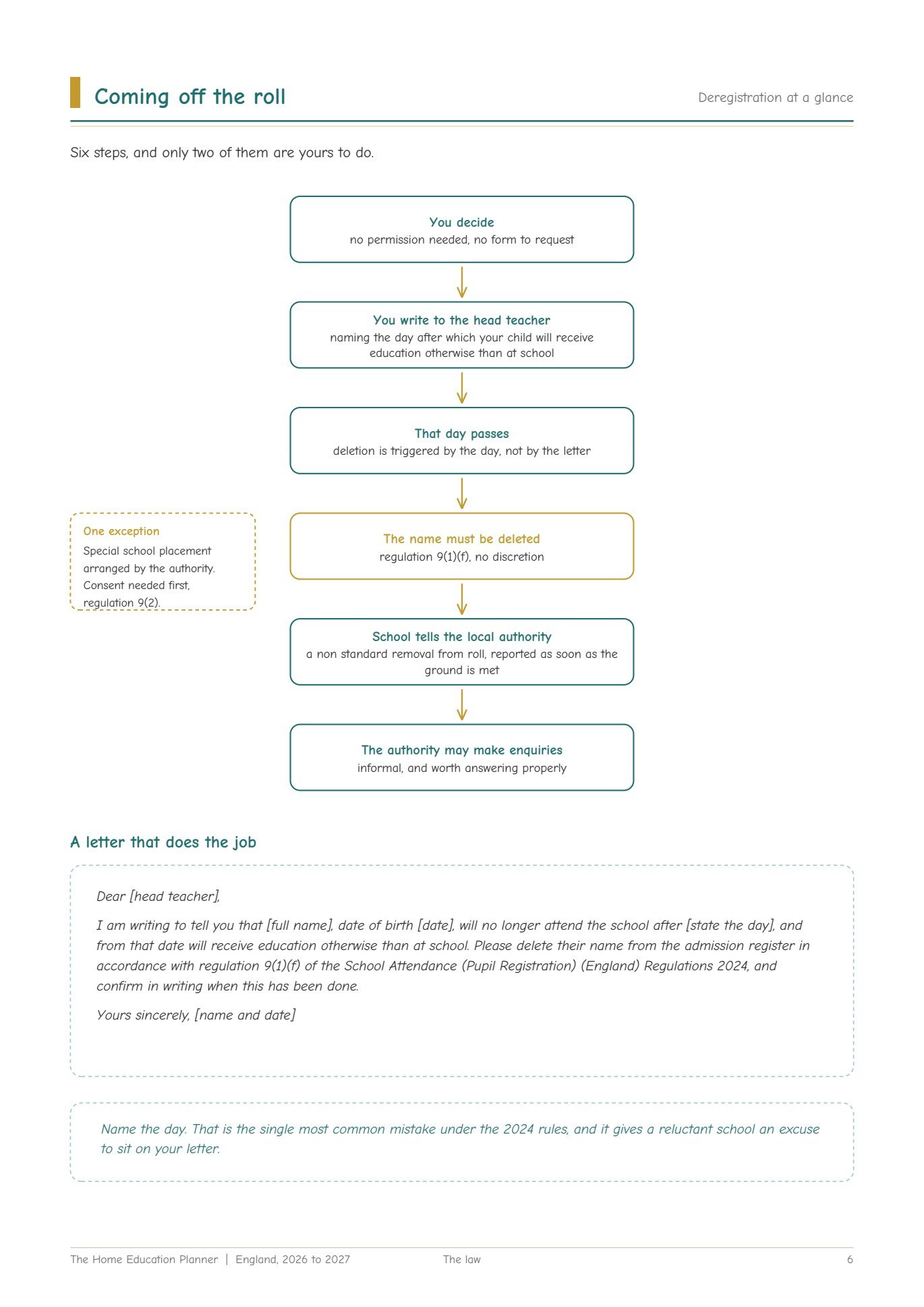
Part one is the law, straight from the source. Start here even if you think you know it. The Education (Pupil Registration) (England) Regulations 2006 were revoked on 19 August 2024 and replaced by the School Attendance (Pupil Registration) (England) Regulations 2024. The old regulation 8(1)(d) no longer exists, deregistration is now regulation 9(1)(f), and the new wording means your letter has to name a day. A great deal of advice still circulating online has not caught up.
Alongside that you get section 7 of the Education Act 1996, section 436A, section 437, section 19, regulation 9(2) on special schools,
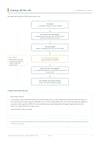
There are diagrams of the deregistration route and the escalation route, a model deregistration letter that names the day properly, and a page on what you are not required to do.
There is also a page on EHC plans that most families need and few are given. There are two quite different routes under the Children and Families Act 2014, and which one you are on changes what the local authority owes you. If you make your own arrangements, the section 42 duty does not bite. If the plan names education at home, it does, and that can carry funding and hours with it. It is worth asking for rather than drifting into by default.
Then the year itself. Fifty two weekly pages, three term overviews, a year to view, a profile page for each young person, and a page where you write down your approach once so you are never caught improvising it.
Then the evidence, gathered gently. Termly literacy and numeracy logs, breadth logs, a social life log, work samples, reading, trips, and an AQA Unit Award tracker. Incomplete work counts, and the planner says so.
Then the part that makes the rest worth doing. A complete Annual Education Report template, nine sections, built around section 7 itself and the two questions the courts have asked about preparing a child for life and keeping their options open. England has no statutory form and no obligation on you to produce anything, but the courts have twice said a parent who receives an informal enquiry is wise to answer it meaningfully, and whatever you do not write down, somebody else will.
Gold boxes throughout the planner tell you which report section each page feeds.
Then you. Termly parent check ins, and a page called proof that it is working, for the days you cannot see it.
A note on the year this covers. The Children’s Wellbeing and Schools Act 2026 became law in April 2026 and will bring a children not in school register to England, expected from 2027 at the earliest. Nothing is required of you during this planner’s year. But when registration does arrive, the families who already hold a dated, ordinary record of what their young person has been doing will find the whole thing almost boring, which is exactly what you want.
Practical things. A4, print at home or take it to a print shop.
Legislation and judgments are Crown copyright, reproduced under the Open Government Licence, and the law is stated as at September 2026.