
Discover why growing ecommerce teams often create more fulfillment errors instead of fewer. Learn how workflow inconsistency, unclear ownership, training gaps, and process variation impact operational performance.
More Team Members. More Mistakes. Why?
Most ecommerce owners believe hiring more people will solve operational problems.
At first, it seems reasonable.
More orders require more help.
More help should reduce workload.
And reduced workload should improve execution.
But many ecommerce businesses discover the opposite.
The team grows.
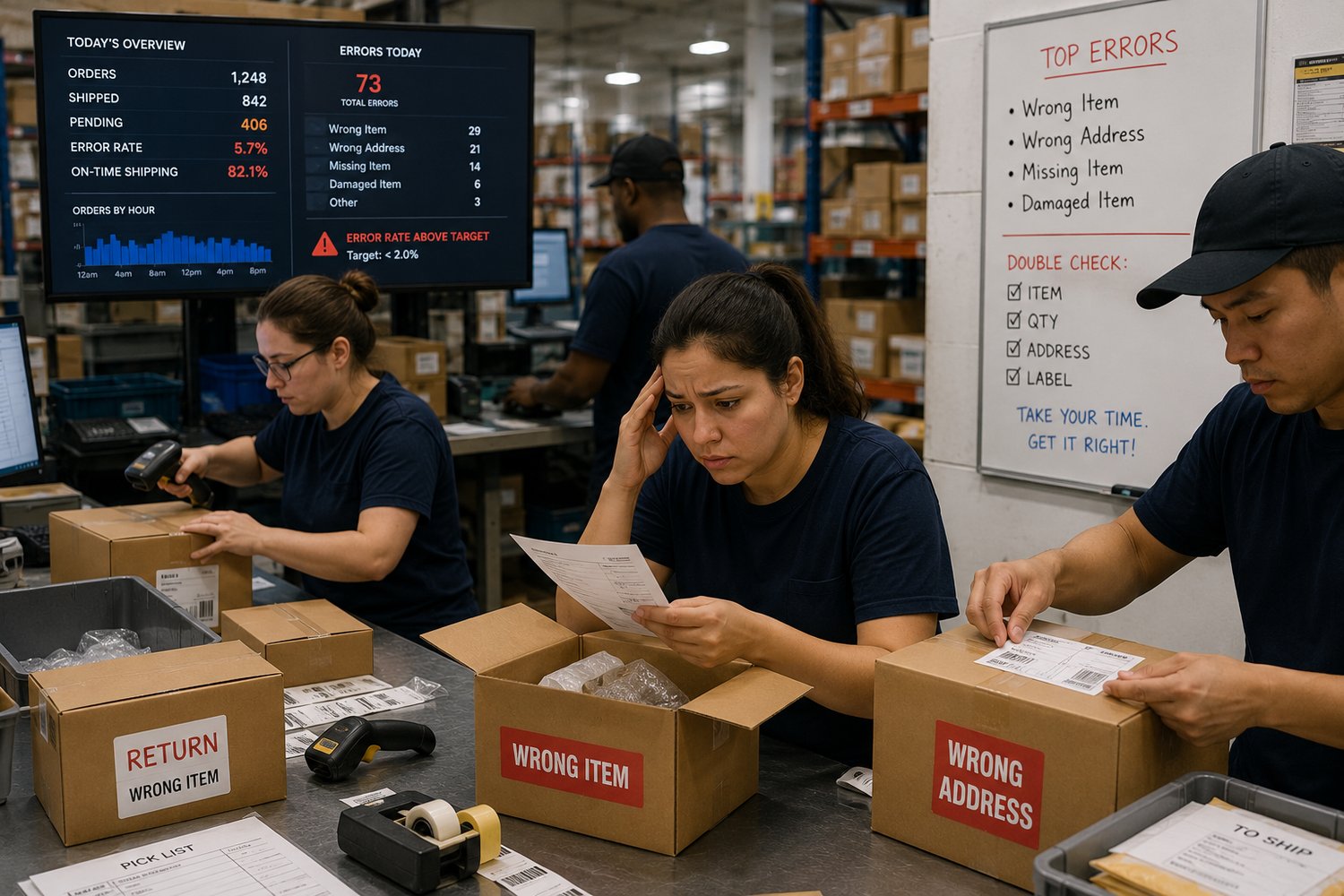
Yet fulfillment mistakes increase.
Customer complaints rise.
Orders require more corrections.
And daily operations become harder to manage.
The surprising reality is this:
Growth does not automatically improve execution.
Without workflow consistency, adding people often creates more operational complexity—and more errors.
The Dangerous Assumption About Team Growth
Many businesses reach a point where the owner can no longer handle everything alone.
This often happens around 10–30 orders per day.
At this stage, sellers begin hiring:
- fulfillment assistants
- customer service support
- virtual assistants
- warehouse staff
- operations coordinators
The expectation is simple:
More people will create more capacity.
What many businesses fail to realize is that capacity and consistency are not the same thing.
Without clear systems, every new person introduces additional variability.
And variability creates mistakes.
The Real Problem Isn't the Team
When errors increase, many owners blame the people.
But people are rarely the root cause.
The real problem is often the workflow.
When workflows are unclear:
- tasks get skipped
- responsibilities overlap
- information gets lost
- decisions become inconsistent
The result looks like a staffing problem.
In reality, it's usually an operational design problem.
Good people struggle inside unclear systems.
Unclear Ownership Creates Hidden Chaos
One of the biggest causes of fulfillment team errors is unclear ownership.
When nobody knows exactly who owns a process, accountability disappears.
Common examples include:
- Who verifies inventory accuracy?
- Who approves refunds?
- Who handles shipping exceptions?
- Who updates tracking issues?
- Who responds to customer escalations?
If multiple people assume someone else is responsible, important tasks fall through the cracks.
The opposite problem is just as dangerous.
Sometimes multiple team members complete the same task.
This creates duplication, confusion, and wasted effort.
Ownership must be obvious.
Otherwise operational reliability suffers.
Inconsistent Training Creates Inconsistent Results
Many ecommerce businesses train new employees informally.
The process often looks like this:
"Watch how Sarah does it."
"Follow what Mike did yesterday."
"Ask questions if you're unsure."
This approach works temporarily.
But it doesn't scale.
Each employee develops slightly different habits.
Over time:
- packing standards vary
- inventory updates differ
- customer responses become inconsistent
- fulfillment procedures change between shifts
The business gradually loses operational consistency.
Not because employees are careless.
Because the process was never standardized.
Process Variation Is the Silent Error Multiplier
One of the least discussed operational risks is process variation.
Variation occurs when multiple people complete the same task differently.
For example:
Employee A verifies every shipment twice.
Employee B verifies once.
Employee C skips verification during busy periods.
All three believe they are doing the job correctly.
Yet the outcome changes depending on who performs the task.
As teams grow, these differences compound.
Small variations become:
- shipping mistakes
- inventory discrepancies
- customer complaints
- fulfillment delays
The larger the team becomes, the more dangerous process variation becomes.
More Communication Doesn't Always Mean Better Communication
Growing teams naturally require more communication.
Unfortunately, more communication often creates more confusion.
Information begins flowing through:
- chat applications
- email threads
- spreadsheets
- verbal instructions
- support systems
Critical details become scattered.
Employees spend more time searching for information than executing work.
Eventually, communication becomes a bottleneck.
Not because people aren't talking.
Because nobody knows where the correct information lives.
Accountability Gaps Create Repeat Mistakes
One-time mistakes are normal.
Repeated mistakes are operational signals.
When the same errors occur repeatedly, accountability gaps often exist.
Examples include:
- recurring shipping errors
- repeated inventory adjustments
- identical customer complaints
- ongoing fulfillment delays
Many businesses fix the immediate issue.
Few investigate why it happened repeatedly.
Without accountability systems, mistakes return.
The organization becomes trapped in a cycle of correction rather than improvement.
Why Growing Teams Often Feel Slower
Many owners become frustrated when hiring doesn't create the expected results.
The team doubles.
But output doesn't.
Sometimes productivity actually declines.
This happens because every new team member increases:
- communication requirements
- training needs
- coordination complexity
- process management demands
Without operational structure, complexity grows faster than capacity.
The business becomes larger but not necessarily better.
The Goal Is Operational Consistency
The highest-performing ecommerce teams are not always the biggest.
They are often the most consistent.
Consistent teams rely on:
- documented workflows
- standardized training
- clear ownership
- defined accountability
- repeatable processes
When everyone follows the same system, execution becomes predictable.
And predictability reduces errors.
What Successful eCommerce Teams Do Differently
Strong operations leaders focus less on individual performance and more on process reliability.
They ask:
- Is ownership clear?
- Is training standardized?
- Is the workflow documented?
- Can tasks be completed consistently?
- Are errors tracked and reviewed?
These questions create systems that scale.
Because sustainable growth depends on process quality—not headcount alone.
Final Thoughts
Many ecommerce businesses assume operational problems disappear when they hire more people.
In reality, growth often exposes workflow weaknesses.
Without consistency, additional staff can create:
- fulfillment team errors
- communication breakdowns
- accountability gaps
- process variation
- customer experience issues
For stores growing beyond 10–30 orders per day, the challenge is not simply building a bigger team.
The challenge is building a more consistent operation.
Because more people do not automatically create better execution.
Better systems do.
Related Reading
Why Inventory Errors Multiply as Stores Scale
Why Customer Complaints Usually Start Before Customers Complain
Why Fast Shipping Doesn't Always Create Happy Customers
Why Operational Delays Create More Support Tickets
Why Some eCommerce Stores Constantly Operate in Crisis Mode
Download the eBay Compliance Self-Assessment Checklist
If your team is growing but mistakes keep increasing, the problem may not be your people.
Learn how operational systems, workflow standardization, and accountability structures help ecommerce businesses scale without sacrificing consistency.
👉 eBay Seller Compliance Risk Audit
 About the Author
I work with Shopify and eBay sellers to identify and stabilize operational systems before fulfillment pressure turns into customer complaints, refunds, and margin loss.
My focus is helping stores handling 10–30 orders per day build resilient workflows that scale without creating hidden operational stress.
👉 Download the free fulfillment audit: eBay Seller Compliance Risk Audit
📢 Share This
Found this useful? Share it with other operators: